This may come as a postscript to the previous or as a sneak preview of upcoming projects that will deal with theatre and its history. An interesting topic with all the networks of actors knitting their personal ties in ever changing ensembles of travelling companies that visit cities and courts, of emerging houses with standing ensembles, of authors, of plays and of various roles – and then again of actors who would play certain types in various plays…
The following itinerary follows one of these groups, the so called Hochdeutsche Hofcomödianten or the Velten Company, named after the Veltens, a couple who were the directors between 1670s and 1712.
The image catches all the journeys this group took between 1693 and 1712, the years when Catharina Elisabeth Velten was the company’s director. The FactGrid viewer gives the list of the known stays as Günther Hansen noted them in his Formen der Commedia dell’ Arte in Deutschland (1968), p. 269.
The image is interesting as it captures a structural characteristic of the itineraries which theatre companies were likely to produce back in the 17th and 18th centuries. The actors did not travel as tourists. They were rather acting like nomadic families following larger herds as these were looking for ever fresh pastures.
We are speaking here of companies that could have 100 plays in their repertoires. They would come to a place, determine what they could offer as relative novelty – depending here on the rivalling enterprises that had been there in recent years with their respective repertoires. Once a company had been at a place for two weeks it had exploited its repertoire and exhausted the audience. The group could return a couple of years later to attract fresh audiences with plays that would now be interesting. The pattern is therefore more like the pattern groups following herds of reindeer that would in turn find their various regional barriers. Language barriers are the natural barriers of theatre players, though German was here an extremely useful language – spoken in the present German speaking territories but also in much of Poland and in major places in Scandinavia and the Baltic area where merchant communities of the old Hanse world had become major ethnic groups. The Velten Company spoke – as the name indicated – „Hochdeutsch“, High German, not low German the language that would only be understood in the coastal regions.
The visualisation has its ugly sides: No one could use a plane to fly direct way from Stockholm to Vienna. An alternative would be a database that knows contemporary travel routes. An alternative could also be a map with bigger and smaller nebulous spots to see how often they visited certain places – that, however, would not show the difference between them and people who travelled on their “grand tour”, avoiding to visit a place twice.
The list of stays comes with gaps. How do you get from Frankfurt to Leipzig in 1705? Via Gotha and Erfurt? I resist the temptation to get into the locale state archive to find out when they passed through.
We should collect information down to the level of repertoires, actors, and competing troupes, and and get a picture of how this market developed.
Another view
German Wikipedia user Enyavar responded to the visualisation here with this alternative view of times a place had been visited:
Auftrittsorte der Hochdeutschen Hofcomödianten. In dunkelblau unter Paulsen; in orange unter Johannes Velten; in dunkelrot unter Catharina Velten
which adds information on the era of Catharina’s husband, the preceding director, and which gives a clearer view on Leipzig and Dresden, the home base of the company that was privileged by Dresden’s court.
Header image: Balthasar Beschey, La Commedia dell’Arte, 18th century, Wikimedia Commons
A collaboration involving FactGrid as the project ressource, the following scholarship announcement in French, English and German:
2 postes de doctorant-e en histoire moderne, XVIIIe-XIXe siècles (Université de Fribourg, Suisse)
Le Département d’histoire de l’Université de Fribourg met en concours deux postes de doctorant-e-s en histoire moderne (4 ans, 100%) à partir du 1er mars 2022. Les postes sont intégrés au projet FNS The Mesmerism in Switzerland: interactions, transnational circles and networks, media / Le mesmérisme en Suisse : interactions, cercles et réseaux transnationaux, médias / Der Mesmerismus in der Schweiz: Interaktionen, transnationale Zirkel und Netzwerke, Media sous la direction de prof. Claire Gantet, financé par le Fonds national Suisse.
1 thèse Le mesmérisme en Suisse occidentale : sociabilités, mobilités, constellations
1 thèse Un flux d’informations : le mesmérisme en Suisse
Les projets se concentrent sur le problème du mesmérisme en tant que nouvelle thérapie très influente élaborée par Franz Anton Mesmer (1734-1815) – découverte de l’hypnose et son utilisation en médecine– et sur les relations entre croyance et science ainsi qu’entre patient et médecin. Ils le font en maniant des perspectives notamment d’histoire culturelle, d’histoire micro-historique et d’histoire transnationale. Les projets de thèse se situent dans le domaine de l’histoire des savoirs et étudieront les pratiques et relations d’interdépendance du mesmérisme. Une cotutelle avec un expert étranger est possible.
Vos tâches
Vous développerez un projet de recherche indépendant sur le mesmérisme. Au cours de votre thèse, vous aurez l’occasion de participer à des ateliers et à des conférences internationales et d’échanger des idées avec des expert-e-s de votre domaine de recherche. Vos données complèteront les bases de données Harmonia universalis (https://harmoniauniversalis.univ-paris1.fr/#/) et FactGrid (https://database.factgrid.de/wiki/FactGrid:Early_Modern).
Votre profil
Vous devez être titulaire d’un master en histoire, si possible des XVIIIe et XIXe siècles, ou dans un domaine connexe avant le commencement du poste. Vous savez mener une recherche de façon autonome et avez de bonnes capacités de lecture en français, en anglais et en allemand. La thèse peut être rédigée en anglais, en allemand ou en français. Vous devez avoir une adresse en Suisse durant la durée du contrat.
Ce que nous offrons
Nous vous offrons la possibilité d’effectuer un projet de recherche indépendant en collaboration et en échange avec une équipe motivée. Le département bilingue d’histoire de l’Université de Fribourg vous offrira également un environnement de recherche stimulant. Dans le cadre de la thèse, vous aurez diverses possibilités de supervision et de développement professionnel, notamment la participation à des colloques, ateliers, conférences et publications. Nous offrons un contrat de quatre ans avec un salaire conforme aux taux du FNS pour les doctorant-e-s (environ 47’000 CHF la première année). Des fonds sont disponibles pour des activités de recherche spécifiques telles que des séjours de recherche et la participation à des conférences.
Votre candidature doit comprendre
Une lettre de motivation : Veuillez expliquer ce qui vous attire dans ce poste et en quoi vous êtes apte à répondre aux attentes
Votre mémoire de Master ou un travail de séminaire important, si possible avec le rapport des examinateurs
Un curriculum vitae détaillé
Copies de vos certificats et diplômes universitaires avec une liste des cours suivis
Noms et adresses électroniques de deux personnes de référence que l’Université de Fribourg pourrait contacter
Vous pouvez rédiger la lettre de motivation et le CV en allemand, en français ou en anglais, selon votre préférence.
L’Université de Fribourg s’efforce d’assurer une représentation équilibrée des femmes et des hommes. Les candidatures de femmes sont donc explicitement les bienvenues. En tant que signataire de la Déclaration DORA, l’Université de Fribourg attache une grande importance à l’évaluation qualitative des résultats académiques.
Veuillez envoyer votre candidature sous forme d’un document PDF par courriel à prof. Claire Gantet (claire.gantet@unifr.ch) avant le 15 Décembre 2021.
Pour tout renseignement complémentaire, veuillez contacter Claire Gantet : claire.gantetnifr.ch.
2 PhD positions in early modern history, 18th-19th centuries (University of Fribourg, Switzerland)
The Department of History of the University of Fribourg invites applications for two PhD positions (4 years, 100%) in early modern history. The PhD thesis will be realized in the framework of the FNS project The Mesmerism in Switzerland: interactions, transnational circles and networks, media / Le mesmérisme en Suisse : interactions, cercles et réseaux transnationaux, médias / Der Mesmerismus in der Schweiz: Interaktionen, transnationale Zirkel und Netzwerke, Media directed by Claire Gantet and financed by the Swiss National Science Foundation. The positions will start on 1 March 2022:
1 PhD thesis: The mesmerism in western Switzerland: sociability, mobility, constellations
1 PhD thesis: An information flow: mesmerism in Switzerland
The project focuses on the problem of Mesmerism as the new and influential method of treatment developed by Franz Anton Mesmer (1734–1815)–discovery of hypnosis and its use in medicine–and the relationships between knowledge and belief or the physician-patient-relationship. It explores it by intersecting multiple perspectives such as cultural, microhistorical, and transnational history. The advertised PhD projects will be situated in the history of knowledge and explore practices and entanglements of Mesmerism.
Your responsibilities
You will define and conduct your own independent research project on Mesmerism. While writing your dissertation, you will be able to participate in international workshops and conferences with leading experts of the field. Your data will be filed in the databases Harmonia universalis (https://harmoniauniversalis.univ-paris1.fr/#/) and FactGrid (https://database.factgrid.de/wiki/FactGrid:Early_Modern).
Your profile
You hold a master’s degree in History (18th-19th century) or a related field by the time you enter the position. You should be highly motivated to do historical research and have good reading skills in French, English and German. Familiarity with history of medicine or history of Switzerland and paleographical or digital abilities are welcome. The PhD thesis may be written in English, German, or French. For the duration of the contract, residency in Switzerland is required.
What we offer
We offer you the possibility to develop your own research project in collaboration and exchange with a highly motivated team situated in the stimulating research environment of University of Fribourg’s bi-lingual department of history and you benefit from its contacts with international experts. Furthermore, we provide you with opportunities for professional development (participation in conferences and publications, workshops with experts in the field). We offer a four-year employment contract with a salary paid according to the SNSF rates for doctoral students (approximately 47’000 CHF for the first year). Extra funding for research activities such as travel to conferences and stays in research libraries is available.
Your application should include
A letter of motivation: Please explain what makes you a suitable candidate for this position and why you are interested in it.
Your MA thesis or a significant seminar paper, if possible with the examiners’ report.
A full CV.
Copies of your university transcripts and diplomas.
The names and e-mail addresses of two possible referees whom the University of Fribourg may contact.
The letter of motivation and the CV may be written in German, French, or English, according to the candidate’s preference.
The University of Fribourg strives for a balanced representation of women and men. Applications by women are therefore explicitly welcome. As a signatory of the DORA Declaration, the University of Fribourg attaches importance to a qualitative assessment of academic performance.
Please send your application in one PDF file by e-mail to Claire Gantet (claire.gantet@unifr.ch) until 15 December 2021 at the latest.
For further information, please contact Claire Gantet: claire.gantet@unifr.ch
2 Doktoratsstellen, Geschichte des 18. und 19. Jahrhunderts (Université de Fribourg, Schweiz)
Am Departement für Geschichte der Universität Freiburg sind ab dem 1. März 2022 zwei Doktoratsstellen in frühneuzeitlicher Geschichte (4 Jahre, 100%) zu besetzen. Die Stellen sind Teil des vom Schweizerischen Nationalfonds geförderten Projekts The Mesmerism in Switzerland: interactions, transnational circles and networks, media / Le mesmérisme en Suisse : interactions, cercles et réseaux transnationaux, médias / Der Mesmerismus in der Schweiz: Interaktionen, transnationale Zirkel und Netzwerke, Media unter der Leitung von Prof. Dr. Claire Gantet. Der Zeitpunkt des Stellenantritts ist der 1.3.2022.
1 Dissertation über die Akteure, Geselligkeitsformen, Mobilität und Netzwerke, 1780–1840
1 Dissertation über die Medien des Mesmerismus, 1780–1840
Das Projekt richtet sein Augenmerk auf das Problem des Mesmerismus als von Franz Anton Mesmer (1734–1815) entwickelte neue, maßgebende Behandlungsmethode (Entdeckung der Hypnose und ihre Verwendung in der Medizin) und den Zusammenhang zwischen Glauben und Wissen sowie das Arzt-Patienten-Verhältnis. Dieses wird u.a. aus kultureller, mikrohistorischer und transnationaler Perspektive beleuchtet. Die ausgeschriebenen Dissertationsprojekte sind zudem im Bereich der Wissensgeschichte situiert und werden die Praktiken und Verflechtungen des Mesmerismus untersuchen. Eine Doppelbetreuung (cotutelle) mit einem/einer auswärtigen Experten/Expertin ist möglich.
Ihre Aufgaben
Sie entwickeln ein eigenständiges Forschungsprojekt zum Mesmerismus. Während der Dissertationsphase werden Sie die Gelegenheit haben, an Kolloquien, Workshops und internationalen Konferenzen teilzunehmen und sich mit führenden Expert:innen aus relevanten Forschungsfeldern auszutauschen. Ihre Daten werden die Datenbank Harmonia universalis (https://harmoniauniversalis.univ-paris1.fr/#/) und FactGrid (https://database.factgrid.de/wiki/FactGrid:Early_Modern) ergänzen.
Ihr Profil
Sie sollten spätestens bis zum Zeitpunkt des Stellenantritts im Besitz eines Masterabschlusses in Geschichte der frühen Neuzeit oder der Neuzeit (18.–19. Jht.) oder einem benachbarten Fach sein. Sie sind forschungsorientiert und haben gute Lesekenntnisse in Französisch und Englisch. Linguistische und historische Vorkenntnisse zur damaligen Medizin oder zur Geschichte der Schweiz sowie paläographische oder digitale Fähigkeiten sind sehr willkommen. Die Dissertation kann in Englisch, Deutsch oder Französisch verfasst werden. Für die Dauer des Vertrages müssen Sie in der Schweiz wohnhaft sein.
Was wir bieten
Wir bieten Ihnen die Möglichkeit, ein eigenständiges Forschungsprojekt in Zusammenarbeit und Austausch mit einem motivierten Team zu verfolgen. Das zweisprachige Departement für Geschichte der Universität Freiburg und ihre Vernetzung mit u.a. französischen Spezialisten werden Ihnen darüber hinaus ein stimulierendes Forschungsumfeld bieten. Im Rahmen der Dissertation werden Sie verschiedene Möglichkeiten der fachlichen Begleitung und Entwicklung haben, darunter die Teilnahme an Kolloquien, Workshops, Konferenzen und Publikationen. Wir bieten einen vierjährigen Vertrag mit einem Lohn, der den SNF-Ansätzen für Doktorierende entspricht (ca. 47‘000 CHF im ersten Jahr mit steigendem Gehalt). Gelder für spezielle Forschungsaktivitäten wie Forschungsaufenthalte und Teilnahmen an Konferenzen stehen zur Verfügung.
Ihre Bewerbung sollte enthalten
Ein Motivationsschreiben: Bitte erklären Sie, was Sie an der Stelle interessiert und warum Sie dafür geeignet sind.
Ihre Masterarbeit oder eine längere Seminararbeit, wenn möglich mit Gutachten.
Ein ausführliches Curriculum vitae.
Kopien Ihrer universitären Zeugnisse und Diplome inklusive Liste der besuchten Kurse.
Namen und Mailadressen von zwei möglichen Referenzpersonen, die die Universität Freiburg kontaktieren kann.
Sie können das Motivationsschreiben und den Lebenslauf je nach Ihren Präferenzen in Deutsch, Französisch oder Englisch verfassen.
Die Universität Freiburg strebt eine ausgeglichene Repräsentation von Frauen und Männern an. Bewerbungen von Frauen sind deshalb explizit willkommen. Als Unterzeichnerin der DORA-Deklaration legt die Universität Freiburg Wert auf eine qualitative Beurteilung von akademischen Leistungen.
Bitte senden Sie Ihre Bewerbung bis zum 15. Dezember 2021 gebündelt in einem PDF-Dokument per Mail an Claire Gantet (claire.gantet@unifr.ch).
Für weitere Informationen kontaktieren Sie bitte Claire Gantet: claire.gantet@unifr.ch
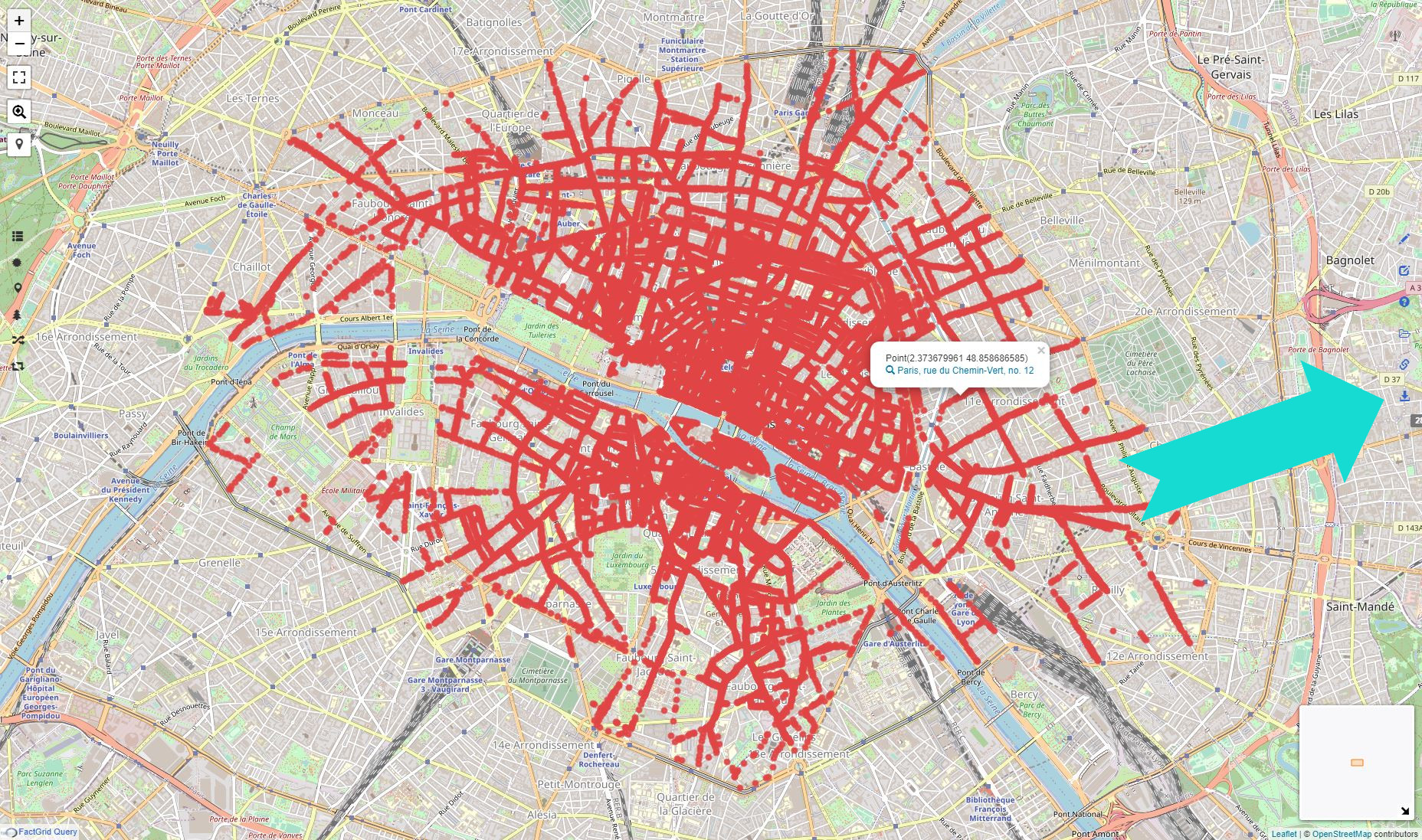
PARIS TO DOWNLOAD comes with a double purpose: it is first designed to provide a dataset for historians to download with one simple click. Click the image below and a SPARQL query will bring the addresses of Paris c. 1830 onto a modern map.
On the right hand side you will be able to activate the menu that allows you to download the raw data behind this visualisation to your computer. TSV or CSV are the practical formats here. TSV (table separated) data can be copied and pasted into any spreadsheet. The download will come with the geographic coordinates and the address names, CC0-licensed and ready to use in any software environment of your choice…
…which might, however, not be the most interesting use to make of this data set. It should be far more attractive to create your own visualisations here on FactGrid with information you can put on any of the items underneath the visualisation. You will need an account to augment information on this data set and we are eager to open these accounts to all researchers working on historical Paris.
The collaborative project that we are offering here is still in its infancy. Its aim is to make resources on the history of Paris available to the general public, and more particularly historical data on Parisian roads and facilities. A lot of data exists on Paris but they are scattered and often difficult to access. FactGrid makes it possible to store, consult and retrieve them for free en masse and according to needs by simple queries.
PARIS TO DOWNLOAD already provides a resource that will be of interest to all historians of 19th century Paris: a gazetteer giving the geocoded addresses of all buildings in Paris in the first half of the 19th century.
Some details below that might help to use the data set:
The history of house numbering in Paris
For a long time, urban addresses were identified by the names of houses and their signs (David Garrioch). Despite some attempts to number houses in modern times, it was not until after 1750 that real house numbering systems appeared in European and North American cities, and it was not until the 19th century that they became the norm for identifying urban addresses (Anton Tantner).
The house numbering errupted as a new element of rationality to order the city. As Anton Tantner and Reuben Rose-Redswood have shown, introducing numbers into the urban space is a ‘technique of power’ characteristic of the new governmentality that took hold in the second half of the 18th century. It was only later that the inhabitants themselves appropriated the new signage and made it a major tool for orientation and address location.
The history of house numbering in Paris is part of this general history of numbering (see Numérotation des immeubles de Paris). The first numbering system in Paris, introduced in 1779, was the work of a private contractor, Kreenfelt. This system is sequential by street and follows the course of a horseshoe. The doors, not the buildings, are numbered. In 1791 this first system was abandoned in favour of a system of house numbering by district (named section). In this system the numbers could be very large and the same street could have several identical numbers in case it belonged to several sections. Finally, because of these disadvantages, the system of 1791 was abandoned in 1805 and a new system was introduced on the initiative of the préfet Frochot, now inspired by the numbering system of Philadelphia
The 1805 numbering system
Frochot’s system is the one that it is still used in Paris today. It is sequential by street and of the even/odd type. The series of numbers in a street is made up of even numbers on the right side, and odd numbers on the left side. The right side is the one to the right-hand of the passer-by going up the street towards the Seine. If the street is parallel to the Seine, the right side is the one to the right-hand of the passer-by going up the street in the direction of the river course. The numbers are visibly inscribed on the facades of each house (document 1).
Document 1: No. 13, rue de la Bûcherie, drawing by J.-A. Chauvet, coll. Musée Carnavalet
Although the 1805 system is still used in Paris, many streets were renumbered during the 19th century. The most important reform of Parisian numbering was carried out by the prefect Rambuteau in 1847. In addition, the incorporation of neighbouring communes in 1860 and the Hausmannian transformations considerably extended the house numbering compared to the initial state. Since the end of the 19th century, however, address numbering has changed little in Paris.
Today, the Parisian house numbering covers about 150,000 addresses, compared to about 28,000 in 1805.
Parisian directories of the 19th Century
House numbering facilitated the making of address books and directories (see a list in the wiki Geohistoricaldata). The most famous one is the Bottin, the directory published by Sébastien Bottin. Each year since 1819, Bottin published the addresses of the trades and those of the most notable inhabitants (see document 2)
Document 2: Bottin, 1825: addresses of boarding schools. Source: Gallica
In 1834 Guyot de Fère published a Statistique des lettres et des sciences and the following year a Statistique des Beaux-Arts which gave the addresses of Parisian writers and artists. Numerous other publications provided the addresses of shops, workshops, schools, associations, etc. In other words, we have easily accessible sources for mapping the economic, social and business life of the city in the 19th and 20th centuries, provided we can locate the address numbers.
How to locate an old Parisian address?
Finding the location of an address is now a breeze: just go to OnStreetMap, Google Maps, or any other web mapping platform. You can also easily download for free the dataset of the current 150,000 Parisian addresses on the site Data Paris. But what about addresses of the past? If old addresses cannot be located, directories are of no use to the historian. It is therefore not surprising that this type of source has been little used in historical works on Paris until now.
The present data set has taught me some of the intricacies of locating Parisian addresses of the past. I leave aside here the difficult question of the location of Parisian addresses before the end of the 18th century. Let us see how it would be possible to proceed from the creation of the first house numbering system in 1779. It is easy to understand that the only possible method is to geocode the address, i.e. to associate the address number of each house with its geographic coordinates, but it does’nt get us very far: how do we know the geographical coordinates of an address? That is the question.
The problem of the maps
The only possible answer is: having a map. We can use current maps. Especially OneStreetMap is of good value here, as it displays house numbers. For example, no. 6 of Place des Vosges where Victor Hugo had a flat between 1832 and 1848 (now the Musée Victor Hugo) was already no. 6 at that time. The same for no. 10, rue Monsieur-le-Prince, where Auguste Comte lived from 1841 to 1857 or for no. 8, rue de Caumartin, where Stendhal wrote his famous novel The Charterhouse of Parma in 56 days in 1838. The address of Eugène Delacroix’s studio from 1844 to 1858 is still at the same address, no. 58, rue Notre-Dame-de-Lorette. etc.
The majority of the address numbers of the early nineteenth century has not changed. But there are many exceptions. For instance, Stendhal wrote his novel The Red and the Black at no. 71, rue de Richelieu, which is now no. 69 of the same street (the original building has been demolished). Géricault’s studio was at no. 25, rue des Martyrs, which is now the no. 23. etc. But there are worse cases. A lot of old streets of Paris have been destroyed, reduced in size or extensively redesigned. For instance, no. 27, rue Notre-Dame-des-Champs, where Victor Hugo wrote his play Hernani in 1829, had disappeared with the opening of the Boulevard Raspail.
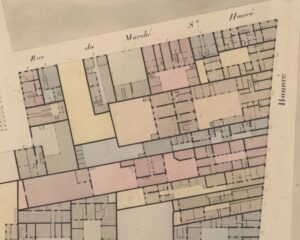
The examples show that using current maps remains an unreliable method of locating old Parisian addresses. To solve the problem, we would like to have georeferenced historic maps of Paris displaying house numbers. Obviously such maps do not exist ready-made, but they can be created from two old collections of maps based on the excellent topographical survey realized by Verniquet in 1790: the Atlas Vasserot drawn up between 1810 and 1836, and the Atlas Jacoubet published between 1827 and 1839. Both of them indicate the house numbers (see documents 3 and 4).
Document 3: Atlas Vasserot. Rue du Marché-Saint-HonoréDocument 4: Atlas Jacoubet. Rue du Marché-Saint-Honoré
Georefencing and geocoding
The georeferencing of the Atlas Vasserot has been realized between 2006 and 2010 by the team ALPAGE (LAMOP, CNRS/Paris 1, resp. H. Noizet) and the result is available on the platform ALPAGE. A georeferencing of the Atlas Jacoubet has also be realized by the team SIGParis18-19 (EHESS), but the resulting georeferenced map is not yet published.
The next step is the geocoding of the addresses. The work has been done on the georeferenced Atlas Vasserot by A.-L. Bethe (ALPAGE) in 2010 and the data set (about 28000 addresses) is available on the platform ALPAGE, données Vasserot. The team SIGParis18-19 has used its georeferenced map of the Atlas Jacoubet (transferred to the Atlas Verniquet of 1790) to geocode the Parisian addresses of 1789 (about 23000 addresses). The methodoly is explained in an article with some applications (Anne Varet-Vitu, Mathieu Marraud, Éric Mermet, 2020), but the dataset is again not yet published. I would add that a wiki project Localisations parisiennes (1780-1810) was launched in 2017 by Dominique Waquet to make a street-by-street inventory of Parisian buildings during the Revolution aiming at a future geocoding of the addresses following the numbering system of 1791, but so far only the addresses of the rue Saint-Honoré have been located.
The Parisian addresses on FactGrid
Each of the 28000 Parisian addresses on FactGrid is a Q-item. The form of its label is :
“Paris, street name, no. #”
and its description indicates the numbering system and the initial time (most often 1805). English, German and French labels and descriptions are available. You can also select these languages on the FactGrid viewer.
Each address has the following linked data:
1. the street , 2. the quarter, 3. the city (Paris), 4. the numbering system, 5. the geographical coordinates (WGS84) with the parcel ID as qualifier and the reference to the dataset “Données Vasserot”; some items are additional linked data like the previous address at the same location.
Each street of Paris (for the period 1805-1850) is also a Q-item. See the example of the rue Saint-Honoré. The same for the quarters and the arrondissements (for the same period).
The dataset “Données Vasserot”
The project PARIS TO DOWNLOAD has put the dataset “Données Vasserot version 1 (2010, A.-L. Bethe), Alpage” on FactGrid (with the agreement of ALPAGE).
The dataset “Données Vasserot” is based on information collected before the mid-1820s and does not include the addresses for streets opened after 1805. However, these addresses, for which the Atlas Vasserot is of no help, are in FactGrid. Their geocoding is based on the Atlas Jacoubet combined with information coming both from the Dictionnaire administratif et historique des rues de Paris and from the Bottin of 1850 (this volume, unfortunately not yet available on the internet, contains a conversion table between the old address numbers and the numbers adopted after the 1847 reform of the house numbering). This geocoding is here work in progress and some streets and addresses are still missing.
For the moment, the Parisian addresses produced on FactGrid by PARIS TO DOWNLOAD are reliable for the period between 1805 and 1848. These data should be used with caution for the period after 1848, as the Rambuteau reform of the house numbering introduced many changes, even if they were mostly shifts of a few numbers. In addition, the incorporation of neighbouring communes in 1860 dramatically increased the number of streets and addresses in Paris. It would be very useful to undertake geocoding all these addresses, but that is another task.
One of the advantages of the FactGrid repository is that it is possible to make a selection. Suppose you want only the addresses of the rue de la Harpe. You can get a map (don’t forget to launch the query) or a data table (don’t forget to launch the query).
If you have a data file with Parisian addresses (for instance the list of all Parisian physicians extracted from the Bottin of the year 1825), you can download the 28000 geocoded addresses from FactGrid, match these addresses with the addresses of your file in order to collect the geographical coordinates and use your completed data file to create a map on your favourite GIS. OpenRefine makes the work still easier (an OpenRefine service will be available very soon on FactGrid).
However, the best option is to put your data file directly on FactGrid and to add a statement Address (P208) to each Q-item you have created, in order to benefit of all the power of the FactGrid database and query service. See, as a simple example, the eleven Parisian addresses of Auguste Comte.
As said in the beginning: The dataset is designed to work in any other software environment, but it is beyond that an invitation to aggregate information here on the site — on the address items and on the items of people and objects you are interested in and you would like to create and to interconnect within the data set. It’s free, open and collaborative.
FactGrid began in 2018 with the input of Hermann Schüttler’s list of 1,351 (verified and unverified) members of the Illuminati, our Items Q25 to Q1376.
Items Q249748 to Q250919 widen that list with an interesting overlap of 111 names with the members of the Strict Observance. It was the largest and most widespread Freemasonic umbrella organization in Europe, that imploded with a massive impact on the world of Freemasonry in 1782, the same year when the Illuminati began their three years of rapid growth before they imploded in turn from 1786-87 and ceased to exist altogether by August 1788.
The Strict Observance had, in hindsight a longer life, beginning in either 1751 or 1764, depending on how we define their beginning. In a way the Order has not disappeared altogether. It lives on in an augmented form within Sweden’s branch of national Freemasonry, the Swedish Rite. Swedish Masons affiliated with the Strict Observance only in 1778 at the convention of Wolfenbüttel with the election of Duke Carl of Södermanland (later King Carl XIII of Sweden) as Grandmaster, after the death of their founder Baron von Hund in 1776. The Swedish Masons then withdrew in 1780 and created their own IXth Province of the Order, having constructed their own distinct form of Freemasonry on top of the superstructure of the Strict Observance rituals. Retaining ritual elements from the earlier degrees of Carl Friedrich Eckleff, Duke Carl revised the Strict Observance rituals and constructed additional degrees, giving his new system its own distinct national flavour of Freemasonry.
The Rite of Strict Observance, also known as the Order of the Temple, was the most influential 18th century Masonic system in Germany and possibly on the European continent. It was the first Masonic system to transition fully into a secret society, complete with Order Name alias for the members, and an inner and outer order being led by “unknown superiors”. For their correspondence there were multiple complex ciphers, along with substituted geographical names for cities and their own calendar system. These Masons were said to possess the true secrets of Freemasonry and according to their liturgy, claimed to directly descend from the Knights Templar in an unbroken chain of successive Grandmasters. Though this legend was ultimately proved to be spurious, resulting in the colossal collapse of the Order at the 1782 Wilhelmsbad convention, its brief period as the original and dominant German Masonic system forever changed the development of Freemasonry in Germany and its surrounding countries. From its ashes emerged the Zinnendorf Rite, the Swedish Rite, the Chevaliers Bienfaisants du la Cité Sainte, and the Order of the Illuminati. It claimed some of the most influential members of society, along with Kings, Princes, and members of the nobility. A majority of these members continued their journey in Freemasonry after its demise, joining the ranks of the descendants of the Strict Observance. Now for the first time, a comprehensive and detailed member list of the Order has begun to emerge on FactGrid, and a clearer perspective of its legacy has begun to be manifested.
It is easy to add additional columns, e.g. on family ties, places of education, further membership statements and so on by modifying the SPARQL query with further requests. FactGrid’s Directory of Property states all the Properties that can generate additional columns in this data set. You can switch languages on the Query Service – all these data are available in English German and French.
The Strict Observance: Enlightened Masons as heirs of the Templars
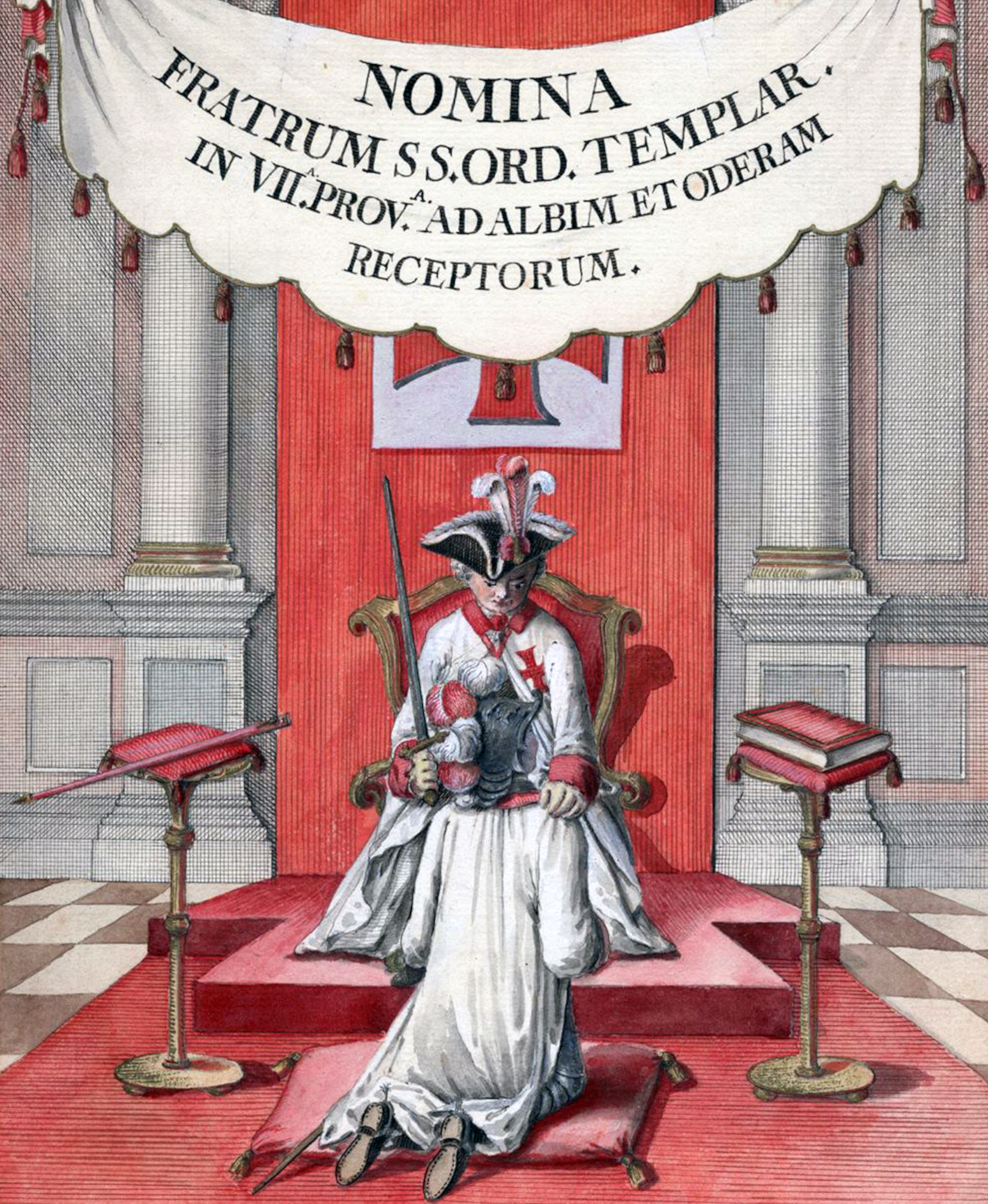
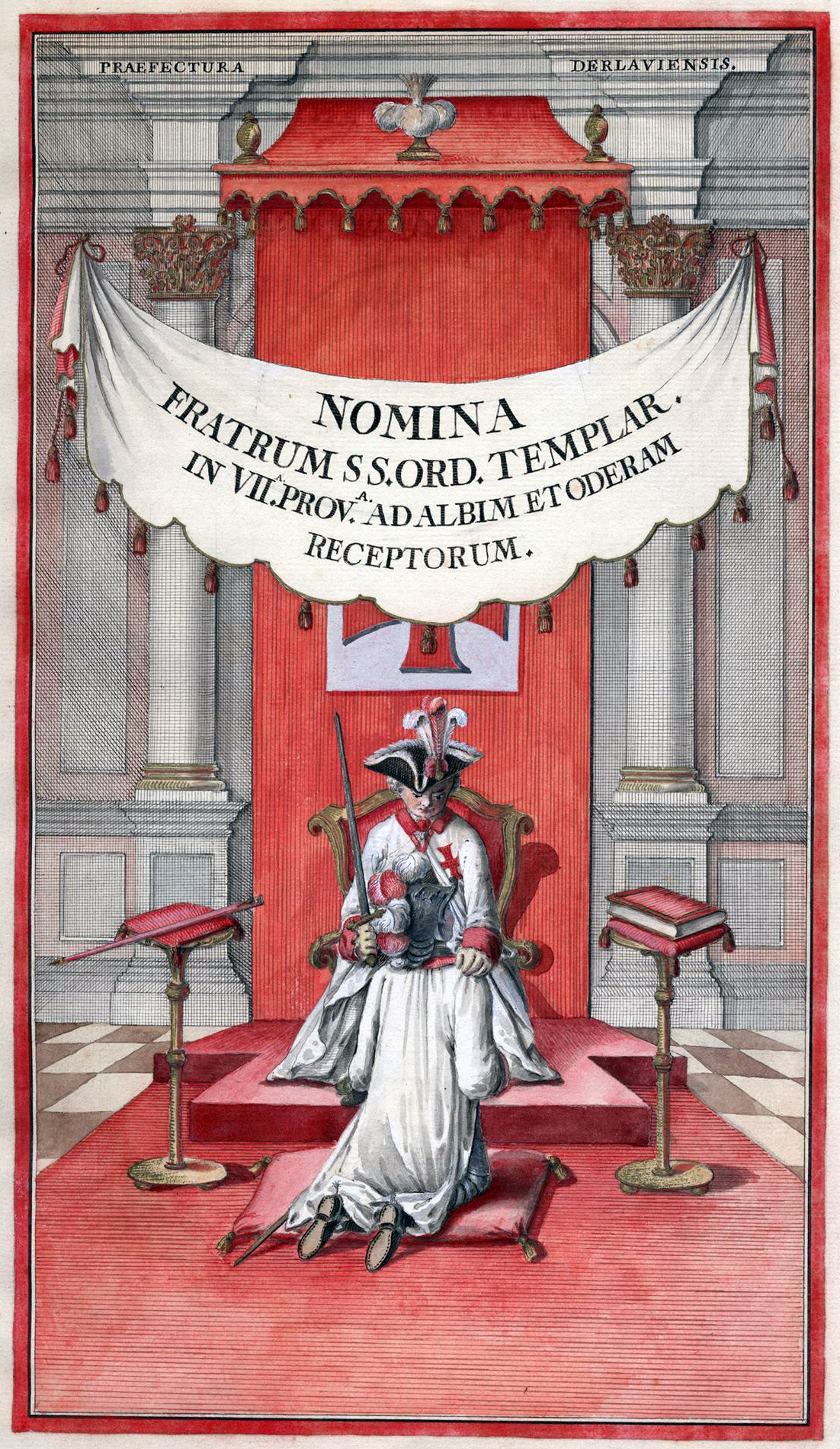
This image depicting the reception of a newly made Knights Templar is part of the collection known as the Derla Manuscripts, and are housed at the Musée de la franc-maçonnerie, Paris. They represent a nearly complete collection of rituals and records for the Derla Prefecture of the Strict Observance in Leipzig, 1775.
The history of Freemasonry is deeply intertwined into the history of the Enlightenment, and indeed the organization itself is purely a child of the century of light. This association founded on, and dedicated to, the principles of self-perfection, through a moral application of unique symbols and allegories, the equality of men, and self-governance under the divine guidance of deity, offered an attractive proposition to men of all stations in the 18th century. Merchant and Noble, all are recorded in the minuet books for posterity without distinction. The association is more than the sum of the moral precepts it imparts and is equally experiential, as it is fraternity bound by common initiation ceremonies. Each Masonic body therefore has its own unique variations in the ritual and these different flavours give its own distinct character. Freemasonry was exported from England to the continent of Europe in earnest in the 1720’s and by the middle 1730’s there were a handful of German Lodges.
Where did they come from, how were they connected within the world of Freemasonry?
Lodges in Germany primarily worked only the first three degrees of Freemasonry from 1736 through the early 1740’s. Many of the fragments that we have of these early rituals indicate that the first German language printing of Pritchard’s Masonry Dissected, had a profound impact on the origins of German ritual. The establishment of the Scottish Lodge l’Union annexed to the Berlin Lodge the Three Globes on 30 November 1742, and its chartering of daughter lodges in Germany and surrounding countries, meant that German Masons effectively had four Masonic degrees being offered, culminating at the Scots Master degree. This arrangement ran until the mid-1750’s and by the end of that decade, French high degrees began to appear during the Seven Years War and were combined and augmented into a set of high degrees called the Clermont Rite. The Strict Observance therefore is a revision to the existing tradition, with a new capitular superstructure at the helm.
The question of when precisely did the Strict Observance begin is a matter of perspective. Did the Order begin with Baron von Hund’s founding of the first Lodge in Unwürde in 1751 or is it later when the top two degrees containing the Templar liturgy and superstructure are constructed along with the Lodges uniting under this banner at the treaty of Altenberga in 1764?
What did they offer to members?
The Rite was constructed to attract the most wealthy and influential Freemasons. Expensive initiations and dues, elaborate costumes and regalia, rich ceremonies, and lavish conventions were tailored to whet the appetites of the most well to do members of society. It was a system of six-degrees and supposedly being led by Unknown Superiors. Additionally there was a financial charity scheme established much in the same vein as the charity scheme of the Premier Grand Lodge of England. Members could ask for assistance, and provided that their situation was not the result of bad housekeeping, they received a pecuniary contribution. Fraternal assistance was a particularly valuable proposition, in an age without social safety nets.
Who could become a member?
Theoretically anyone could be a member of the strict Observance, as there were no explicit provisions with respect to class, provided that a candidate was of the Christian faith. The liturgy in the ritual of the Rite is broadly constructed upon Christianity, and specifically upon the betrayal of Jacques de Molay and the restoration of the Templar Order. The issue of religion here is less of a concern with belief and more a concern of suitability. Practically speaking the initiation fees, regalia costs, dues etc., were of such a level that entry was excluded to at least the middle class and even there not without some considerable cost. This is visible in the professions of the members.
We could actually give career statements on almost all the members – the problem at this moment is the importation of the statements that remain in Swedish on the Labels of the Swedish members.
What rites did they perform?
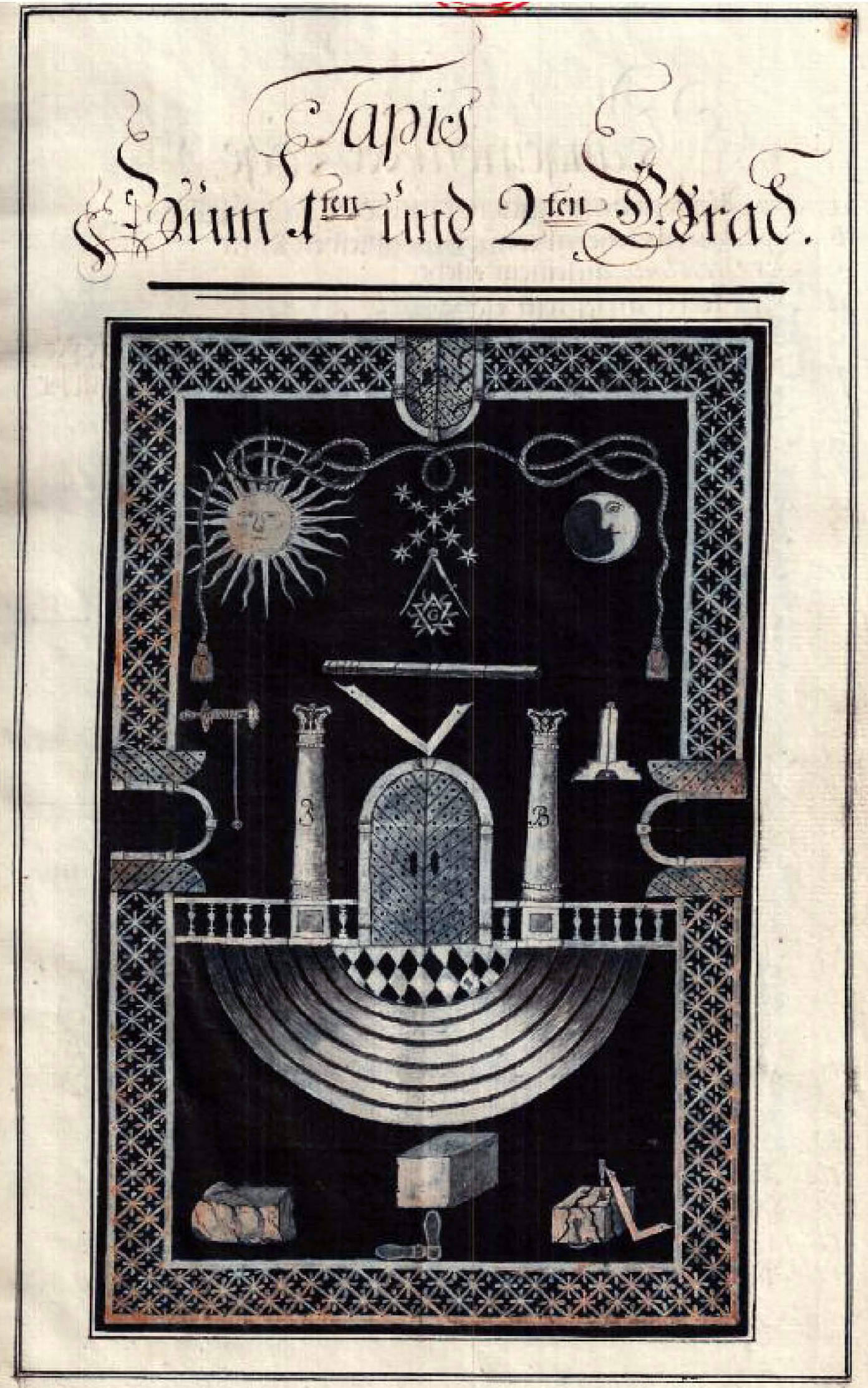
Carpet or Tapis for the Apprentice and Fellow degrees of the Strict Observance. From the archives of the Frankfurt Lodge Zur Eingkeit in 1776.
The Strict Observance was effectively a revision and then an expansion of the existing German Masonic traditions. The first three symbolic degrees retain the so-called ancient landmarks making them acceptable with respect to regularity but differ, however, in key places in the ritual. There are technical changes and also insertions evident as well. The tracing boards of each degree differ from the standard rituals offered in other lodges at that time. The same is true for the Scots Master degree. These innovations in the ceremonies are unique to the Strict Observance, and are deliberate as it is these subtle differences, that build up the Templar legenda revealed later in the fifth and sixth degrees. Hund effectively built a Templar secret society, high degree system on top of the extant Masonic system. The initiate transitioned from being merely a Freemason and became a Knights Templar complete with an elaborate knighting and investiture ceremony. The Masonic degrees comprised the outer order and the Templar degrees comprised the inner order. Its these concepts that Knigge drew from when he set about building the degree system of the Illuminati from 1780-1784.
Strict Observance
Illuminati
The Strict Observance does not have a Preparatory Order.
I. Minerval Class. Preparatory Order (non Masonic).
1. Novice.
2. Minerval.
3. Minervalis Illuminatus.
Governance of the Strict Observance was organized at two levels; an administrative level and also at a local level. The Saint John’s Lodges offering the first through the third degrees were governed by the elected officers of the Lodge. Above this lodge was Saint Andrew’s Lodge administering the fourth degree, Scots Master, and governed by its own elected officers. Above this lodge was the Chapter, offering the Novice and Knight degrees, and administrating not only the Chapter, but also the whole local presence of the Strict Observance in each locality. Reports were constructed and a portion of the monies received were forwarded from the Treasurers and Secretaries of both St. John’s and St. Andrew’s Lodges to their counterparts in the Chapter. The Chapter abstracted these reports and forwarded its portion of the monies in conjunction and sent them the Prefecture. The Prefecture comprised of several chapters performs the same functions and reports to the Provincial Grand Master of the Province. Provinces are composed of several Prefectures and assembled roughly every few years at conventions to work out the business of the Order, and often to settle internal disputes.
Knigge again borrowed from his time in the Strict Observance as well, with respect to external structure. The main difference is that Minerval Assemblies, the Preparatory Order unique to the Illuminati is included at the local level and subordinate to the St. John’s Lodge. Knigge also made refinements at the Administrative level as well. Provinces were localized within states, whereas they had crossed these boundaries within the Strict Observance. Additionally Provinces in the Illuminati reported to the National Inspector and these Inspectors were to be united at conventions called National Inspections. None of this ever occurred however, as the Illuminati faded into obscurity as quickly as it had ascended.
Strict Observance
Illuminati
Administrative Level.
— Province. (Prv. Grand Master)
— Prefecture (Prefect).
Local Level.
— Chapter. (5°, 6°)
— St. Andrew’s Lodge. (4°)— St. Johns Lodge. (1°, 2°, 3°)
Local Level
— Chapter. (Priests)
— St. Andrew’s Lodge. (Scottish Novices and Knights)
— St. Johns Lodge. (1°, 2°, 3°)
— Minerval Assemblies. (3°)
Disintegration and Survival
The Strict Observance ceased to exist much in the same way it began; at a convention. From the Templar perspective the rite was born, chaotically at the convention of Altenberga in 1764, after a Gentleman named Leucht passed himself off as a Superior of the Templars named Johnson. Baron Karl Gotthelf von Hund assumed control after Johnson had appointed him Heermeister, suspecting him of fraud and had him imprisoned after he confessed to this deception. Hund assumed command of the Order though it was a risky venture.
Johnson sought to gain control by deception over all of the local lodges practicing the Clermont System of high degrees, a composite of French high degrees fortified with alchemy and theosophy. Exploiting the occult leaning tendencies of the local Lodges and using a sleight of hand involving the production of gold, he proceeded to organize a general convention in effort to alter their masonic system and place himself at its head. Johnson had the deputies of the local lodges bring their rituals and papers and had them burned while introducing his new ceremonies. This singular act, and subsequent variability in the receptions conferred immediately afterwards by Johnson and von Hund, quickly led to the 1764 Altenberga Convent, and the only order of business was to reform all of the Lodges and join them to the Order of the Temple. Standardization was the ultimate goal.
During the convention it was discovered that Johnson was a charlatan named Leucht, and he was ultimately arrested and imprisoned extrajudicially until his death in 1777. Baron von Hund found himself in a very precarious situation, and at stake was no less than the future of local Masonry, given that all of their records had just been immolated by a fraudster. Hund seized control and stabilised the situation. Johnson’s new rituals and economic plan were to be implemented despite his roguery, out of necessity.
Johann Schubart, a close associate of von Hund, was tasked with implementing this new reform on all of the Lodges with the assistance of J.J.C. Bode. Through Schubart, Hund used the conferral of these new degrees to gain favour over the brethren, and to assert himself as being the Heermeister or Chief of the Army. Key was the Lodges participation in the newly crafted financial scheme, the Plan ad Interim. This move was not without suspicion, however and many of the lodges altered or flatly refused participation.
Regular conventions were organized as a result. These conventions served partly to enact new policy and reforms, and partly to maintain control of a rapidly expanding system. In 1768 the so-called clerical Branch appeared and much to the chagrin of the Brethren, they were incorporated into the Order by Baron von Hund. The Clerical Brethren in fact practiced a different form of the high degrees with a bent towards the occult sciences, and this inexplicable act his called into question, in the minds of many precisely how was Baron von Hund initiated into the Order of the Temple?
At the convention of Brunswick in 1775, von Hund said that ‘he had been received into the Order in Paris in 1743 by a Superior, Bro. von der rothen Feder, in the presence of Lord Kilmarnock, and had then been introduced to the Pretender. On various occasions subsequently Bro. von der rothen Feder had asked Bro. ab Ense for certain sums of money for the American undertakings. Finally, however, Bro. ab Ense had grown tired of these demands and had terminated this correspondence. This episode will still be in the memory of most of the Right Worshipful Brethren of the Order, as will the story that when the Reverend Bro. ab Ense was asked to reveal more about the identity of Bro. von der rothen Feder he burst into tears and assured his questioners with the warmest emotion that ‘to do so would be against his oath and his conscience’ and that, if he revealed his identity completely, then ‘he would upset certain more worthy persons.’ Earlier that same year at the convention of Hamburg he with great difficulty presented a document in cipher which was supposed to be his patent of authority. Ultimately he only showed it to four brethren, none of which could decipher let alone read it.
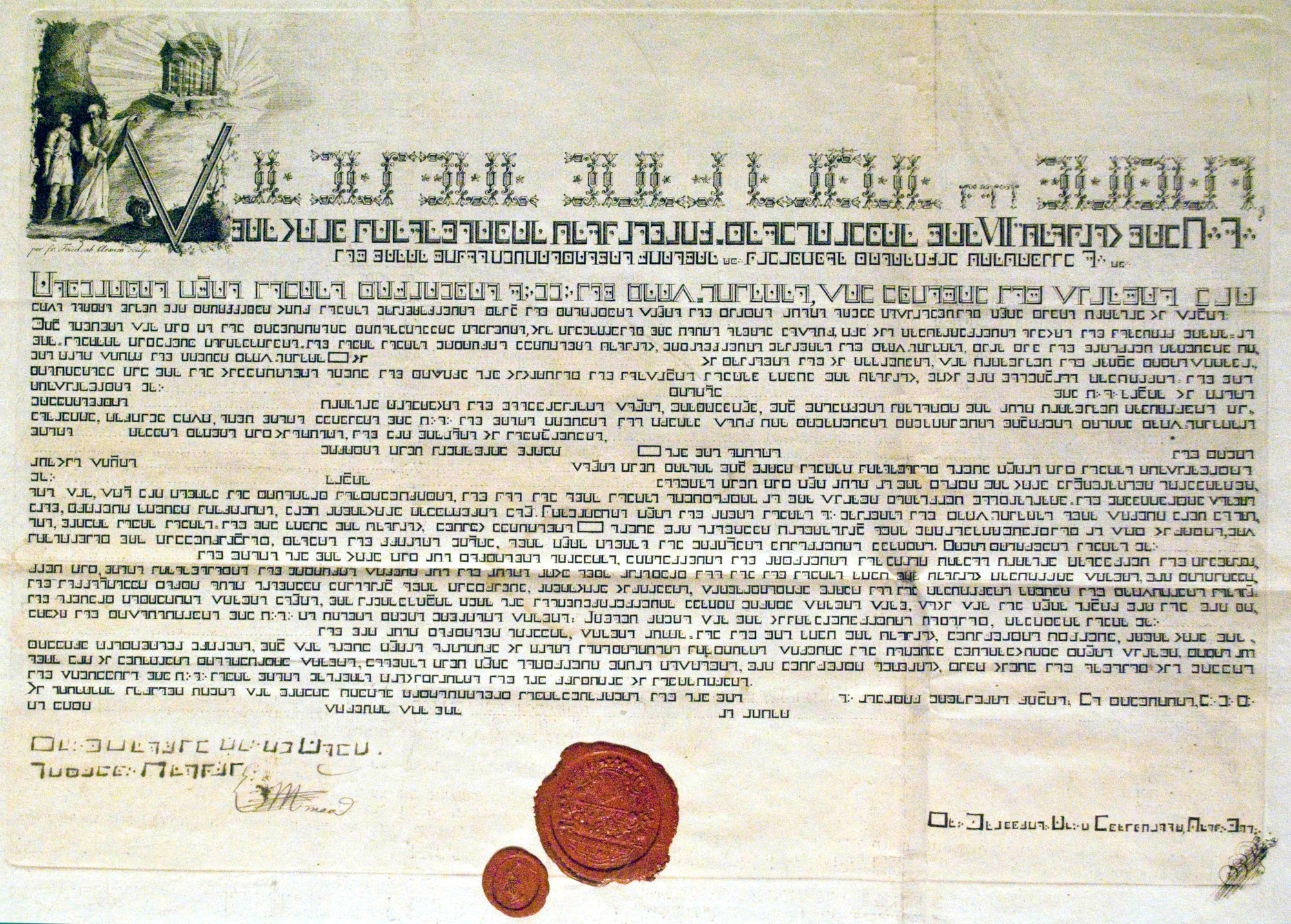
Masonic members patent in cipher. From Den Danske Frimurerorden Archiv.
Ultimately von Hund never revealed the identity of his initiator and took his secret with him to the grave in 1776, his fortunes greatly reduced through his support of the Order. This started the terminal decline of the Strict Observance. Only recently has his patent been deciphered, but sadly no new information has been gleaned from the transcript, as it is merely a recounting of his initiation by the so-called Knight of the Red Feather. In the subsequent convents after his death, Carl the Duke of Södermanland was proposed and elected Grand Master of the Order in 1778 at the convention of Wolfenbüttel, and only two years later resigned. Carl’s election was rejected by the Grand Lodge of the Three Globes in Berlin, who withdrew from the Order, and thus the unravelling began in earnest and culminated at the convention of Wilhelmsbad in 1782. At this convention the association with the Knights Templar was officially removed, and the French Brethren coalescing around the orbit of Jean Baptiste Willermoz officially proposed that the new reform ritual constructed by Willermoz in 1778 and being worked in France under the CBCS, be adopted as the official ritual. This proposition was rejected by the German Lodges, and the Strict Observance ceased to exist in precisely the same manner it came into existence; at a convention. It had become clear even in von Hund’s lifetime that there were never really any Unknown Superiors directing the Order, and this issue was amplified after his demise.
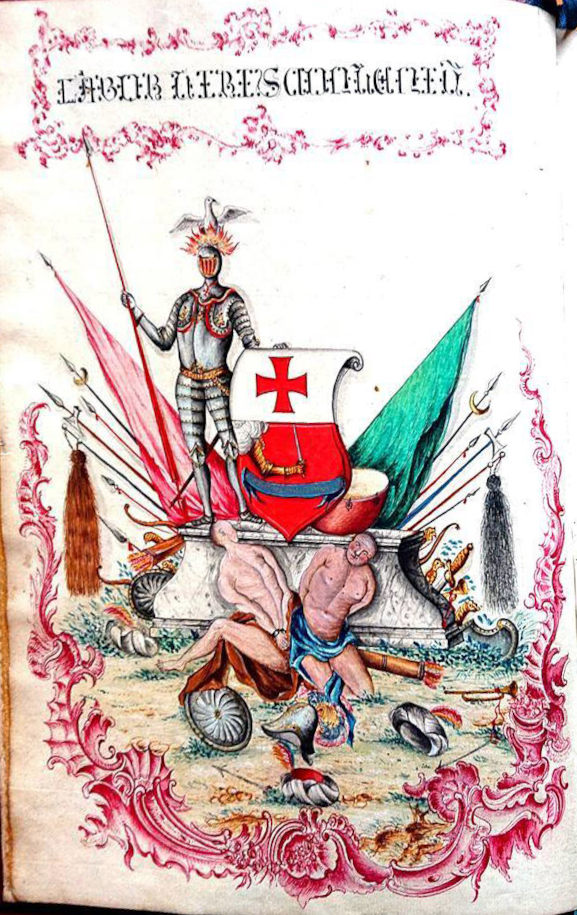
Labor uiris conuenit; Labour is suitable for men. From Den Danske Frimurerorden Archiv.
The death of the dominant Rite in Germany created a massive power vacuum, that was quickly filled by her daughter systems. The real legacy of the Strict Observance therefore is that it was the mother of several subsequent high degree systems, and its scope and influence forever changed Freemasonry in Europe.
Were the Illuminati a counter movement? The answer will, apparently, be a “yes and no”. The entire organization adopted structures, yet the Illuminati as represented by Knigge at the convention of Wilhelmsbad, made eventually a major acquisition of J. J. C. Bode who in turn with Knigge brought many members of the Strict Observance with them into the Illuminati. Ultimately the convention of Wilhelmsbad ended the Strict Observance while at the same time gave birth to the CBCS. The Illuminati were a counter movement of and the antithesis to the CBCS, and were in competition not only with them, but also with the Gold und Rosenkreutzer Orden for the members of the Strict Observance.
The fusion of this list into FactGrid created a much larger data set of now 1,596 members – certainly without reaching the complete number. Hermann Schüttler had identified several new members, but the largest subset came here with the input of the 4,200 18th-century Swedish Freemasons which Andreas Önnerfors provided earlier in 2020.
The dynamic list is with all these inputs conclusive on the leadership level of the Strict Observance yet it will not fully account for the lower ranking members at the local levels, which will create the largest position of the membership. Over time these local records will be populated, and the overlaps to other organizations will grow more substantial.
We will now have to learn how to use these data. Von Lindt’s, Verzeichniss sämmtlicher inner Ordensbrüder der Strikten Observanz was a defined paper publication. One could run through its lists to identify a particular member with its internal name and localization, but the database does this job far better. Type in any of the internal names into the basic search field and you will be in the data set of the person who adopted this name. Our list is enriched with name variants in the aliases – you get the variants in the autocomplete when looking for a person’s data set.
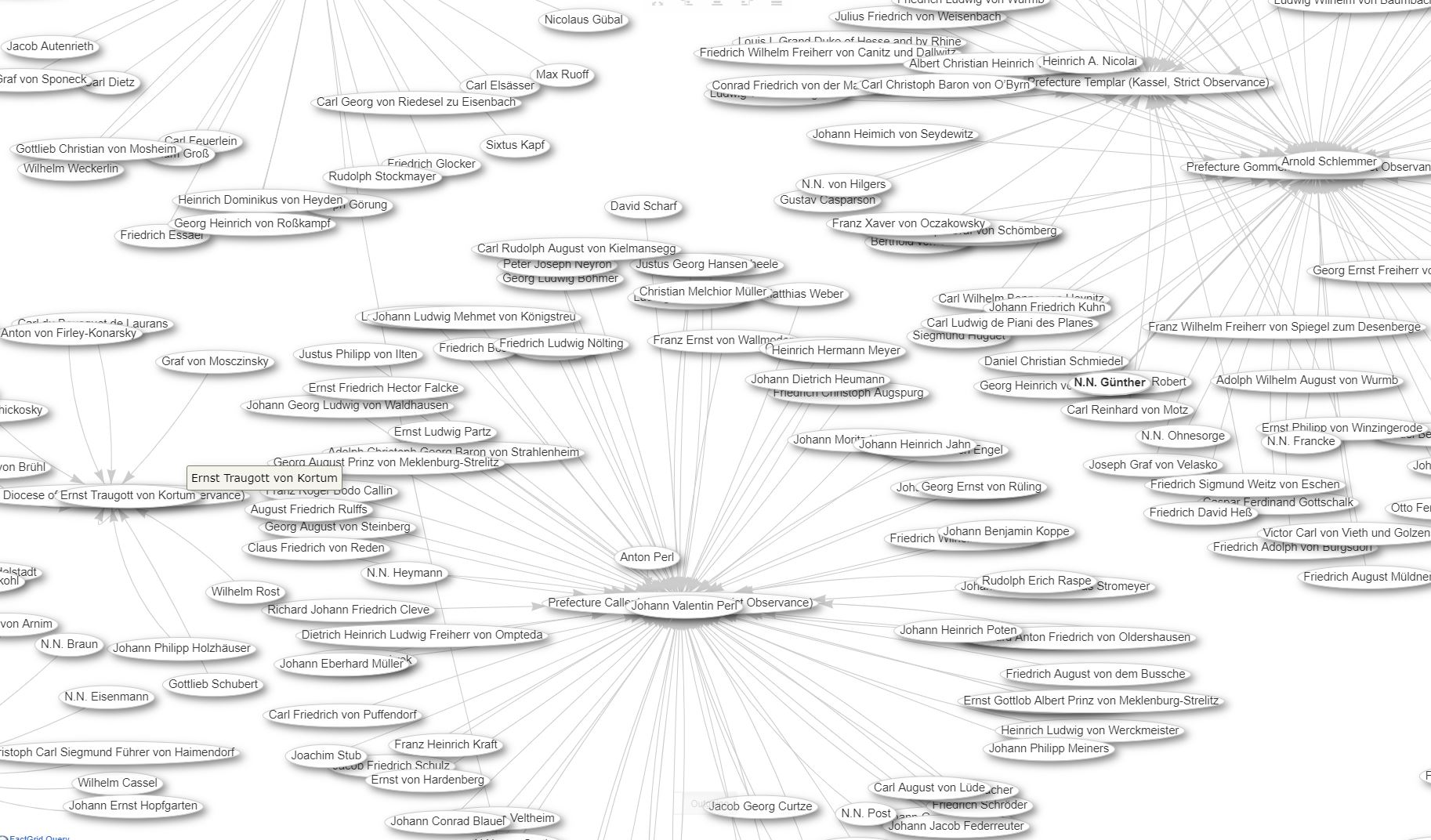
At present, we are now handling information in a web of interconnected statements; the entries of all members including information on the provinces and the local affiliations. If you are ready to modify the following script, you get the listings for any prefecture you are interested in or run any other filter on the set like these two:
The following searches gives you the list of the provinces with their respective prefectures – on a table and on the map – both lists are useful as they give the Item numbers or specified explorations of the prefectures and provinces
Many of the members have career statements on their personal records. The following bubble graph gives the full spectrums without further accumulation – not very practical as this gives a pattern of a load of variations. The statements are, however, part of a provisional classification, so that you can also sort them under a first classification – links two and three give this homogenized pattern in bubble and bar charts:
The representations remain problematic as they accumulate practically all the career statements made on all these persons over their respective lifetimes. It is not that easy to formulate a search that asks for everyone’s position in a year like 1780 – both the search and the data have to be prepared for such a representation.
Many of those listed have further membership statements on their items. It is easy to create a table of all these membership statements – and to convert this table into a bubble chart that shows the size of these overlaps.
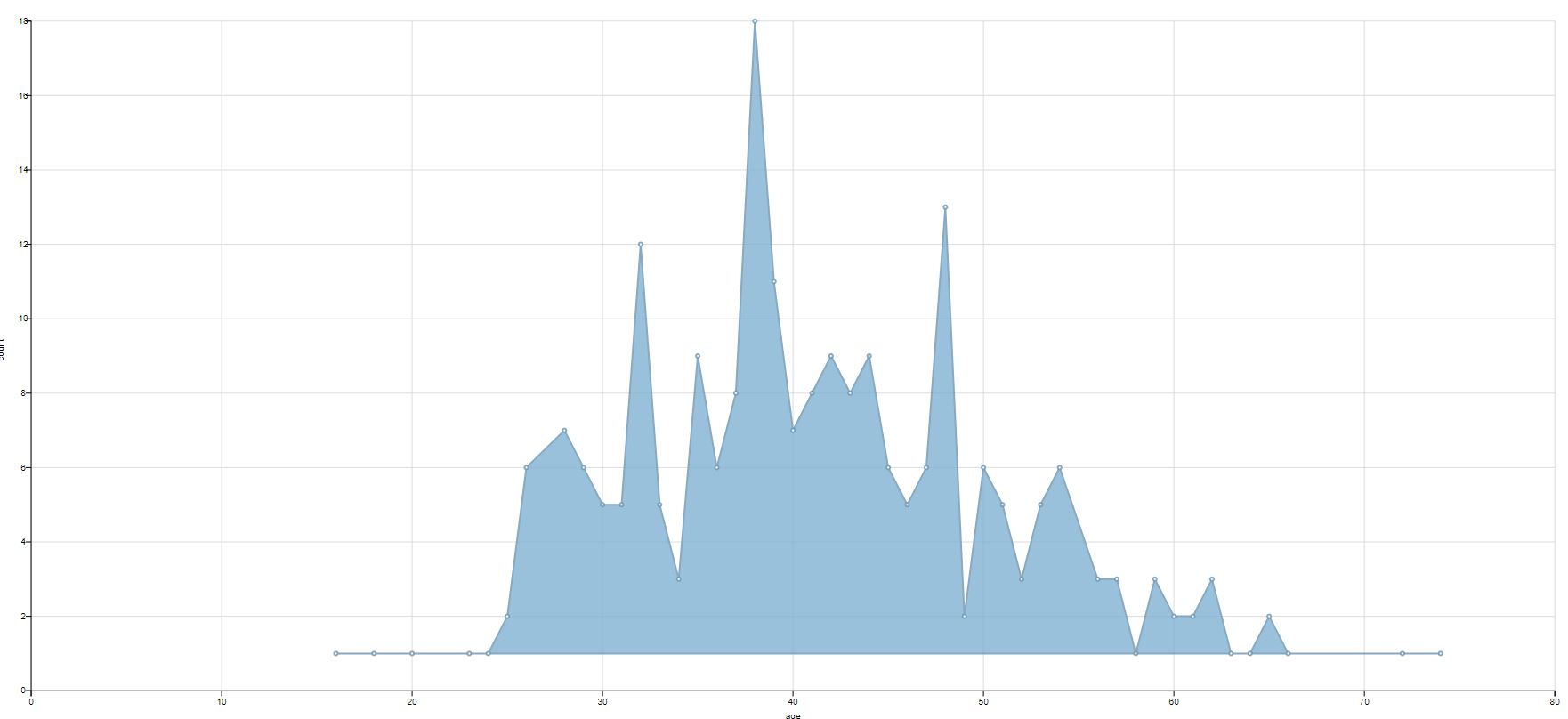
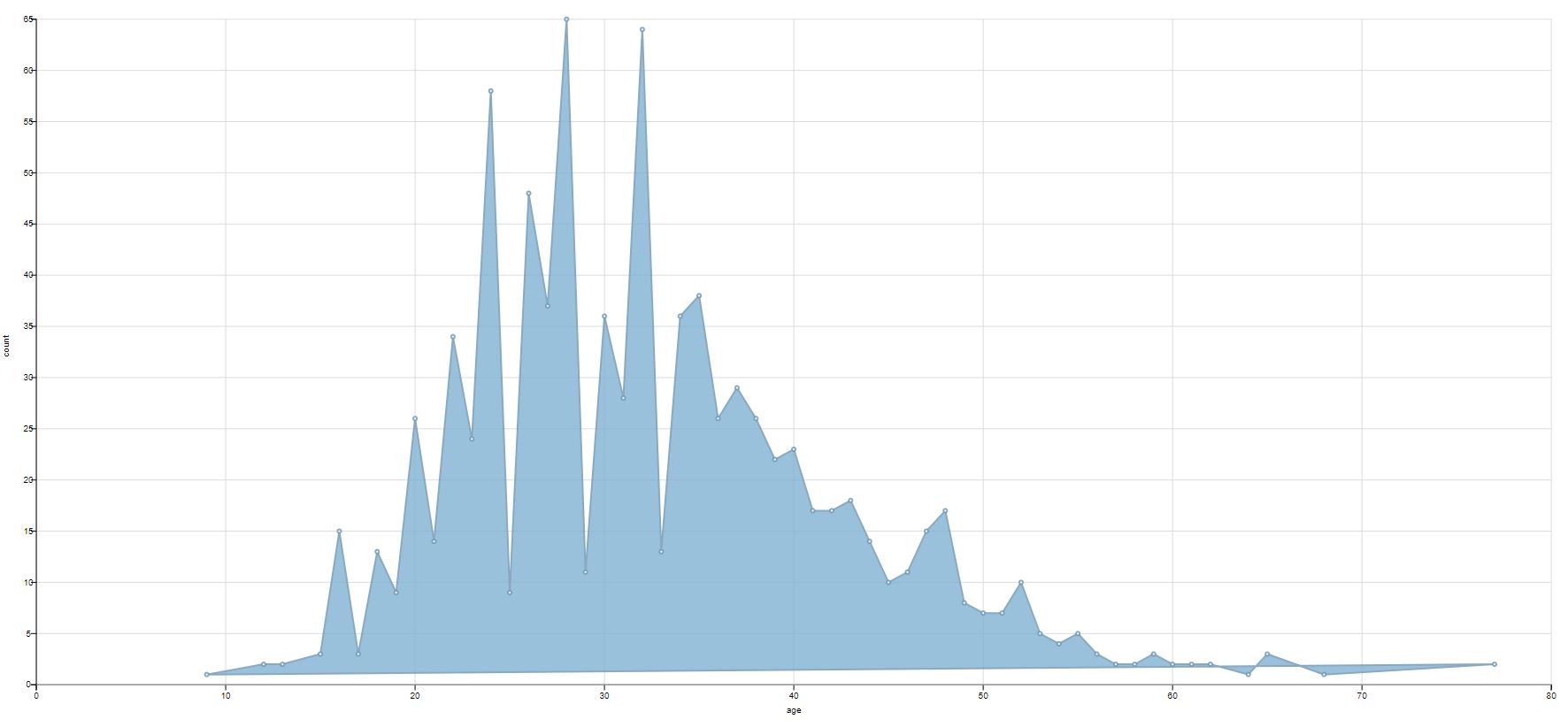
Age profile of the Strict Observance in 1782Age profile of the Illuminati in 1782
The age profile is extremely interesting to evaluate organizations. The pattern has, if given by year of birth, its coincidental ups and downs; a moving average or a distribution by decades would straighten that; but it gives an idea of the outreach of the respective organisation. The Strict Observance was an organization for advanced Freemasons, for men between 35 and 65. The Illuminati wanted to educate and form their members; they were particularly eager to recruit students, and this is clearly visible in their far younger profile with its first peaks in the late 20s. Both graphs state the situations for the year 1782:
The biggest problem with data as we have them now is that the further categorization is lagging behind. It would be easy to give the medieval three estates of church, nobility and peasants – the 1780s are, however, no longer the era for such a simple pattern. Academics had gained a distinction; the nobility called for a far clearer differentiation between the ruling princes and lower ranks of all sorts. A huge group of citizens had grown over last 500 years and called for complex patterns. We would need social historians to categorize our the biographical datasets – no trivial task in a database that bridges through the centuries.
Designed to accumulate and aggregate data
The main advantage of the present data set is that it is now extremely open. You can download the set with any arrangement of statements you are interested in, as far as these statements are made on persons in the set – and here FactGrid has a wealth of unprecedented information on many of the members. All data are CC0, that is free to be used in any other environment, whether you want to publish such a list in book form or whether you want to run visualizations in software-environments of your choice.
The far more interesting use will be online and in the database. FactGrid is distributing accounts; the data sets presented with this post are open to be augmented and aggregated into any direction. One would love to have lists like these for all the masonic organizations that competed on the late 18th century market. It would be extremely interesting to understand the membership careers, the biographical movements on the constantly changing landscape of competing or well-connected associations.
We are very pleased to announce a pilot project funded by the U.S. federal government’s National Endowment of the Humanities (NEH): “PhiloBiblon: From Siloed Databases to Linked Open Data via Wikibase: Proof of Concept.” It will begin June 1, 2021. and end May 30, 2022 and will be hosted by FactGrid.
The project is focused on PhiloBiblon. a forty-year-old database for the study of the medieval history and literatures of the Romance cultures of the Iberian Peninsula: Portuguese and Galician-Portuguese, Castilian, and Catalan. It contains four subsidiary databases:
BETA: Bibliografía Española de Textos Antiguos: Medieval texts in Spanish.
BIPA: Bibliografía de la Poesía Áurea: Golden Age (16th-17th c.) Poetry in Spanish.
BITAGAP: Bibliografia de Textos Antigos Galegos e Portugueses: Medieval texts in Galician, Galician-Portuguese, and Portuguese,
BITECA: Bibliografia de Textos Antics Catalans, Valencians i Balears: Medieval texts in Catalan.
The project is designed to solve one of the most vexing problems facing long-standing digital projects: maintainance of the software platform. PhiloBiblon started out in 1975 as an ancillary database of the Dictionary of the Old Spanish Language project, carried out at University of Wisconsin, Madison, by Lloyd Kasten and his student, John Nitti. In Madison the database management system (DBMS) used was FAMULUS, created, ironically, in Berkeley in 1964, for the Pacific Southwest Forest and Range Experiment Station. Since then, technological transformation has been a constant: from the CD-ROM discs of ADMYTE (Archivo Digital de Manuscritos y Texts Españoles ) to a first web version in 1997 to the current 2014 version. Each transformation has usually required multiple grant applications to agencies and foundations, especially to NEH.
PhiloBiblon currently runs under Windows on Revelation Technology’s MultiValue database, OpenInsight. PhiloBiblon’s 1987 implementation was designed on Revelation G., the ancestor of OpenInsight, by John May, a graduate student in History of Science who eventually left the academy for a business career. John has maintained and enhanced the PhiloBiblon DBMS for more than 35 years, building it out to encompass ten relational tables (texts, witnesses, primary source manuscripts and imprints, copies of imprints, persons, institutions, toponyms, and secondary references). Among them these ten tables contain 1246 data elements (fields), 98 controlled vocabulary lists with more than 3000 properties, 110 search indexes, and 30 data entry screens.
PhiloBiblon and its relational DBMS existed before Tim Berners-Lee invented the Worldwide Web at CERN in Geneva in 1989. It was evident from the advent of the first really useful commercial browser, Netscape, that the WWW offered a vastly superior vehicle for making information available to students and scholars, much better than print and CD-ROM. In PhiloBiblon’s first web version (1997), data were exported from the OpenInsight DBMS and uploaded to a web server at Berkeley in HTML format. Users could search only for authors, titles, or keywords; and the result of the search was just a list of manuscripts or editions, each of which had to be opened, one-by-one, to find the item of interest.
In the current version OpenInsight data is still exported—usually every two or three months—and uploaded to a web server at Berkeley (and to a mirror site at the Universitat Pompeu Fabra in Barcelona) in ten separate files, one for each table, in the more advanced XML format. On the server the eXtensible Text Framework (XTF) program, created by the California Digital Library of the University of California, parses each file into individual records, indexes them, and serves them to users as a result of a search request from the PhiloBiblon web site. The search mechanisms are much more powerful, offering not only keyword searching but also a set of search boxes tailored to each entity.
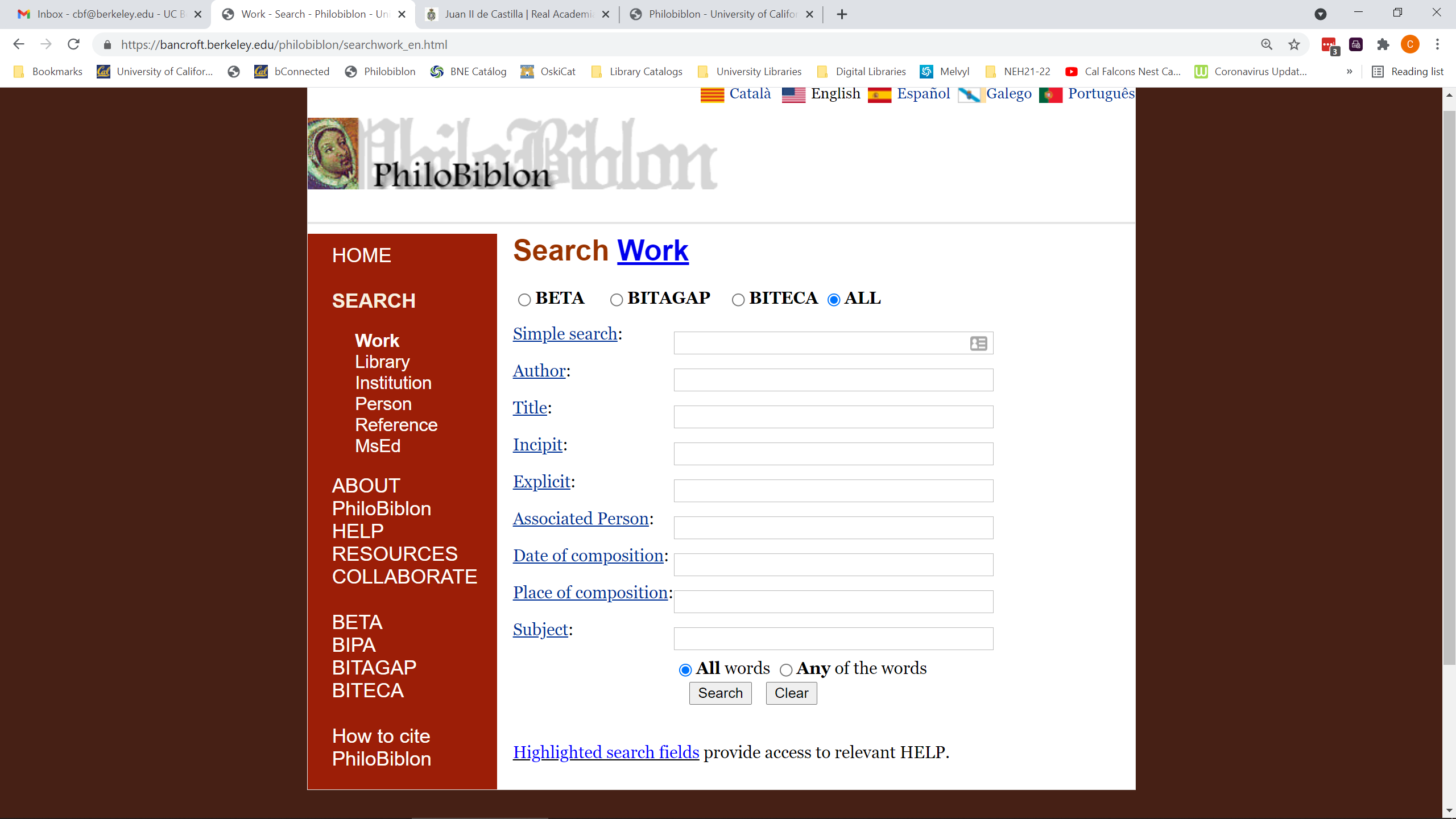
Thus for texts (works): keyword (simple search), author, title, incipit, explicit, associate person, date and place of composition, subject.
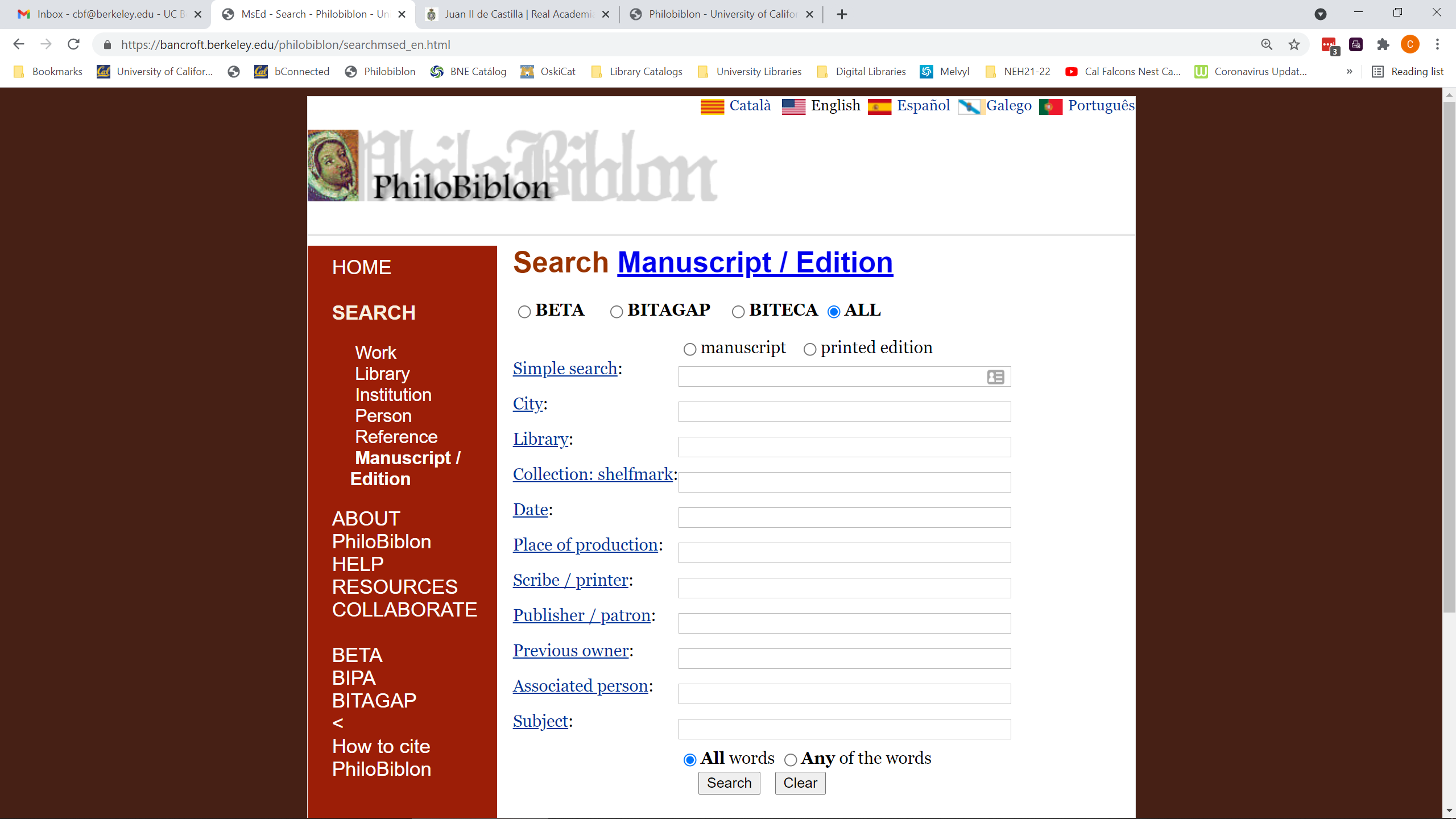
For manuscripts and editions: City and library holding the item, shelfmark, date and place of production, printer and publisher, scribe and patron, previous owner or other associated person:
The time lag between data input and its appearance on the web is annoying. Moreover, the process required to export data and upload it to the web to the web is is neither elegant nor efficient. Aside from this and from the problem of maintaining and enhancing both the Windows DBMS and the web software, the most urgent issue facing PhiloBiblon is its status as an information silo, with no organic relationship with other information sources. The web 3.0, the semantic web, is designed to make use of Linked Open Data and the Resource Description Framework (LD/RDF) in order to make possible automatic links to other information resources, like the Virtual International Authority File (VIAF).
Since 2014 the PhiloBiblon research teams have prepared a series of unsuccessful grant proposals, separately as well as in collaboration with other projects, to NEH and to Spanish, Catalan, and European agencies and foundations with the goal of funding the transformation of PhiloBiblon into an LD/RDF resource.
Last year, instead of proposing the creation ex professo of a new web-based DBMS for PhiloBiblon, on the advice of our neighbors at Stanford University, the University of California, Davis, and the international library consortium OCLC, we decided to explore a radically different solution: to incorporate PhiloBiblon into the wiki world. PhiloBiblon already cites Wikipedia constantly, more than 1400 times in nine different languages. Of more interest than Wikipedia as a model, however, is the more structured but still open environment of Wikidata. Wikidata, however, is too open. PhiloBiblon requires more control over the individuals who can contribute to it.
This led us to FactGrid, which is ideal for our purposes. Open only to members, it offers a perfect sandbox for the PhiloBiblon staff to explore the relationship between PhiloBiblon’s highly structured data model and the elegant and infinitely extensible model of triplestores based on Q# entities and P# properties. We are enormously grateful to Olaf Simons not only for his generous offer to make it available for this purpose but also for agreeing to serve on the Advisory Board of the current NEH project.
When this project ends May 31, 2022, we hope to have shown that the Wikidata model is viable for PhiloBiblon over the long term and that we can make use of its standard input processes, modified as necessary, to map PhiloBiblon’s 421,000 records into the corresponding FactGrid entities and properties, creating new ones as necessary. This work will be carried out primarily by data analyst Adam Anderson, whose academic specialization is Assyriology and cuneiform studies. He will also study Wikibase’s LD access points to and from libraries and archives and test the Wikibase data export module for JSON-LD, RDF, and XML on PhiloBiblon data.
TABLA
BETA
BITAGAP
BITECA
BIPA
ANALYTIC (witnesses)
14692
52084
12239
89926
REFERENCES
7270
21558
5976
472
PERSONS
7423
32309
3473
3418
GEOGRAPHY
1814
4759
840
211
INSTITUTIONS
794
3297
585
4
LIBRARIES
915
455
420
119
MANUSCRIPTS & IMPRINTS
5168
5886
1971
1572
COPIES OF PRINTED BOOKS
4157
1146
1473
137
SUBJECT HEADINGS
339
34
149
126
WORKS (texts)
6034
31962
6173
89913
TOTAL
48606
153490
33299
185898
421293
In addition, software engineer Josep María Formentí (Barcelona), after evaluating the Wikibase data entry module and report format, will create prototypes of more user-friendly query and data entry screens and report formats.
All of this work will be carried out in collaboration with the twenty members of the PhiloBiblon volunteer academic staff and, we hope, numerous volunteers from the Hispano-medievalist community.
Image: Rueland Frueauf the Elder (1440–1507) The Education of the Infant Christ (1506) Wikimedia Commons.
Nach den Pfarrern des Gothaer Territoriums (und ihren Ehefrauen, beidseitigen Eltern, Kindern und deren Ehepartnern – insgesamt gut 15.000 Datenbankobjekten) legt Heino Richard hiermit einen zweiten, quer durch diese Gruppe reichenden Datensatz vor: Die Absolventen des Gymnasiums Illustre Gotha/ Ernestinum.
Primär erfasst sind dabei nach den Listen, die Max Scheider und im Nachtrag Ulrich Lutzkat vorlegten: 4215 Schüler von der Frühphase des am 21. Dezember 1524 gegründeten Gymnasiums bis in den Abschlussjahrgang des Septembers 1882. Von diesen waren uns 872 Schüler bereits bekannt, davon (die Zahlen werden sich ändern, wo immer wir mit den neuen Daten bislang unklare Identitäten auflösen können):
7 aus der Gothaer Illuminatenforschung
21 aus den Gothaer Adressbüchern der Jahre 1828, 1843 und 1846
17 aus dem Gothaer Wählervereichnis von 1849
810 aus dem erwähnten Projekt der Sachsen-Gothaischen Pfarrer
…wobei die Adressbücher uns nach wie vor vor das Problem stellen, dass wir aus ihnen Personen zwar mit Adress- und Berufsangaben aber weitgehend ohne Vornamen bezogen. Die Identifikation kommt hier nur zäh voran.
3343 Personen kamen neu hinzu und zogen dabei 279 neue Väter mit sich, macht unter dem Strich 3622 neue Personen (zwei besonders prominente Neuankömmlinge sind der Absolvent Christian Gryphius mit seinem Vater, dem noch berühmteren Dichter, Andreas).
Die Überlappungen waren ein attraktives Moment des Projektes. Mit jeder von ihnen stabilisierten sich Identifikationen und kamen Hintergrunddaten hinzu, oft zu bislang nur spärlich beleuchteten Personen.
Mit den folgenden beiden Datenbankabfragen werden alle uns bekannten Schüler aufgelistet (es sind derzeit zwei Handvoll mehr, dank einiger bekannter Schüler, die früher abgingen):
derselbe Datensatz erweitert mit Informationen zu beiden Eltern, Ehepartnern, ausgeübten Berufen als Demonstration, wie erweitert wird. Die Zeilenzahl ist bei dieser Suche größer, da Mehrfachnennungen (bei Berufen etwa) in Folgezeilen unter derselben Q-Nummer der Person erscheinen. Abfragen wie diese lassen sich theoretisch in die verlinkten Objekte etwa der Väter oder der Berufe hinein ausdehnen. Die Datensätze lassen sich wie immer in verschiedenen Formaten CC0-lizenziert zur Nutzung auf anderen Plattformen herunterladen.)
Geburtsdaten, Herkunftsorte, Familienbeziehungen, besuchte Universitäten, Berufe…
Wie schon im Fall des Pfarrerbuchs so sind die Daten der Schülerschaft des Gymnasiums Illustre/ Ernestinum, vor alle ein offenes Angebot an die Forschung. Alle erfassten Personen stattete Heino Richard mit Geburtsdaten aus – entweder aus den vorliegenden Quellen oder über eine Rückrechnung (die, wo wir sie vornahmen, durchweg im qualifizierenden Statement zur Genauigkeit der Angabe vermerkt ist; wir gingen dabei von einer 20-Jahres-Differenz als Regelfall aus, das legten die notierten Daten nahe).
Der Artikel der deutschen Wikipedia zum Gymnasium notiert:
Im 17. Jahrhundert wurde das Gymnasium durch Herzog Ernst I. von Sachsen-Gotha-Altenburg weiterhin gefördert. Er bot Söhnen verfolgter Lutheraner aus Ungarn, Schlesien, Polen, Russland und Skandinavien Asyl, die am hiesigen Gymnasium lernten. [abgerufen 2021-04-21]
Das lässt sich nun präzisieren. Skandinavien (sieht man von einigen Dänen ab) erscheint hier nicht, Schlesien und die ehemaligen deutschen Ostgebiete im heutigen Polen sowie, als Randlage, Ungarn jedoch schon (zudem im 19. Jahrhundert auch ein Schüler aus der Karibik). Näher hinein-gezoomt zeichnet sich dann aber das Sachsen-Gotha-Altenburgisch und Coburgischen Territorium ab. Allein 1462 der 4215 Absolventen kamen unmittelbar aus Gotha, die meisten waren „Landeskinder“, Söhne von Amtsleuten und Pfarrern der Dörfer des Territoriums.
Zum großen Reiz von Wikibase-Instanzen gehört, dass man sie gewissermaßen über Ecken durchsuchen kann. Die Frage nach der sozialen Herkunft der Schüler lässt sich damit überraschend zielgerichtet angehen. Unmittelbar sind die Berufe, Bildungswege und Arbeitsverhältnisse der Väter ein Indikator für das jeweilige Elternhaus. Die Mütter sind in der Regel Hausfrauen. Ihr Stand entscheidet sich über den Beruf und die Ausbildung ihrer Väter. Die Fragen lassen sic präzise in die Vernetzung der Information hinein stellen:
Familiäre Hintergründe: Berufe der Väter und der Väter der Mütter, Kurzlink
Konsequent erfasst sind die genealogischen Hintergrundinformationen; sie ermöglichten die Suche über Eck. Langzeitvisualisierungen der familiären Netzwerke wären eine Herausforderung. Hier ist vor allem unklar, wie man Datenvisualisierungen im historischen Verlauf gestalten sollte – eine Herausforderung für SPARQL-Könner und Tool-Programmierer.
Einladung an die Bildungsgeschichte sich dieses Zettelkastens zu bedienen
Projekte der Bildungsgeschichte, auf der Suche nach einem ergiebigen Untersuchungsgegenstand sollten hier eine extrem praktische Vorarbeit entdecken. Gothas Gymnasium Illustre/ Ernestinum bietet eine noch weitgehend unerschlossene archivalische Überlieferung von 8,3 laufenden Regalmetern im Thüringischen Staatsarchiv Gotha mit extremer Datendichte – darin finden sich:
Dokumente zum Unterricht in den verschiedenen Fachgebieten von Griechisch bis Turnen ab der Frühphase
Schulordnungen ab 1641
Akten der Lehrer mit Gehaltsinformationen ab 1837 ff.
Zeugnislisten der Jahrgänge 1641 bis 1946
Informationen über „spezielle Verhältnisse der Schüler“ ab 1837
Akten zur Finanzierung des Gymnasiums ab 1772
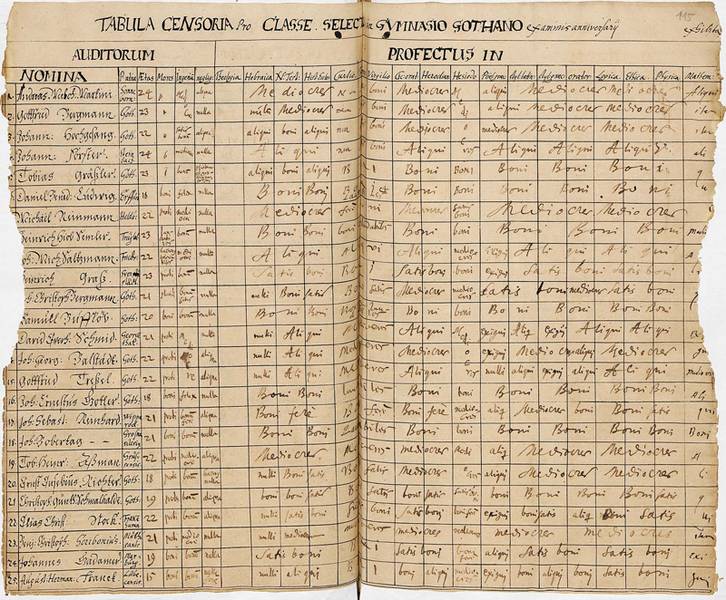
(Hier das elektronische Findbuch zu diesen Beständen.) Spektakulär sind in diesem Bestand die Zeugnislisten mit ihren Beurteilungen der Leistungen im Wandel der Beurteilungskriterien und Fächer. Aus ihnen wird nebenbei ersichtlich, wie die Schule Unterricht organisierte. Man kann mit diesen Listen im Detail Schülerkarrieren – auch die der Schüler, die nicht bis zum Abschluss kamen und uns bislang fehlen – Schuljahr für Schuljahr nachvollziehen.
Zeugnisliste des Gymnasiums Illustre aus dem Thüringischen Staatsarchiv Gotha
Das FactGrid sollte in seinen Datenstrukturen so angenehm frei modellierbar sein, dass es Projekte, die diesen Aktenbestand angehen, anziehen sollte, mit dem Geschenk des fertigen Rasters, von dem aus sich beliebig viel tiefer in die archivalische Datenerhebung einsteigen lässt.
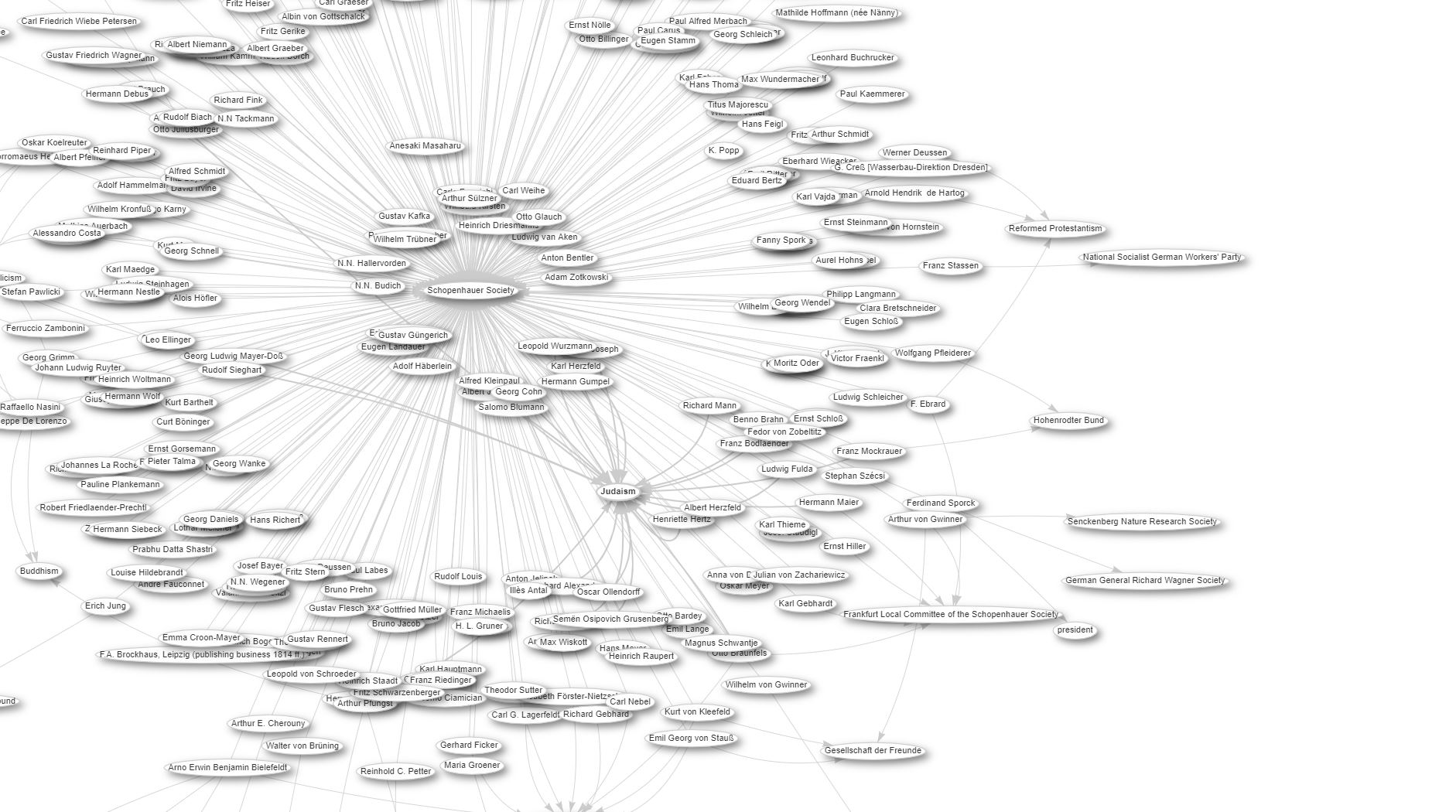
Im Rahmen eines größeren Forschungsprojekts zu deutsch-indischen Kulturbeziehungen in der Zeit des Nationalsozialismus stellte sich mir wiederholt die Frage, weshalb immer wieder eine bestimmte Gruppe von Künstlern und Schopenhauerenthusiasten eine besondere Neigung zu einer Art „spiritueller Indienverehrung“ zeigten. Alle waren verbunden mit Paul Deussen (1845-1919), dem zentralen Initiator der Schopenhauer-Gesellschaft, gegründet 1911 in Kiel. Die Gesellschaft besteht bis heute. Um diese Fälle zu kontextualisieren und um festzustellen, ob diese Nähe zu Schopenhauers Philosophie in einem ursächlichen Zusammenhang mit einer Begeisterung für Indien stand oder doch nicht eher ein Zufall war, habe ich mich, mit der tatkräftigen Unterstützung von Olaf Simons und Martin Gollasch daran gemacht, die Mitgliederlisten der Jahre 1912 und 1913 in FactGrid aufzunehmen und die Personen zu identifizieren. Das Ergebnis überraschte uns in gewisser Weise alle. Im Folgenden sollen die gesammelten Daten anhand einiger Fragen visualisiert und damit „zum Sprechen“ gebracht werden.
Dass die Mitglieder der Schopenhauer Gesellschaft eine bestimmte Schicht bürgerlicher Intellektueller widerspiegeln würde, kann als gesetzt gelten. Indes waren die Fans von Schopenhauer doch etwas speziell in ihrer Zusammensetzung. Es überrascht nicht, dass überdurchschnittlich viele Universitätsprofessoren unter den Mitgliedern waren; eines der Ziele war es doch, den zu Lebzeiten von den deutschen Universitäten stets frustrierten Philosophen postum zu Ansehen zu verhelfen. Ein Überhang von Juristen und Bankiers war schon zu Schopenhauers Lebzeiten auffällig (Hansert 2010: 35) und setzt sich in der Gesellschaft fort. Andere Erkenntnisse, aber auch neue Fragen brachte erst die systematische Identifizierung der ca. 300 Mitglieder zutage.
Zunächst ist die Verteilung der Wohnorte überraschend. Nähme man die Geburtsorte der Mitglieder noch hinzu, käme man zu einem noch größerem Bezug zu Osteuropa, dem Baltikum und Südosteuropa. Die Internationalität der Gesellschaft, die sicherlich ihr Ansehen und ihre Bedeutung erhöhte, sparte den „Westen“ aus, und auch in den USA sehen wir nur deutsche Emigranten. Sicher gab es in Westeuropa kurz vor dem Ersten Weltkrieg gewisse Vorbehalte auch gegen deutsche Philosophie, aber die fast vollständige Abwesenheit von Franzosen und Briten ist schon bemerkenswert. Dass Paul Deussen sehr viele persönliche Freundschaften in Italien pflegte, erklärt einen Teil der Mitglieder dort, aber längst nicht alle. Hier würde der Vergleich mit ähnlichen Gruppen (Richard-Wagner-Vereine), aber auch komplementäre (Anhänger:innen des Positivismus von Auguste Comte, o.a.) sicher interessante Überschneidungen und Unterschiede herauszukristallisieren helfen.
Ein Anfangsverdacht, die Indienbegeisterung habe sich auch mit einem mehr oder weniger expliziten Antisemitismus gepaart, bestätigte sich jedenfalls nicht. Es zeigte sich, im Gegenteil, dass der Anteil jüdischer Mitglieder und solcher, die später aufgrund „jüdischer Abstammung“ Verfolgungen ausgesetzt gewesen wären, oder es auch tatsächlich wurden, ist, im Vergleich zur Gesamtbevölkerung sehr hoch war: 24 der 308 Personen, das sind 7,79%, deutlich mehr als im Bevölkerungsdurchschnitt (der Wert lag in der Volkszählung von 1933 mit den 502.799 gezählten bei 0,77%). Ich vermute, dass der Eintritt in eine Gesellschaft, die als „besonders deutsch“ galt, auch einen integrativen Charakter für assimilierte Jüdinnen und Juden besaß.
Zumindest für die Zeit vor dem Ersten Weltkrieg kann also hinsichtlich des Antisemitismus und im Allgemeinen zu „völkischen“ Ideen kein genauer Zusammenhang hergestellt werden, obwohl viele direkte und indirekte Verbindungen zum „Clan“ der Wagners nach Bayreuth wiesen. Der gesellige und einnehmende Charakter des Paul Deussen (dessen Ehefrau auch aus einer konvertierten jüdischen Familie stammte) hielt die sehr heterogene Gesellschaft zusammen, die in ihrem unangepassten Idol Arthur Schopenhauer auch neue Impulse zur Gestaltung der Zukunft suchten. Hier fanden sich also ganz besondere Leute, Modernekritiker, Antisemit:innen, Sucher nach Ganzheit, Anhänger:innen indischer Weisheit, Platoniker, Künstler:innen, Weltverbesserer, kurz eine Ansammlung von „Querdenkern“ ante litteram (im positiven wie im negativen Sinn). Und dies ist sicherlich kein Zufall, da Schopenhauer als Leitfigur doch für ein „alternatives“ Denken stand und potenziell auch ein anderes Publikum anzog als etwa die viel größeren Goethe-Gesellschaft (gegr. 1885, zu ihrer Zusammensetzung (Wilson 2018: 12-18)) und Kant-Gesellschaft (gegr. 1904).
Nach dem verlorenen Krieg und dem Tod Deussens zeigte sich jedoch der erste Bruch 1920 innerhalb der Gesellschaft genau entlang der Trennlinie mit der Abspaltung der explizit antisemitischen Neuen Deutschen Schopenhauer Gesellschaft, deren stete Nadelstiche der Hauptgesellschaft erheblichen Schaden zufügte (Ciriacì 2011).
Interessant ist der hohe Anteil von Künstler:innen, und zwar besonders im Bereich von Musik, Malerei und Literatur, der verdient, weiter untersucht zu werden. Bisher sind die Mitgliederlisten 1912-13 erfasst und haben schon erstaunliche Funde hervorgebracht. Beispielsweise tauchten nicht weniger als vier Opern mit indischem Sujet in der Nachfolge Wagners auf, die, einmal aufgeführt, keinen Eingang in das klassische Repertoire deutscher Opernhäuser gefunden haben. Des weiteren „indische“ Romane, Pioniere des Buddhismus in Deutschland und Italien, Vegetarier und Kämpfer für Tierrechte, kurz, Gestalter einer Gesellschaft der Zukunft, deren Ideen sich jedoch nicht durchsetzten. Die weitere Arbeit an diesem Datensatz bringt sicher weitere interessante Aspekte hervor. Beiträge dazu sind hoch willkommen!
Für Fragen und zur Zusammenarbeit wenden Sie sich gerne an isabella.schwaderer@uni-erfurt.de.
Ciriacì, Fabio (2011): Die Neue Deutsche Schopenhauer-Gesellschaft in den Zwanziger- und Dreißigerjahren. In: Jahrbuch der Schopenhauer-Gesellschaft, S. 175–184.
Hansert, Andreas (2010): Schopenhauer im 20. Jahrhundert. Geschichte der Schopenhauer-Gesellschaft. Wien: Böhlau.
Wilson, W. Daniel (2018): Der Faustische Pakt. Goethe und die Goethe-Gesellschaft im Dritten Reich. Originalausgabe. München: dtv.
With any luck, by the end of this year my book on the Early Sources on the emerging high degree Masonic bodies that became the Scottish Rite will see the press. COVID-19 has been challenging on all aspects of the economy and society, and the publishing industry is no exception. One positive aspect is that one finds themselves with extra time on their hands, allowing for some experimentation. These French sources will comprise a bilingual book (French and English) with all known correspondence from 1744-1767, containing all of the Sharp documents [a collection of Elus Parfaits corresponce covering France, the Antilles and Louisiana], the Etienne Morin letters published in St. Claudius by Choumitzky, along with the correspondence from the former Grand Lodge of France, that came into the possession of the Grand Orient de France. The project is a collaboration between the Grand Collège des Rites écossais and the Scottish Rite Research Society. It has been a massive undertaking and will yield an extremely useful source book for both Historians and Masons alike. I will try to give the data that went into the project here on FactGrid so that the research community can use and expand this base into any direction.
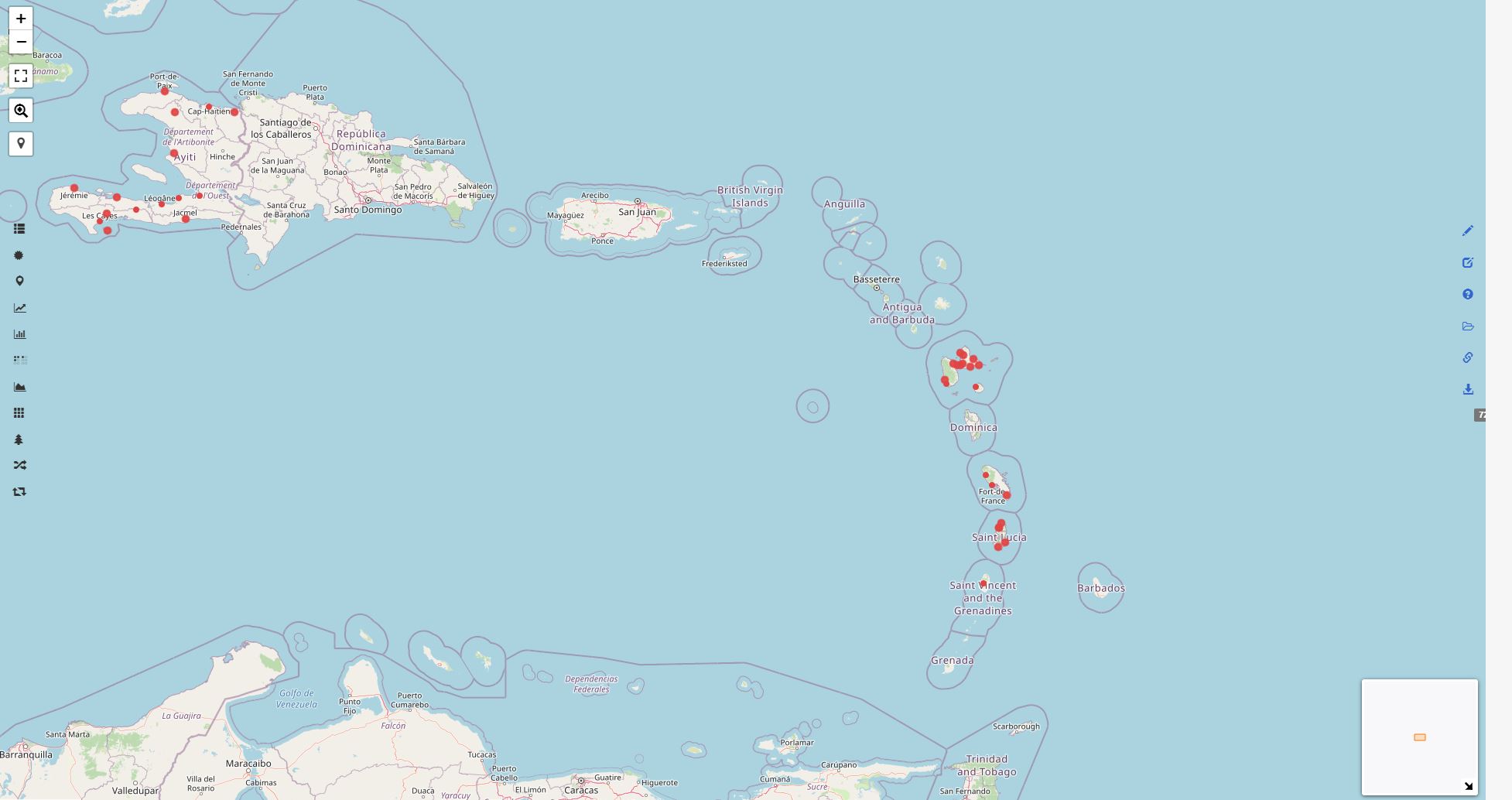
The curious question leading me here is: What did Freemasonry look like in the colonial possessions of France during the 18th century? What role did it play among those who settled in this periphery with the power of European networks and military support? To solve this question, one would have to obtain the records for every lodge, which thankfully are digitally accessible from the Bibliothèque nationale de France at a moderate expense. Fortunately, my work on the aforementioned project had already collected much of this data. The goal then became to first list every colonial French Masonic Lodge, its name, location, and year of founding from 1700-1799. These sources in conjunction the valuable work of Alain le Bihan, allowed for an excel matrix to be constructed and then reformatted and loaded into FactGrid. The results are intriguing.
With this information displayed on a map, immediately one is struck with some obvious takeaways. Nearly every city that had a lodge was a coastal city with a port. Saint Domingue, the jewel of the Antilles and a major contributor to French GDP in the 18th century, had a lodge in nearly every port during the century, and the larger cities had multiple lodges in the same town at the same time. This is also the case with Saint Lucia, Martinique, and Guadeloupe. Based on the occupations of the members of these lodges, French colonial Freemasonry appears to have been transmitted across the seas, the highways of the 18th century and was a nexus point for merchants, traders, landowners, the military, civil servants, and upwardly mobile people in society. One is struck by the sheer number of lodges on these tiny islands, suggesting that Freemasonry was an integral thread to colonial society. Indeed it appears that the appearance of Masonic lodges was a mark of civilization in these developing communities much in the same way that establishment and construction of churches and civic buildings indicates the same thing. Though this data is only in its infancy and will be greatly expanded and developed over time, it is already useful and allows one to appreciate the civilizing aspect Freemasonry played in the French colonies.
Looking at the data one can see that several of the early lodges go on to found daughter lodges, and that they themselves are founded initially by other lodges through representatives like Etienne Morin, and then later in the century by the Grand Orient de France itself. These nodes therefore are links in a chain of union and make it possible study the genealogy of Freemasonry, the spread of rites and traditions, and in the future with detailed member information, the migration of members across the globe. The second phase therefore will be to populate the Lodges with members from all the extant tableaus and lists. With this data it should be possible to graphically demonstrate the spread of Freemasonry over time, producing an animation. Given the density of lodges, and the shear breadth of its geographical spread, it will be necessary to focus on the Antilles on an island-by-island basis, and to initially exclude the remote locations in New Orleans, Newfoundland, India, and Africa as they are not within the scope of this primary region. This should yield some remarkably interesting and informative graphics. Niall Ferguson in his book, The Square and the Tower made the salient point that for too long historians have focused too much on hierarchies and not enough on networks. Indeed this approach is blind because it fails to capture the spread of ideas, organizations, and people. He proposes instead to study and focus on the networks of people, as their interconnected relationships provide context and explain the means of transmission. With any luck this endeavour will go on to inspire others to begin at once, work of a similar nature within their respective disciplines. Given the size and scope of this data set, it will be necessary that a wider community will add facets to this emerging world of data. It would be interesting to have experts of the present colonial studies on board and to bring economic history into this web of information.
In Wikiversity erstveröffentlichter Wikimedia-Wettbewerbsbeitrag
Projektbeschreibung
Das Wissen über die Welt und den menschlichen Umgang mit dieser, über praktische Fähigkeiten und theoretische Erkenntnisse, wurden über Jahrhunderte in Handschriften gesammelt und verfügbar gemacht. Die ältesten deutschen Wissens- und Gebrauchstexte stammen noch aus Althochdeutscher Zeit (8. – 11. Jahrhundert) und besonders in Frühneuhochdeutscher Zeit (ca. 1350¬1650), wächst die Anzahl der Texte und Themengebiete rapide. Immer neue Wissensbereiche wurden in deutscher Sprache erschlossen und ein Großteil der spätmittelalterlichen deutschen Handschriften enthält Wissens- und Gebrauchstexte. Dennoch stehen diese Texte nicht im Zentrum germanistischer Forschung und sind – auch aufgrund ihrer Diversität und Komplexität – wesentlich schlechter erschlossen als literarische Texte. In meiner Forschung versuche ich diese Wissenslücke zu schließen und bislang vernachlässigte Textsorten, wie etwa Losbücher, Kalender, Geomantien, Textamulette, Tintenrezepte oder Anleitungen zur Dämonenbeschwörung (auch hier, hier und hier) so zu erschließen, dass sie von Fachkollegen, aber auch einem größeren Publikum, aufgefunden, gelesen und verstanden werden können. Dies soll auch dazu dienen die Überlieferung dieser Texte und damit die geographische wir soziale Verbreitung historischer Wissensbestände nachvollziehbar zu machen. Ein großes Problem ist dabei die mangelnde Referenzierbarkeit der Texte, die aufgrund ihrer Form (bspw. Rezepte) oder ihre Unbekanntheit keine etablierten Titel haben, in den einschlägigen Fachlexika (Verfasserlexikon) nicht erfasst sind und auch innerhalb der Forschungsliteratur unterschiedlich bezeichnet werden. Im digitalen Umgang mit diesen Texten verstärkt sich dieses Problem, da handschriftlich überlieferte deutsche Texte überhaupt nur in Ausnahmefällen über Normdaten oder andere Linked-Open-Data-Formate erschlossen sind.
Im Rahmen des Fellow-Programm Freies Wissen soll ein Best-Practice-Szenario für die Erschließung historischer Wissens- und Gebrauchsliteratur als Open Data entwickelt werden. Dieses schließt an bisherige Arbeiten zu den Losbüchern und Chiromantien sowie der laufenden Katalogisierung der illustrierten mantischen Prognostiken für den Katalog der deutschsprachigen illustrierten Handschriften an und soll die deutschsprachigen mantischen Texte des Spätmittelalters einem breiteren Publikum erschließen und Forschungsdaten nachnutzbar machen. Dazu ist eine Kombination aus Open-Access-Forschungsbeiträgen, der Überarbeitung von Wikipedia-Artikeln, der Veröffentlichung von Handschriftenabbildungen (im Archive und in Wikimedia Commons) sowie der Generierung von offen zugänglichen Erschließungsdaten vorgesehen. Dabei sollen Erschließungsdaten zu deutschsprachigen Wissens- und Gebrauchstexten des 14. bis 16. Jahrhunderts erstmals in der FactGrid-Datenbank und damit auf einer Wikibase-Instanz erfasst werden. Über die FactGrid-Datenbank sollen nicht nur einzelne Texte dauerhaft und eindeutig identifizierbar gemacht, sondern auch verschiedene digitale (Handschriftendatenbanken, Bibliothekskataloge, Handschriftendigitalisate) und analoge (Forschungsliteratur) Angebote vernetzt werden, sodass Informationen zu einzelnen Texten zentral auffindbar sind. Gleichzeitig ermöglicht die Erfassung von Textereignissen einzelner Handschriften und Werken in FactGrid auch eine maschinelle Auswertung und Visualisierung dieser Daten.
Im Projektzeitraum der Fellow-Programm steht vor allem die Aufbereitung der bereits erschlossenen Daten zu den Losbüchern und Chiromantien für das FactGrid-Repository und die Entwicklung von Arbeitsroutinen zu Integration der Daten im Vordergrund. Über Vorträge, unter anderem im Netzwerk Historische Wissens und Gebrauchsliteratur soll das Projekt während dieser Zeit bekannt gemacht und mit einem Beitrag in der Open-Access-Zeitschrift „Mittelalter. Interdisziplinäre Forschung und Rezeptionsgeschichte“ vorläufig abgeschlossen werden.
Meilensteine
Entwicklung eines Modells der Datenstruktur für die Einträge in FactGrid
Entwicklung eines Routine zur Aufbereitung und Intergration der Daten
Intergration der Daten zu den Chiromantien [student. Hilfskraft]
Intergration der Daten der Dissertation (Das Losbuch. Manuskriptologie einer Textsorte des 14.-16. Jahrhundert. 2018) [student. Hilfskraft]
Zeitschriftenbeitrag zur Überlieferung der deutschsprachigen Chiromantien bis ca. 1520
Überarbeitung des Wikipedia-Artikels ‘Chiromantie’
Zeitschrftenbeitrag über Projekt
Zwischenbericht Oktober/November 2020
Die Monate Oktober und November dienten vor allem zur organisatorischen Vorbereitung der Forschungsarbeit:
1. Personal:
Zunächst war unklar, ob und auf welche Wiese eine studentische Hilfskraft eingestellt werden kann. Dies ist nun über den Lehrstuhl für Ältere Deutsche Literatur der RWTH Aachen möglich. Der Abschluss eines Arbeitsvertrags ist aber erst dann sinnvoll, wenn die gesamt Summe des Stipendiums ausgezahlt wurde. Ansonsten wäre die Laufzeit zu kurz.
2. Forschungscommunity:
Aus einer seit 2019 bestehenden losen Forschergruppe heraus, haben wir am 4.10.2020 den Verein Netzwerk Historische Wissens- und Gebrauchsliteratur] (HWGL) gegründet und ich habe dessen Vorsitz übernommen. Der Verein organisiert regelmäßig Netzwerktreffen, in denen auch die kollaborative Datenspeicherung abgesprochen wird. Es besteht bereits ein von mir betriebenes Wiki. Ob sich FactGrid als Erweiterung desselben eignet, soll in diesem Projekt erkundet werden.
3. Datenmodell/Workshop:
Das Datenmodell soll gleichzeitig praktikabel und theoretisch fundiert sein. Es muss daher mit der Forschungscomunity abgestimmt werden. Einen ersten Entwurf werde ich am 10.12.2020 auf dem 1. HWGL-Abendkolloquium vorstellen. Auf einem Workshop im Rahmen des (virtuelles) Netzwerktreffen Historische Wissens- und Gebrauchsliteratur (08.-11.01.2021) soll der praktische Umgang mit diesem erprobt werden. Ich bin auch an der Organisation beider Veranstaltungen beteiligt. Bei der Gestaltung des Datenmodells sind auch rechtliche Aspekte wichtig. Ursprünglich war ein Import der gesamten Datenbestände des Handschriftencensus angedacht. Dies ist aus rechtlichen Gründen (Unterschiede in der Lizensierung), jedoch nicht möglich. Ein Import von Daten scheint mir nur dann rechtlich zulässig, wenn das Datenmodell der FactGrid Datenbank sich wesentlich von dem des Handschriftencensus unterscheidet.
4. Thematisch relevante Publikationen:
Zu den Artikel ‘Sortes’ und ‘German Texts on Superstition’ des Handbuchs Prognostication in the Medieval World mussten noch die Fahnen korrigiert werden. Das Handbuch ist am 09.11.2020 erschienen.
Das Manuskript eines Beitrags zur Analyse von handschriftlich Überliefertem mittels Graph-Datenbanken, habe ich im September abgeschlossen. Dieser Beitrag hat Einfluss auf das Datenmodell in FactGrid, denn die dort entwickelten Analyseprozesse sollen auch mit den späteren FactGrid-Daten möglich sein. Der Artikel wird in der Zeitschrift für digitale Geisteswissenschaften erscheinen und wird derzeit redaktionell eingearbeitet.
Gemeinsam mit Björn Reich und Matthias Standke gebe ich einen Sammelband mit Editionen früher gedruckter Losbücher heraus. Die eingereichten Texte werden von uns redigiert. Die Erschließungsdaten der Losbücher, die ich hauptsächlich bereits in meiner Dissertation erfasst habe, werden einer der ersten Datenbestände sein, die in FactGrid importiert werden.
Meine Mentorin Anita Runge hat mich durch ihre Perspektive auf meine Forschung davon Überzeugt, dass deren Gegenstände und Ergebnisse auch für ein breiteres Publikum interessant sind. Ich versuche mich daher stärker im Bereich Wissenschaftskommunikation zu engagieren.
Bereits seit Anfang des Jahres läuft die Zusammenarbeit mit dem Germanischen Nationalmuseum in Nürnberg zur Ausstellung Zeichen der Zukunft. Wahrsagen in Ostasien und Europa, die eigentlich Anfang Dezember 2020 eröffnet werden sollte. Für den Katalog zur Ausstellung habe ich drei Artikel verfasst.
Im Januar werde ich für eine Folge des Podcasts Anno PunktPunktPunkt zum Thema Zukunftsprognostik im 15. Jahrhundert zwischen Aberglaube, Wissenschaft und Spiel. Zur Beziehung zwischen Diskurswandel und Medienwandel interviewt. Die Folge soll im Februar 2021 erscheinen.
An der Universität Salzburg werde ich am 13.1.2021 einen Gastvortrag zum Thema Kristallsehen. Praktiken und Erklärungsmodelle von der Antike bis heute halten.
Bild:
Konrad Bollstatter: ‘Complexiones-Würfelbuch’ Augsburg 1455
Schreiber: Konrad Bollstatter, Illustrationen: Werkstatt Johannes Bämler
München, Bayerische Staatsbibliothek, Cgm 312, fol. 51v-52r
(Bild: Bayerische Staatsbibliothek, Montage: Marco Heiles, Lizenz: CC BY-NC-SA 4.0)
Die folgende Materialpräsentation ist das Ergebnis eines zweimonatigen Praktikums im Forschungszentrum Gotha. Mein Projekt war es, der Forschung Vorarbeiten zu einem unvollendet gebliebenen Buchprojekt Hermann Schüttlers datenbankgestützt auf den FactGrid-Seiten zugänglich zu machen. Es handelte sich hierbei um Transkriptionen von 71 Dokumenten aus dem inneren Machtzirkel des Illuminatenordens der Jahre 1781 bis 1785. Im Gegensatz zu den von Hermann Schüttler und Reinhard Markner zuvor bereits vorgelegten Bänden der Illuminatenkorrespondenz steht hier das interne Berichtswesen des Ordens im Zentrum. Das Corpus birgt:
12 für den Orden verfasste (Auto-)biographien,
26 Inspektionsberichte,
29 Sitzungsprotokolle der bisher wenig bekannten “zweiten” Minervalkirche Frankfurts; zu ihnen kommen drei Protokolle der Gothaer Minervalkirche und eines aus Weimar.
Es galt dabei erstens, die unterschiedlich umfangreich verfußnoteten Transkripte im Gesamtumfang von bislang 237 Seiten von ihren Word-Dateien in Wiki-Seiten des FactGrid zu überführen, sie dabei mit kurzen Einleitungen zu versehen und die Fußnotung an die Datenbank anzukoppeln oder in einem Großteil der Dokumente erst durch eigene Recherche zu erstellen – bei den Inspektionsberichten kamen im Extremfall über 200 Fußnoten im Einzeldokument in den Blick. Zu allen Dokumenten waren im zweiten Schritt Datenbankobjekte anzulegen, die die Transkripte grundlegend erschließen und Datenbankrecherchen zugänglich machen. Zentral war hier die Erfassung von Autor, Entstehungsort und -datum; erwähnten Personen, Orten und Themen. Zu den Protokollen von Sitzungen wurden zudem Ereignis-Datenbankobjekte angelegt, an die sich nun eigene Fragen, etwa zu Nachweisen persönlicher Begegnungen von Sitzungsteilnehmenden, stellen lassen.
Wissensakkumulation in der Phase des rasant wachsenden Geheimordens
In die erste Phase des Illuminatenordens – die Phase des primär bayerischen Ordens unter der unmittelbaren Führung Adam Weishaupts – gaben 1787 die Aktenveröffentlichungen des Bayerischen Staates Einblick, die den Orden noch im Sommer 1787 im Raum der deutschen und österreichischen Territorien kollabieren ließen. Über die Spätphase des Ordens, in der unter Johann Joachim Christoph Bode Thüringen zum neuen Zentrum wurde, sind wir auf der anderen Seite aus den Dokumenten der Schwedenkiste informiert.
Die Dokumente, die Hermann Schüttler vorliegend transkribierte, stammen vor allem aus dem Nachlass Adam Weishaupts und dem Sonderarchiv Moskau. Einige Dokumente der Schwedenkiste kamen hinzu. Zusammen geben sie einen Einblick in die turbulente Zwischenphase, in der Adolph Freiherr von Knigge für das große Wachstum des Ordens sorgte. Berichterstatter sind dabei unter anderem Johann Martin Graf zu Stolberg-Roßla, Franz Dietrich Freiherr von Ditfurth und am häufigsten Knigge selbst. Gemeinsam präsentieren sie ein multiperspektivisches Bild der mit dem Wachstum kommenden Anforderung, Überblick zu wahren. Noch in diesen Versuchen wird klarer, dass es keine gemeinsame Ordenspolitik mehr gibt und kaum noch eine Chance, intern abzustimmen, wer in diesen Orden aufgenommen wird und Karriere macht. Zerreißproben tun sich mit Einzelfällen auf, über die es zum Streit kommen würde, wenn alle Informationen im Orden öffentlich würden; der Konflikt des Ordens mit Knigge erweist sich dabei als mehr denn ein Konflikt zwischen diesem und Weishaupt, dem Ordensinitiator.
Exemplarische Selbstauskünfte
Alle neuen Mitglieder mussten eine Verschwiegenheitserklärung unterzeichnen: das Revers. Sie beantworteten Fragen zu ihren Erwartungen an die unbekannte Organisation, die sich ihnen damit inmitten der Freimaurerei auftat und waren aufgefordert, autobiographische Selbstauskünfte einzureichen. Zwölf dieser Selbstauskünfte umfasst die Textauswahl. Es handelt sich hierbei überwiegend um kurze Lebensläufe und um einem Frageraster folgende Reflexionen über verschiedene Aspekte der eigenen Person vom physischen Zustand bis zum politischen und moralischen Charakter. Hinzu kamen standardisierte Fragen, beispielsweise für die Aufnahme ins Schottische Noviziat, die in Stichworten beantwortet wurden. Häufig wählten die Verfasser jedoch eine freiere Form und schilderten in Fließtexten mit unterschiedlichen inhaltlichen Schwerpunkten ihre wichtigsten Lebensstationen und zwischenmenschlichen Beziehungen.
In einem offenkundigen Zusammenhang zu den übrigen Dokumenten dieser Materialsammlung stehen die (auto-)biographischen Einlassungen Q175807 und Q175808 zu Christian Gottlob Neefe. Neefe war im hier dokumentierten Zeitraum als Gast der “zweiten” Minervalkirche Edessas/Frankfurts aktiv. Bei den Teilnehmenden aus den drei Sitzungsprotokollen in Gotha gibt es weitere Überschneidungen mit fünf der autobiographischen Texte. Zwei Autobiographien stammen von Mitgliedern aus Neuwied, die dortige Minervalkirche taucht häufig als einflussreiches Zentrum in den Inspektionsberichten auf. Bodes autobiographische Selbstauskunft rundet die Auswahl ab – der zukünftig zentrale Akteur des Ordens ist hier mit im Geflecht der Selbstaussagen vertreten.
Besonders gewinnbringend war die Bearbeitung der autobiographischen Texte im Hinblick auf die Details, die sich aus ihnen für die bestehenden Datensätze ziehen ließen. So konnten bei jeder der Personen Aussagen zu Aufenthalten, Berufen und ähnlichem ergänzt werden. Noch spannender waren ihre Informationen für die Verdichtung von Netzwerken. Durch die Erwähnung von Verwandten, Freunden, Arbeitgebern und anderen Personen, die die eigene Entwicklung prägend tangierten, konnten viele neue Personen angelegt und in Relation zu bereits bestehenden Items gesetzt werden.
Inspektionsberichte: Wie der Orden versuchte, Überblick in der Informationsflut zu gewinnen
Extensive Quellen sind im Set die fünf Inspektionsberichte Stolberg-Roßlas. In ihnen fließen Informationen aus den Minervalkirchen geordnet nach den Provinzen, ihren Präfekturen und deren Minervalkirchen zusammen in einer Berichterstattung, die bis zu den einzelnen Mitgliedern an den verschiedenen Orten hinab reicht.
Dabei steht als größtes strategisches Problem im Raum, dass im Moment mehr Orte auf der illuminatischen Landkarte der geheimen Ordensgeographie als an diesen Orten bereits arbeitende Minervalkirchen zu finden sind.
Der Aufbau der Minervalkirchen verlief über Mitglieder einzelner Logen, die unmittelbar zu hochrangigen Illuminaten “ihrer” Orte wurden. Von ihnen wurde erwartet, dass sie aus ihren Logen die Mitglieder für die lokalen Minervalkirchen gewinnen. Unter den Mitgliedern machten Studenten eine große Gruppe aus. Zu den flächendeckenden Rekrutierungen kamen die individuellen Vorschläge, die alle Ordensmitglieder machen konnten und über die auf höherer Ordensebene konsistent entschieden werden sollte. Aus den Dokumenten sprechen Konflikte zwischen Beteiligten, die von der Aufnahme anderer erfuhren, mit denen sie keineswegs im selben Orden sein wollten. Gleichzeitig wird sichtbar, dass die Verantwortlichen hier längst in einem Spannungsfeld persönlicher Befindlichkeiten und Verbindlichkeiten agierten, in dem sie im Ernstfall nur noch darauf hoffen konnten, dass Konflikte im Raum des Geheimordens nicht vor der inneren Öffentlichkeit sichtbar werden. Knigge berichtet am 26. September 1782 in diesem Gewirr von Aufnahmen, für die er grünes Licht gab, obwohl er ihr Konfliktpotential absehen konnte:
Mein Plan war, den Epictet nach und nach zu stimmen, und jedem in der Provinz eine Laufbahn zu eröffnen, welche sich nicht kreutzen könnte. Den Hrn. W[und] zu gewinnen, war um so nöthiger, da die neue Freymäurerey die Direction der VIII. Provinz nach Heidelberg verlegt, und ihm die Direction gegeben hat. Ich verlangte als erste Probe der Treue, daß er unsre Leute in der Pfalz mit zu der Sache ziehen sollte … [Tanskript]
Deutlich zeigt sich an dieser Stelle ein nicht mehr zu lösender Widerspruch zwischen der Zentralisierung des Informationsflusses und der Freiheit, mit der die mittlere Führungsebene agieren musste und auch agierte.
Das Berichtswesen, das mit den Dokumenten sichtbar wird, erweist sich als ausgefeilt und modern:
Aus den Minervalkirchen trafen zu allen Personen monatliche Zeugnisse ein. Im Orden wurde, um hier den Überblick zu behalten, ein standardisierter Strichcode eingeführt, mit Hilfe dessen man auf einen Blick zu erfassen hoffte, wo sich besonders interessante Personen sammelten. Aus den Inspektionsberichten schimmert jedoch durch, dass man hier eher erfasste, wo Verantwortliche auf der mittleren Ebene ihre eigene Arbeit in ein besonders gutes Licht zu stellen suchten.
Anleitung für das Verfassen von Illuminatischen Provinz und Inspektionsberichten, SK15-406
Die Transkripte der Inspektionsberichte geben diese Strichcodes für Hunderte von Personen wieder. Greifbar wird im selben Moment der erhebliche Arbeitsaufwand, den dieses Berichtswesen auch in dieser Kondensierung noch bereitete. Die höhere Hierarchieebene musste Protokolle zusammenführen und Korrespondenzen in alle entstehenden und agierenden Filialen unterhalten. Knigge konnte man hier die Überlastung im Wachstum des Ordens anmerken:
Noch einmal wiederhole ich, was ich nicht genug wiederholen kann: wenn wir|
a.) Das ganze System ausgearbeitet haben,
b.) Wenn jede Provinz ihren Provinzial hat,
c.) Wenn über 3 Provinzen ein Inspector gesetzt ist,
d.) Wenn wir in Rom unsere National-Direction haben:
e.) Wenn mit diesen allen die Areopagiten nichts zu thun haben, sondern im Verborgenen das Ruder führen, folglich nicht entdeckt werden können, nicht so sehr mit verdrüßlichen Details überhäuft sind, sondern das System überschauen, verfeinern, in andere Lander ausbreiten, zur rechten Zeit der dirigirenden Classe beystehen können: – Dann, und nicht eher richten wir etwas aus. Wir bedärfen also dann keiner so lärmenden Anstalten, müßen jeden Provincial in seine Gränzen zurückweisen. – Fahren wir aber fort so in die Kreuz und Quere zu operiren, so sind wir in 3 Jahren gesprengt. Nun zu meinen Berichte… [Transkript]
Die Protokolle der “zweiten” Frankfurter Minervalkirche und der Konflikt mit Knigge
Die vorgelegten Protokolle aus Frankfurt ermöglichen es, den Konstituierungsprozess einer Minervalkirche exemplarisch nachzuvollziehen und geben einen vertiefteren Einblick in die Geschichte der zwei Minervalkirchen Frankfurts, zwei nacheinander aktiven, verschiedenen Gruppen mit größtenteils denselben Mitgliedern. Die Protokolle der “zweiten” Frankfurter Minervalkirche zeichnen sich dabei in der Anfangsphase durch die Regelmäßigkeit und Ausführlichkeit sowie formelle Konsistenz aus. Wie später in Gotha traf man sich monatlich in der Minervalkirche und, die höheren Mitglieder, im exklusiven Magistrat. Die Treffen lassen sich mit der Datenbank auf einen Zeitstrahl projizieren und dabei bis auf die Wochentage heranzoomen. Die Frankfurter Teilnehmendenlisten zeugen von Kontinuität und erlauben Rückschlüsse auf die Mitgliederstruktur in diesem Zeitraum. Eingehend erfasst sind in den ersten Monaten jeweils Programmpunkte wie die Planung von gemeinsamen Lesungen und inhaltlichen Diskussionen über Grundsätze der Leitlinien des Ordens, die förmliche Initiation der neuen Magistraten auf einer eigens dafür organisierten, ordentlichen Versammlung und die pünktliche Abgabe schriftlicher Ausfertigungen sowie der Austausch der Quibus Licet und Reprochen, die sich sehr ausführlich dokumentiert in den Transkripten zur weiteren Vertiefung nachlesen lassen.
In den Protokollen werden nicht minder interne Konflikte greifbar, wie sie die Aktivität des Ordens immer wieder nachhaltig prägten. Interessant ist dabei der sich noch vor dem Zerwürfnis zwischen Weishaupt und Knigge aufzeigende Konflikt vor Ort: Am 15. Juni 1783 sollte Johann Ludwig Hetzler nach einer Anweisung der Oberen ein Treffen der vormals aktiven Mitglieder der Minervalkirche Edessa initiieren, um diese nach einem großen internen Streit, der schließlich zur Inaktivität der Gruppe führte, wiederzubeleben. Knigges Wirken stand, so lässt sich in Umrissen ersehen, im Zentrum dieses Konflikts. Nach den Aussagen der anwesenden Mitglieder hatte er versucht, heimlich alle Ordensgeschäfte vor Ort unter seine Kontrolle zu bringen und darüber hinaus eine gänzlich neue Minervalkirche unter Ausschluss der bisher Aktiven zu errichten. Die Konstituierung der neuen Minervalkirche wurde daher auch nur unter der Versicherung der Oberen vollzogen, dass Knigge nichts mehr mit der Präfektur zu tun haben werde (Vgl. J.P.C. Müllers Bericht vom 15.6.1783).
Ihr Gegengewicht finden diese Dokumente in der vorliegenden Textauswahl mit den vier von Frankfurt aus verfassten Inspektionsberichten Knigges aus den Jahren 1781 und 1782. Im Juli 1781 berichtet er bereits, dass die meisten Mitglieder der örtlichen Minervalkirche, die beinahe ausnahmslos deckungsgleich mit den Aktiven und der Führungsebene 1783 sind, unbrauchbar für den Orden seien. Einzig lobend hebt er Simon Friedrich Küstner und Johann Friedrich Piehl hervor (Vgl. Knigge, Inspektionsbericht vom 11.7.1781). Während Ersterer später in der “zweiten” Frankfurter Minervalkirche im Amt des Sekretärs aktiv im Magistrat der Gruppe mitwirkt, erklärte Letzterer noch zu Beginn der neu konstituierten Kirche, dass er, ehemaliger Censor und Teil der bisherigen lokalen Führungsriege, künftig nichts mehr mit dem Orden zu tun haben wolle (Vgl. J.P.C. Müllers Bericht vom 23.6.1783).
Im September 1781 schien sich die Lage noch deutlicher zugespitzt zu haben, denn nun verkündete Knigge, dass er wegen einer generellen Nachlässigkeit aller Mitglieder der Minervalkirche diese verlassen habe und keine Quibus Licet mehr von ihnen annehmen werde, bis eine deutliche Besserung eingetreten wäre. Darüber hinaus hoffe er mit der Hilfe Leonhardis und Küstners, bald eine neue Gruppe ohne die anderen bisherigen Mitglieder aufbauen zu können (Vgl. Knigges Inspektionsbericht vom 10.9.1781). Beide sollten zwei Jahre später höhere Ämter in der “zweiten” Minervalkirche innehaben.
In den Berichten Knigges vom Oktober 1781 und August 1782 findet sich kein Wort mehr zu der Minervalkirche in Frankfurt, obwohl er in beiden Fällen noch vor Ort lebte und im Orden für die Provinz zuständig war. Ab Februar 1783 kamen seine Inspektionsberichte aus Heidelberg. An diesen Weggang knüpfen jedoch drei Inspektionsberichte Stolberg-Roßlas ab März 1783 an. Dieser erwähnt explizit in dem ersten Inspektionsbericht vom 5. März 1783 über den vorherigen Monat, dass sich Knigge künftig nicht mehr mit Edessa abgebe (Vgl. Stolberg-Roßlas Inspektionsbericht vom 5.3.1783.
Stolberg-Roßlas Berichte geben weiteren Aufschluss über die Entwicklung vor Ort. Auch er kritisiert die lokale Niederlassung und die aktiven Mitglieder stark und spricht ihnen direkt oder indirekt durch die Einschätzungen Dritter den Wert für den Orden ab. Besonders deutlich wird dies durch Zeilen wie:
Das alte Elend! Alles ist confus. […] Alle Bbr. sind gegen einander, fast alle kalt, aufgebracht. Mittelmäßige Leute stehen oben, und andre, die ich aus Briefen als kluge und wohldenkende Männer habe kennen lernen, stehen unten und werden versäumt. Kurz der Geist der Verwirrung herrscht da im höchsten Grade. [Stolberg-Roßla, Inspektionsbericht vom 5.3.1783]
Konkreter werden die Konfliktlinien und die Probleme vor Ort indes nicht benannt, es findet sich nur eine Andeutung Hetzlers, dass in der Gruppe zu viele Reformierte seien, die herrschen wollten und ein vager Verweis auf Schwierigkeiten mit München. Im selben Bericht schreibt Stolberg-Roßla, dass alles so schön angelegt sei, den Orden auf ewig aus dieser Stadt zu verbannen und ergänzt im folgenden Bericht, Ditfurth und er kämen darüber hinaus zu dem Schluss, dass keinem Edesser, insbesondere nicht Hetzler, der Priester- und Regenten-Grad gegeben werden solle. Dem steht entgegen, dass Knigge nach Stolberg-Roßlas Kenntnisstand schon längst für diese um Erlaubnis gebeten hatte (Vgl. Stolberg-Roßlas Inspektionsbericht vom 27.03.1783). Im April 1783 berichtet Stolberg-Roßla weiter, dass Johann Leopold Bleibtreu, wie schon im März angekündigt, nun vor Ort sei und sein Möglichstes versuche, Ordnung zu schaffen (Vgl. Stolberg-Roßla, Inspektionsbericht vom 18.4.1783).
Berichte zum Konvent von Wilhelmsbad
Eine Gelenkfunktion gewinnen im hier vorgelegten Materialcorpus die Berichte rund um den Konvent von Wilhelmsbad bei Hanau im Sommer 1782. Für die kontinentaleuropäische Hochgradfreimaurerei wurde der mehrwöchige Kongress zur inneren Zerreißprobe, die die Strikte Observanz – gestützt auf nicht länger haltbaren Behauptungen von Wurzeln im Templerorden der Kreuzzugszeit, war sie das große Hochgradsystem der letzten beiden Jahrzehnte gewesen – nicht überleben sollte. Um das Geschichtsangebot, welches die Ursache des Streits war, ging es dabei nur zum Teil. Die Darlegungen drehen sich um Betrüger in der Freimaurerei, um Schwärmerei und damit um bislang in den Konfessionen ausgetragene Konflikte. All dies überlagert von persönlichen Befindlichkeiten zwischen hochrangigen Teilnehmern, die sich gegenseitig nicht angemessen respektiert sahen und mitten im Zusammenbruch der Strikten Observanz um den Zuschnitt zukünftiger Provinzen rangen.
Im ausgewählten Materialkomplex stehen hier Knigges Beobachtungen unmittelbar neben denen Franz Dietrich Freiherr von Ditfurths. Beide waren hochrangige Illuminaten, die mit ihren Berichten direkt an Weishaupt rapportierten – und die, wie aus den Dokumenten sichtbar wird, einander mit deutlicher Skepsis beobachteten. Knigge sollte am Rand des Konvents bahnbrechend J.J.C. Bode für den Orden gewinnen, der im Auftrag Ernst II. von Gotha am Konvent teilnahm, und Bode sollte wiederum im Verlauf Ferdinand von Braunschweig und Carl von Hessen-Kassel, die führenden Repräsentanten der Strikten Observanz auf dem Konvent, in den Illuminatenorden bringen und damit den Orden in eine innere Zerreißprobe führen.
In Ditfurths Bericht tauchen all diese Beteiligten auf – nun kritisch von Ditfurth beobachtet, dessen Wirken Knigge kritisch kommentiert. Ditfurths Bericht wird sich so schnell nicht zusammenfassen lassen. Auf 34 Seiten Manuskript wurde hier, ohne sichtbare Gliederung, eine Aneinanderreihung von Augenblickswahrnehmungen und Gesprächsfetzen, die den Autor aufrüttelten, sowie Charakterisierungen der Teilnehmer Weishaupt vorgelegt. Bode erscheint in diesem Gewirr als pragmatischer Politiker, der den ganzen Kongress rettet, als er allen nahelegt, hier erst einmal frei zu sprechen und später für sich zu entscheiden, welchem maurerischen System sie in Zukunft anhängen wollen. Mit Ferdinand von Braunschweig und Carl von Hessen-Kassel gerät Ditfurth in den unter höflichen Repliken verborgenen offenen Konflikt. Knigge als über Dritte informierter Beobachter nimmt Ditfurth inmitten dieser Konflikte als jemanden wahr, der sich öffentlich unmöglich macht.
Für den Illuminatenorden wurde der Konvent ein heimlicher Wendepunkt. In Knigges Bericht für den Januar 1783 wird das spektakulär deutlich. Während Ditfurth sich, so Knigges (mit Vorsicht zu lesende) Darstellung, mit seinem konfrontativen Auftreten erst einmal unmöglich machte, soll doch seltsam verbreitet bekannt gewesen sein, dass es den Orden gab, so bekannt, dass er, Knigge, am Rande von allen möglichen Seiten aus kontaktiert und mit Aufnahmeanträgen überhäuft worden sei:
Mit den Cheffs des Zinnendorfischen Systems nahm ich Gelegenheit, einen Briefwechsel anzufangen, den ich auch noch jetzt fortsetze. Die Emissarien anderer Gesellschaften forschte ich theils durch andere Wege aus, theils hatten sie selbst das Zutrauen zu mir, sich mir zu entdecken, weil sie von mir wußten, daß ich mich nicht aus Eigennutz, sondern aus Eifer für die gute Sache dabey interessiere. Die Deputierten im Wilhelmsbad aber kamen fast alle zu mir, und da sie | (ich weiß nicht woher) Nachricht von der Existenz unsrer Verbindung hatten; so bathen sie mich alle, auch der [Prinz Carl] von H[essen], um die Aufnahme. Nun hielte ich es am beßten gethan, daß ich die Mehrsten einen Revers unterschreiben ließ, ihnen also Stillschweigen auferlegte, aber keinem einzigen von ihnen, während der Convent-Zeit das geringste schriftlich mittheilte. Dieß that ich, und redete nur im allgemeinen mit ihnen. [Transkript]
Wollte Weishaupt seine Organisation eher aus reinem machtpolitischen Kalkül mit der Aura großer Geheimnisse ausgestattet haben, um das gegnerische Lager zu infiltrieren, so wird aus diesem Kalkül unter der Hand ein kaum kontrollierbares Anliegen – der Orden verändert sich mit der rasanten Aufnahmepraxis und droht unregierbar zu werden, nun nachdem er Regenten aufnimmt und ein ganzes, soeben scheiterndes, von “Schwärmerei” durchdrungenes System als Führungsebene importiert.
Die Sitzungsprotokolle aus Gotha und Weimar
Die Sitzungsprotokolle aus Gotha und Weimar tun Schritt in die letzte Phase des Ordens. Knigge hatte Bode für den Orden am Rand des Konvents von Wilhelmsbad gewonnen. Im Herbst 1782 hatte dieser Ernst II. dazu bewegt, sich auf das Experiment Illuminatenorden einzulassen. Gothas Minervalversammlung sollte der Testfall und Zentrum der Ordensarbeit in der neuen Provinz Ionien werden, die Bode binnen zweier Jahre aufbaute, und die nach seinen Planungen von Weimar regiert bis nach Berlin im Norden und Dresden im Osten reichen sollte. Während das Experiment in Gotha und im Verlauf in Erfurt, Rudolstadt und Jena glückte, sollte es in Weimar scheitern, trotz oder vielleicht gerade wegen der berühmten Teilnehmer, die hier mit Goethe und Herder die hohen Ränge der Weimarer Minervalkirche hätten bekleiden sollen. Diese Entwicklungen zeichnen sich in den ausgewählten Protokollen noch nicht ab. Sie geben Einblick in die konkreten ersten Schritte mit denen in Gotha und Weimar Minervalkirchen geplant wurden. Man agierte jeweils aus dem Magistrat von oben herab. Die Gothaer Magistratsberichte werfen dabei ein Licht auf die Infiltration, die der Orden meisterte. Es geht hier en passant um Konflikte zwischen der Gothaer und der Loge Altenburger Freimaurer-Loge. Die Freimaurerei gewinnt eine geheime Dachebene über die der Orden Einblicke erhielt. Das Protokoll vom Dezember 1784 gibt einen Einblick in die Themen der auf den Minervalsitzungen gehaltenen Vorträge und eine kurze Schilderung der Neuaufnahmen. Das Protokoll aus Weimar berichtet von der Sitzung am 17. März 1785, auf der die Verfolgungen Weishaupts, die Gründung einer Filiale in Jena, die studentische Freimaurer aufnehmen solle, und die Konstituierung der eigenen Minervalkirche in Weimar Thema waren. Die hier gegebene Auswahl ist dabei mittlerweile eingeholt von der Erschließung, mit der Markus Meumann, Olaf Simons und Christian Wirkner sämtliche Sitzungsprotokolle des 15. Band der Schwedenkiste auswerteten, um hier die behandelten Aufsätze genauer zu lokalisieren.
Einige Bemerkungen zur technischen Realisation und zu Problemstellen der Datenbanksoftware, die hier zur Nutzung kommt
Die Aktenlage des Illuminatenordens war für mich zu Beginn des Praktikums so neu wie die hier zum Einsatz kommende Technik. Desiderate der Plattform, die nun Zugriff auf die eingebrachten Transkripte und die mit ihnen korrespondierenden Datenbankobjekte erlaubt, sind bereits im Blog, in dem dieser Beitrag erscheint, notiert:
Desiderat 1: Eine Präsentationssoftware, die Transkripte und Objektdaten sichtbar macht
Wikibase verbindet ein konventionelles Media-Wiki, wie es die Wikipedien zum Einsatz bringen, mit einer Wikibase Datenbank. Das FactGrid nutzt beide Bereiche integrativ, das heißt, ich legte für die Transkripte MediaWiki Seiten mit dem aus den Wikipedien bekannten Text Markup an und koppelte diese an Datenbankobjekte, im Konkreten zu den Dokumenten und den nachweisbaren Ereignissen.
Die Koppelung erlaubt es zwar, in der Volltextsuche auf beides, also die Datenbankobjekte zu den Dokumenten und Transkriptseiten, zuzugreifen, aber beide sind lediglich mit wechselseitigen Links aneinander gebunden. Befindet man sich auf einer Textseite, muss man über den Metadaten-Link im Seitenbeginn in den Datensatz hinüberschalten, erst dort stehen die Angaben zu Datum, Autor, Quelle und allen weiteren Informationen.
Was der Software an dieser Stelle fehlt ist eine Präsentationssoftware, die die Informationen aus den Datenbankobjekten geordnet lesbar macht und die dabei in der Lage ist, die Transkripte sichtbar zu machen und auf Wunsch des Lesers zur Gänze einzuspielen.
Desiderat 2: Eine Vorbefüllung der Datenbank, die großflächig Personen zur Verfügung stellt, auf die nun nur noch verlinkt werden muss
Das wohl zeitintensivste Arbeitshemmnis des FactGrid im gegenwärtigen Zustand ist die immer noch zu geringe Anzahl der bereits vorhandenen Datenbankobjekte. Die Dichte bereits vorhandener Personen ist zwar im Projektfeld Illuminatenorden ausgesprochen hoch, doch fehlen im selben Moment kontinuierlich Personen, die hier nur am Rand auftauchen, eigentlich jedoch Schlüsselfiguren der deutschen Geschichte des 18. Jahrhunderts sind. Die Recherche dieser Personen in der GND und Wikidata war in der Regel kein Problem, die Personen mit den hier auffindbaren Daten im FactGrid als aussagekräftige Objekte anzulegen blieb jedoch mühselig und fehleranfällig. Das Problem scheint seit den ersten Editiervorgängen allen in der Datenbank vertraut – das Projekt, die gesamte GND zu importieren, trägt ihm Rechnung, doch bleibt die nützliche breite Datenlage im Moment ein Desiderat.
Desiderat 3: Eine Benutzeroberfläche, die zu guten Datenstrukturen Rat gibt
Wikibase ist konsequent Triple-basiert, theoretisch lassen sich ganz beliebige Aussagen zu ganz beliebigen Objekten formulieren. Tatsächlich lassen sich damit identische Sachverhalte jedoch nicht minder auch ganz unterschiedlich ausdrücken – etwa in sehr definierten Tripeln oder in allgemeineren Tripeln, bei denen man mit Qualifikatoren Kontexte näher bestimmt. Verschiedene Formulierungen von parallelen Aussagen finden sich in der Folge. Zu ihrer Vielzahl kam es offenbar vor allem, weil die Quellenlage mal die eine und mal die andere Variante einer Formulierung nahelegte und von hier aus dann als Muster auf weitere Bearbeiter wirkte.
Dadurch, dass es keine einheitlichen Standards bei der Erstellung von Statements gibt, kam es häufiger zu uneindeutigen oder inhaltlich identischen Aussagen oder Redundanzen, deren Erfassung eine gewisse Zeit im Arbeitsprozess beansprucht. Auch gibt es keine klaren Vorgaben, welche Informationen aus Texten in welcher Form in Triples verwandelt und an anderer Stelle rezipiert werden sollen. Diese freie Gestaltungsmöglichkeit kann gleichzeitig als Vor- und Nachteil betrachtet werden, da die Software der eigenen Arbeit und Weiterentwicklung schon bestehender Arbeit in ihrer sehr offenen Komplexität kaum Grenzen setzt, jedoch im Vergleich zu sehr standardisierter Arbeit deutlich voraussetzungsreicher ist und laufende Seitenblicke auf bestehende Objekte einfordert, um einen passenden Umgang zu finden. Man lernt hier eher eine Sprache möglicher Aussagen, die jederzeit erweitert und präzisiert werden kann, als dass Eingabeschablonen abgearbeitet werden. Das Desiderat könnte an dieser Stelle ein Sowohl-als-auch sein, eine Plattform, die für erste Objekterschließungen Eingabeschablonen gibt, die grundlegend konsistente Datenobjekte in den Basisdaten herstellen, während man bei weiterer Erforschung jederzeit dazu übergehen könnte, Aussagen nach eigenem Interesse und Nutzen bei der Materialdurchdringung frei zu formulieren.
Alle Dokumente, Transkripte und Ereignis-Datensätze dieses Projektes chronologisch sortiert