FAQ FactGrid – Pourquoi devrais-je utiliser FactGrid pour mon projet de recherche ?

Jack Kirby, "The Fourth Dimension is a many splattered thing!" from Alarming Tales, 1 (September 1957).

auf Deutsch
in English
magyar nyelven

Qu’est-ce que FactGrid ?

FactGrid est une installation Wikibase – c’est-à-dire à la fois un wiki ordinaire et une base de données que vous pouvez utiliser pour faire des déclarations sur les objets qui vous intéressent – déclarations que vous pouvez ensuite traiter sur de grands jeux de données dans pratiquement toutes les langues.

La plate-forme est gérée par le Centre de recherche de Gotha et hébergée par l’ThULB Iéna. Elle s’adresse à des projets ayant un intérêt spécifique pour les données historiques.

En collaboration avec Wikimedia Allemagne et le GND de la Bibliothèque nationale allemande, nous essayons d’intégrer cette plateforme dans le prochain consortium d’instances fédérées de Wikibase comme ressource pour les « données de recherche ».

Pourquoi devrais-je utiliser FactGrid pour mes propres recherches ?

Le principal argument en faveur d’un compte FactGrid est la flexibilité imbattable du logiciel Wikibase, que nous avons réussi à installer, dans le cadre d’un projet pilote, en dehors de son site principal Wikidata et avec l’aide de Wikimedia Allemagne :

  • Vous recherchez un logiciel qui parle pratiquement toutes les langues – une plate-forme où vous pouvez entrer des données dans votre propre langue tout en permettant à d’autres de les lire dans leur propre langue ? Wikibase est ce logiciel.
  • Vous recherchez un logiciel qui vous permet de coordonner toute une équipe de manière transparente ? Dans Wikibase, c’est aussi simple que dans le logiciel MediaWiki de Wikipedia.
  • Vous recherchez un logiciel de base de données qui peut faire tout ce que les bases de données d’humanités numériques veulent normalement faire : analyses de réseau, représentations cartographiques, recherches croisées complexes, frises chronologiques (dans différents formats) – un logiciel qui se comporte presque comme un langage humain, tout en fournissant des services complets de base de données ? Wikibase est ce logiciel.
  • Vous avez des données provenant de projets antérieurs que vous voulez développer ? Wikibase dispose d’options de saisie automatique à grande échelle.
  • Vous voulez que vos données puissent être réutilisées ? Wikibase permet le téléchargement et le travail avec vos données, aussi bien hors ligne dans Excel qu’en dligne dans le cadre de nouveaux projets.
  • Vous voulez poser des questions entièrement nouvelles pour votre recherche ? Dans Wikibase, vous pouvez lier n’importe quel objet à n’importe quelle déclaration en fonction de vos intérêts.
  • Vous vous demandez ce qu’il adviendra de vos données et de vos outils de présentation une fois votre projet terminé ? Comptez sur une plate-forme sur laquelle vous ne travaillez pas seul et utilisez une licence de données qui permettra à d’autres personnes de continuer à travailler avec votre travail sans aucun risque !
  • Vous voulez poser des questions entièrement nouvelles dans votre recherche ? Dans Wikibase, vous pouvez relier n’importe quel type d’objet à n’importe quelle déclaration d’intérêt.
  • Vous vous inquiétez de ce qui arrivera à vos données et à vos présentations une fois votre financement terminé ? Comptez sur une plateforme où vous ne travaillez pas seul et utilisez une licence de données qui permet à d’autres de continuer à travailler à la fois avec vos données et vos outils !

Si vous recherchez une perspective à plus long terme, c’est ce que nous essayons d’offrir grâce à notre accord de collaboration en cours avec la Bibliothèque nationale allemande. Nous baserons notre plate-forme sur les données GND afin d’en faire aussi un outil grand public, avec pour objectif de devenir un acteur dans le paysage émergent des “installations fédérées Wikibase”.

Pourquoi ne pas utiliser Wikidata dès maintenant ?

C’est une question légitime à poser. Il y aura des projets (qui utilisent principalement des données) pour lesquels Wikidata sera la meilleure plateforme, comme l’Archivführer zur deutschen Kolonialzeit de la FH Potsdam. Reste que les projets Wikimedia (de même que GND) ne laissent pas de place à la recherche originale. Ils fonctionnent sur des “critères de notoriété” qui ne permettent pas la création à volonté d’objets et de relations entre objets innovants que les chercheurs voudraient tester.

Wikidata et le GND se concentrent sur les informations qui ont déjà été publiées ; ils mobilisent des travailleurs non chercheurs qui alimentent leurs bases de données à partir de recherches déjà publiées. Vous ne serez pas autorisé sur ces plateformes à énoncer des “hypothèses de travail” relevant de “votre recherche”. Vous ne pourrez pas créer des objets de base de données dans le seul but de mener sur eux à un stade ultérieur de votre recherche “rien de plus qu’une analyse statistique”.

Dans FactGrid, nous encourageons au contraire l’utilisation de la plate-forme comme un outil de recherche heuristique.

  • Créez des objets de base de données sur la plate-forme, quelle que soit par ailleurs leur pertinence pour une encyclopédie ou un catalogue de bibliothèque.
  • Risquez comme hypothèses de travail des chronologies provisoires en fonction de vos intérêts personnels.
  • Utilisez FactGrid afin de faire des déclarations non conventionnelles et qui n’ont d’intérêt que pour votre projet de recherche – le logiciel vous donne cette liberté.
  • Créez des objets de base de données spécifiques mentionnant votre projet de recherche dans les jeux de données que vous aurez substantiellement modifiés, ce qui vous permettra d’identifier votre contribution lorsque vous soumettrez votre recherche à votre institution de financement.
  • Risquez de nouvelles hypothèses sur la plateforme et indiquez votre point de vue par un numéro d’objet de base de données (servant en quelque sorte de “micro-publication”), afin d’attester de votre inventivité sur la base de données.

FactGrid est gratuit – comment est-ce possible ?

Le logiciel est disponible gratuitement et en cours de développement dans la communauté plus large des projets Wikimedia et au sein des institutions qui entendent utiliser Wikibase dans les prochaines années.

La plate-forme FactGrid est gérée par le Centre de recherche de Gotha sur un serveur virtuel de l’université d’Erfurt. L’URL allemande coûte 36 euros par an en frais de domaine, financés par le Centre de recherche de Gotha.

Tous les outils Wikidata sont à la disposition de nos utilisateurs. Ils comprennent toutes les applications standard dans les projets d’humanités numériques.

En outre, les logiciels et les outils étant open source, vous pouvez faire appel à votre prestataire de service informatique extérieur pour développer l’application spécifique dont vous auriez besoin.

Proposez à la communauté FactGrid vos propres développements d’outils et de présentation, ce sera le meilleur moyen pour que vos propres visualisations continuent à être développées après la fin du financement de votre projet. Si vous visez plutôt des solutions que vous voulez vendre, vous ne serez pas limité par la licence du logiciel. Vous pourrez commercialiser librement tout ce que vous aurez créé sur la base du logiciel ouvert.

Que dois-je faire des demandes de recherche non orthodoxes ?

Wikibase fait œuvre de pionnier dans la modélisation des données. Pour l’essentiel, vous ne créez que des relations entre des numéros Q (ou entre des numéros Q et des dates, des numéros Q et des coordonnées spatiales, des numéros Q et des fichiers média, des numéros Q et des URL).

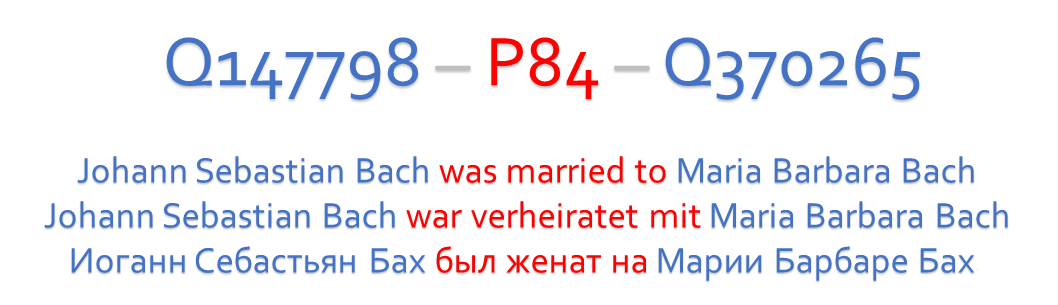
Le logiciel ignore le type sémantique des relations que vous avez créées- il s’agit là encore de simples numéros P : Q1 – P1 – Q2 est un “triplet”, qui peut tout aussi bien signifier “Jean-Sébastien Bach (Q1) est le père de (P1) Carl Philipp Emanuel Bach (Q2) ” que “Cette lettre que j’ai trouvée dans les archives avec la cote XYZ (Q1) aurait été envoyée de (P1) Munich (Q2)”

Les numéros Q peuvent être attribués à toute espèce d’identité : personnes, documents, événements, idées… C’est vous qui décidez des types des numéros P dont vous avez besoin pour faire les déclarations qui vous intéressent. Vous n’avez pas à définir les objets dans un système de catégories a priori ; ce sont vos déclarations qui ajoutent de la chair aux objets que vous créez au fur et à mesure. Ne vous inquiétez pas si vous n’avez pas de modèle de données dès le premier jour. Faites des déclarations dès que vous en avez envie et voyez comment elles acquièrent la masse critique. C’est alors seulement que vous pourrez juger de la valeur de l’ensemble.

Toutes les déclarations peuvent elles-mêmes être « qualifiées » – “Jean-Sébastien Bach (Q1) était marié avec (P2) Maria Barbara Bach (Q2) à partir du (P2) 7 october 1707 (date) jusqu’à (P3) environ 5 juillet 1720 (date).” Toutes ces déclarations peuvent à leur tour être dotées de références : “cela ressort du (P4) registre paroissial de… (Q3)”, ”cela est indiqué dans (P5) la biographie bien connue de Bach XYZ (Q4)”.
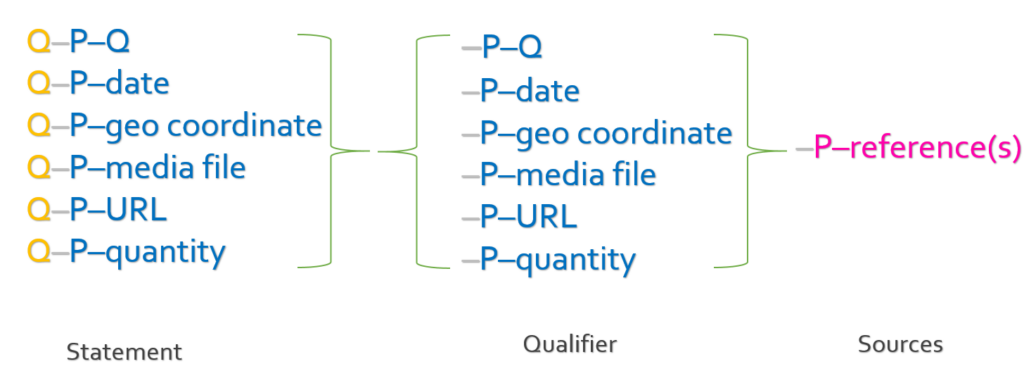
Le système permet à tout moment de proposer des affirmations concurrentes. Elles sont simplement introduites avec leurs différentes sources et peuvent être comparées les unes avec les autres.

En fin de compte, n’importe quelle déclaration en langue naturelle peut être générée avec des triplets de ce genre, mais, surtout, cela permet d’exprimer cette déclaration dans n’importe quelle langue du monde : pour le système, toutes les déclarations ne sont que des liens entre des numéros Q et des numéros P. C’est vous seul qui attribuez aux numéros Q et P des “libellés” et des “définitions” qui leur donnent sens, et cela dans les langues avec lesquelles vous communiquez (le système gère par ailleurs les informations de date et de quantité dans toutes les normes mondiales avec une conversion automatique dans n’importe quelle direction) ; c’est là le secret des plateformes Wikibase, qui permet aux auteurs de saisir les informations dans leurs langues respectives et aux utilisateurs de lire ces informations dans n’importe quelle langue.
Quels sont les outils fournis par le système ?

Les entrées dans la base de données peuvent être effectuées une à une : ouvrez pour cela l’objet-id en question, allez au bas de la page de saisie et cliquez sur le lien “ajouter une déclaration”. Il vous sera alors demandé de saisir la déclaration que vous souhaitez faire. Vous n’avez pas besoin de connaître le numéro P. Il suffit d’indiquer l’objet dans la langue que vous utilisez et de cliquer sur l’auto-complétion qui vous est proposée. La plate-forme utilisera pour vous le numéro P de cette déclaration. Indiquez alors dans le champ qui s’ouvre l’objet de votre déclaration. Le système, là encore, vous proposera, à mesure que vous tapez le texte de votre déclaration, des suggestions de plus en plus précises.

Les entrées dans la base de données peuvent également être créées et enregistrées automatiquement à partir de tableaux Excel ou CSV. (Ceci est le masque de saisie et voici le guide succinct pour le faire).

Les requêtes dans la base de données doivent être formulées sous forme d’interrogations “SPARQL”, un langage de requêtes qui n’est (malheureusement) pas si facile à utiliser, mais qui, au fond, n’est pas plus complexe que les recherches que vous pourriez vouloir effectuer.

Le plus souvent les utilisateurs de SPARQL ne savent pas écrire leurs requêtes dans le code source. Vous pouvez cependant utiliser des modèles de requêtes où sont indiquées les entrées qu’il faut modifier afin d’exécuter votre recherche spécifique.

En outre, si vous savez exactement le type de requêtes que vos utilisateurs doivent exécuter, vous pouvez créer vos propres masques de saisie, comme ceux que vous utilisez dans les interfaces habituelles des bibliothèques en ligne, qui parleront alors SPARQL avec la base de données.

Le système comprend aussi des outils cartographiques, des frises chronologiques, des réseaux, des arbres généalogiques, des graphiques, etc. Vous n’avez pas besoin de télécharger des applications particulières. Vous demanderez à SPARQL de produire la représentation que vous essayez d’obtenir. Le projet Scholia sur Wikidata présente certaines de ces visualisations.

Que dois-je faire si je veux donner mes représentations de données sur ma propre plate-forme ?

Cela ne devrait pas poser de problème technique. Uwe Jung a montré comment l’interface de la FH Potsdam utilise Wikidata comme dépôt de données sans laisser les utilisateurs voir la base de données à laquelle ils accèdent.

Il n’y a rien de mal à utiliser FactGrid comme dépôt externe et à monter son propre projet de recherche sur le serveur de son université d’origine, en y proposant des accès ciblés à la base de données selon un modèle de recherche de son choix.

FactGrid octroie essentiellement des licences d’utilisation des données à CC0 – cela veut-il dire que je renonce à tous les droits sur mes recherches ?

Opter pour la licence Creative Commons signifie essentiellement que vous conservez tous les droits sur l’ensemble de vos données. Mais surtout, la licence CC0 signifie que vos données deviennent librement utilisables et que vous pouvez ainsi réduire le danger de recherches obsolètes à long terme.

Quelques considérations de base : CC BY 4.0 est à première vue la licence que les scientifiques préféreront. Elle permet l’utilisation gratuite des données à la condition que celles-ci soient correctement citées. En pratique, cela fonctionne pour les textes (comme ce billet de blog) ; dans ce cas, on voit clairement comment on aimerait que le texte soit cité : avec une référence à l’auteur, le titre de la publication, le lieu de publication et la date. Mais supposons que vous souhaitiez que vos données soient citées, disons dans une visualisation ? Une lettre envoyée de Paris à Berlin en juin 1753 se réduisant à une ligne sur une carte, comment cette ligne doit-elle être correctement annotée ? Comment voulez-vous être cité si vous n’avez fait qu’améliorer un ensemble de données existantes ? Les licences “share alike” sont encore plus problématiques : “Ces données sont disponibles gratuitement si les utilisateurs ultérieurs les gardent tout aussi libres”. Cela semble être le plaidoyer ultime pour la gratuité. Mais comment un sous-utilisateur peut-il s’assurer que ses sous-utilisateurs respecteront à leur tour votre contrat de licence (surtout si ce sous-utilisateur offre ses données sous CC0) ? Les sous-utilisateurs seront bien avisés de ne pas utiliser de données provenant de plateformes CC-BY ou CC Share-Alike.

Nos entreprises communes avec Wikidata et la Bibliothèque nationale allemande ne nous ont finalement laissé qu’une seule option : rendre nos données aussi librement disponibles que nos partenaires, autrement dit sous CC0, c’est-à-dire sans garantie que les utilisateurs ultérieurs préciseront toujours exactement qui a collecté les données, ni sur ce que les utilisateurs tiers seront autorisés à faire avec ces données.
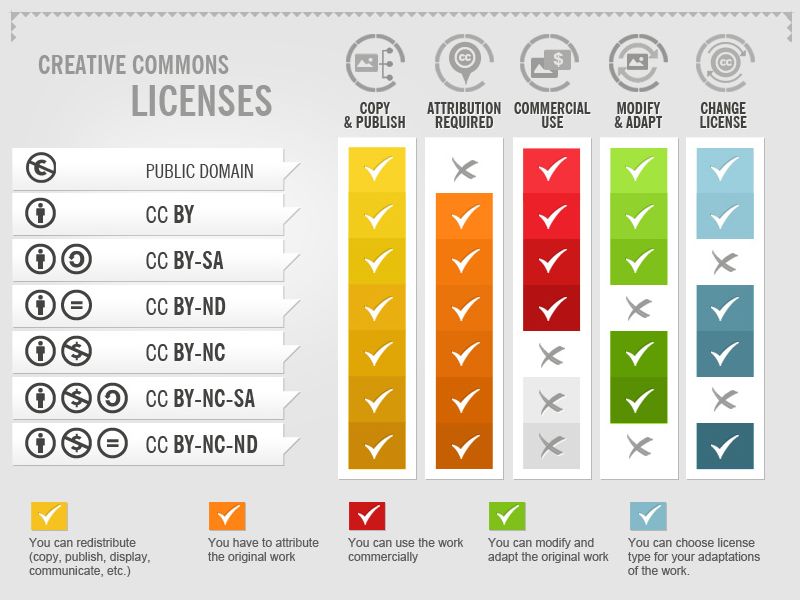
 
En pratique, la licence ouverte maximale ne signifie pas que les données de FactGrid sont des données sans auteur, bien au contraire. Outre que nous suggérons aux utilisateurs de toujours citer la recherche qu’ils utilisent, nous faisons l’hypothèse que Wikidata et le GND souhaiteront renvoyer à la recherche sur notre plate-forme. Toutes les modifications apportées aux jeux de données sont liées par le système à nos vrais noms, visibles par tous les utilisateurs. Si un jeu de données a été tout particulièrement travaillé par un projet de recherche, vous pouvez l’indiquer dans une note à part qui sera transférée avec ce jeu de données. Vous pouvez également noter votre travail dans le jeu de données lui-même. Enfin, tout le monde peut interroger la base de données pour savoir quels jeux de données ont été travaillés dans le cadre d’un projet particulier.

En fait, les bases de données comme Wikidata ou le GND de DNB sont intéressées à citer la recherche – cela renforce la solidité de leurs données, et FactGrid est dans la position unique de fournir aux deux institutions une plate-forme sur laquelle les gens peuvent faire ce qu’ils ne pourraient pas faire sur leurs grandes plates-formes.

Que se passe-t-il si je veux continuer à travailler avec mes données sur une autre plateforme ?

Puisque vous avez saisi vos données sans restriction de droits d’auteur, vous pouvez travailler librement avec elles sur tout autre projet qui vous intéresse. En fait, nous aimons être “juste un incubateur” pour les données de recherche.

Que se passe-t-il si les utilisateurs de FactGrid se disputent sur une date “correcte” ?

Le logiciel permet de traiter des données contradictoires – ce qui est particulièrement intéressant dans le domaine de la recherche historique où nous disposons souvent de preuves documentaires contradictoires, sans pouvoir être certain de l’information correcte. Les noms sont traités avec des orthographes différentes ; il arrive que les historiens se contredisent.

Le système permet de reproduire la situation contradictoire ; il permet d’étayer les déclarations avec des dizaines de références et dans différentes orthographes.

Des déclarations divergentes peuvent être comparées les unes avec les autres – par exemple, la déclaration qui fait actuellement autorité et les variantes qui ne circulent qu’en raison des diverses sources contradictoires.

Que deux chercheurs arrivent à des résultats différents, voilà qui devrait en général vous intéresser. Le danger majeur est d’avoir fait une hypothèse erronée et qu’un autre projet sur une autre plateforme donne la solution de l’énigme et travaille sur la bonne date sans que vous le sachiez, ou pire, sans que vous ayez même la possibilité de corriger votre erreur des années après la fin de votre projet.

Pourquoi devrais-je risquer la transparence de mon projet dès le début ?

C’est probablement le problème le plus difficile, celui qui empêche actuellement certains projets d’utiliser la ressource que nous avons ouverte. L’alternative est une ressource accessible seulement avec un mot de passe aux membres de l’équipe jusqu’à la date de publication, c’est-à-dire quasiment jusqu’à la fin du projet. Aucun projet concurrent ne peut alors s’emparer des résultats, du moins en théorie. Personne ne peut voir l’erreur par où vous avez commencé et que vous avez ultérieurement corrigée. Personne ne peut voir non plus le travail fourni par les assistants qui entrent les données dans la base, ni l’implication réelle du chef de projet – tels sont les avantages supposés d’un travail non transparent sur une plateforme qui ne sera mise en ligne qu’à la fin de votre financement.

La recherche transparente offre ses propres garanties : si vous trouvez un document révolutionnaire et établissez une connexion décisive, c’est l’occasion d’attacher la découverte à votre nom et à votre projet. Si quelqu’un, demain, fait la même découverte dans les archives que vous venez de visiter, pas de chance pour lui : vous aurez enregistré votre observation avec un lien dans l’historique des versions que vos rivaux ne pourront pas nier.

En même temps, la plate-forme collective invite à coopérer. Expliquez clairement aux autres équipes sur quoi vous travaillez et permettez-leur de vous contacter sur la plate-forme !

Les inconvénients d’un site web prétendument sécurisé et qui ne sera mis en ligne qu’à la fin du financement du projet sont sérieux : Lorsque le projet est publié, le temps des échanges avec les utilisateurs est déjà révolu. Si la mise sur Internet se fait dans les dernières semaines, celles où le projet est sous pression, vous vous trouverez totalement incapable de réagir par des changements plus conceptuels. Et si vous avez mené des recherches uniquement pour la publication d’un livre, que ferez-vous, vous et votre équipe, des données que vous avez rassemblées dans des fichiers Word et des feuilles de calcul Excel ? Personne ne pourra les verser dans des bases de données, car l’harmonisation à ce stade tardif sera un obstacle insurmontable. Votre seul espoir est que des lecteurs de votre livre parcourront toutes vos notes de bas de page pour en tirer des corrections pour nos catalogues de bibliothèque et pour différents projets Wikipédia. Le risque, finalement, est d’avoir un livre sans impact sur la base de données collective et sur les projets d’humanités numériques et qui sera, à cet égard au moins, obsolète dès sa publication.

L’avenir devrait résider dans une nouvelle attitude à l’égard de la base de données publique. Les chercheurs devraient pouvoir corriger et élargir encore cette base chaque fois qu’ils y accèdent. Pour cela, il leur faut une incitation et une sécurité que seul peut leur donner un environnement de recherche dans lequel le travail soit référençable et citable. Pour cela, Wikibase est mieux équipée que tout autre système.

Comment puis-je faire accepter mon projet sur FactGrid ?

La plate-forme FactGrid ne comporte pas de couche profonde invisible. Tout le monde peut interroger la base de données et les requêtes donneront les mêmes informations, que vous soyez connecté ou non. Votre compte d’utilisateur personnel présente simplement l’avantage de vous permettre de passer à votre langue préférée lorsque vous consultez les données et de voir le lien d’édition sur chaque déclaration.

Si vous souhaitez alimenter la plate-forme avec vos propres données et si vous souhaitez y mener un projet, vous devez disposer d’un compte. Les comptes sont donnés sous des noms réels par les administrateurs. Le logiciel fournit un lien “demande de compte”. Vous pouvez également nous contacter par courrier électronique. Les chefs de projet peuvent recevoir des comptes administratifs leur permettant de donner accès aux membres de leur équipe et aux utilisateurs qui les intéressent.

Une fois connecté, vous pouvez saisir des données en masse ou apporter des corrections spécifiques où bon vous semble. Toute entrée sera connectée à votre compte d’utilisateur. D’autres utilisateurs peuvent annuler vos modifications, mais non sans laisser une trace documentée de cette intrusion dans l’historique des versions – visible par le monde entier.

Si vous souhaitez travailler sur un projet plus complexe, qu’il s’agisse d’une recherche familiale personnelle, d’une visualisation unique dont vous auriez besoin pour une communication, ou encore de l’intégration dans la base de milliers de documents que vous auriez rassemblés dans le cadre d’un projet de recherche de 5 ans, parlez-en à ceux qui sont déjà sur FactGrid et à ceux qui organisent la plate-forme. Nous ne serons pas (nécessairement) désireux de signer un protocole d’entente avec vous, mais il pourrait être très intéressant de faire connaître votre projet sur le blog, ainsi que sur l’ensemble de la plateforme. Là où votre travail devient passionnant, c’est lorsque vous modifiez le travail que d’autres ont déjà fait et que vous encouragez les acteurs d’autres projets à adopter les bons modèles que vous introduisez. Il n’est pas indispensable de discuter des modèles de données avec tous les autres utilisateurs, mais cela peut aider, ne serait-ce que pour diffuser votre travail sur la plateforme. Adoptez des requêtes de recherche composées par d’autres, découvrez des visualisations auxquelles vous n’avez pas pensé, obtenez de l’aide sur la plateforme.

FactGridest conçu pour gérer un environnement de recherche excitant que vous ne trouverez pas ailleurs.

traduit par Bruno Belhoste

Jack Kirby, "The Fourth Dimension is a many splattered thing!" from Alarming Tales, 1 (September 1957).
Jack Kirby, “The Fourth Dimension is a many splattered thing!” from Alarming Tales, 1 (September 1957).

Call for data for the #EMQuon — The Early Modern Quarantine Conference, Friday 15th May and Friday 26th June 2020

With so many conferences cancelled these days @EMQuon2020 had a particularly refreshing idea to be played out on the internet: To host the first Early Modern Quarantine Conference — or simply Quonference — on Twitter.

We have decided to accept the challenge with a call for data which we would be able to present in a special data driven session on the event.

Whom would we like to attract? With a deadline on May 1st all those who have dying to come out.

If you have data silently passing away on old spreadsheets, decomposing on massive antiquated hard disc drives, decomposing on database islands without a download button… this is the moment to fuse them into the collaborative resource and to see whether we cannot link them to far more data on the community platform.

How to proceed?

  1. Contact us (olaf.simons@pierre-marteau.com) before 1st May with a Google spreadsheet of your data (click on “anyone with a link can edit”, to make your data accessible).
  2. Together we will take a look at your data to assess how much work it would cost to prepare them for input. (Look here for an idea of the database we are running.)
  3. You will have half a month to prepare your data and to see with us how to use them in a presentation.
  4. We will be happy to present your data also here on our blog.

    1. Here the @EMQuon2020 announcement:

      EMQuon
      The Early Modern Quarantine Conference

      About:

      A forum to promote the exchange of ideas and fostering debate for early modern historians during the coronavirus shutdown of 2020.

      Aims:

      To provide an online, open-access, public history conference in response to the absence of workplace discussions, seminars and conferences which normally enrich our thought-processes. The ambition is not to be REF-able or replace formal presentation experiences but to offer an alternative in difficult times. Our priority is to create an event that is both fun and mentally stimulating, anything more is a bonus.

      Ethos:

      The underlying emphasis is on simplicity, effectiveness and pragmatism as we have all suddenly had our lives upturned. We want a streamlined process for submissions focus on getting papers out there without too much worrying about format or style. Write in a way that is comfortable to you and is accessible for the well-read public and non-specialist (including explaining terms).

      Period:

      Anything that broadly deals with the ‘long early modern’ c.1400-1850 which is intended to encompass anything within the transition from the medieval to modern world. A cliché but Acton’s ‘problems not periods’ stands, and we seek a focus on themes and issues.

      Background:

      A holistic view to include all approaches and disciplines, across them and everything in-between. We encourage people from all backgrounds, experiences and career-statuses, particularly postgraduate, early-career and independent historians.

      #EMQuon
      EMQuon@outlook.com

      Martin Luther 1483–1546.
      Luther at the Reichstag in Worms in front of the emperor and electors, April 17/18, 1521.
      (“Here I stand, I can do no other, so help me God. Amen”). Woodcut,
      colored, from: L. Rabus, Historien der Heyligen Ausserwählten Gottes Zeugen,
      Strasbourg 1557.

      Guidelines:

      Format:

      • Each presentation should consist of between 5 and 15 tweets. Each tweet should have the official hashtag #EMQuon and be numbered i.e. 1/15.
      • You can almost think of the tweet-thread as a kind of Power Point with identifiable sections.

      Content:

      • Tweets can contain pictures and even links to other media, sources or papers but the presentation should be understandable by reading just the tweets. Please explain terms and acronyms.
      • Please tweet in any language though with subsidiary English tweets (you can use twice the length).

      Preparing to present:

      • You should draft your tweets so they are ready to be sent when your time opens. This way you ensure you meet the character limit and have time to troubleshoot if you have any issues with images or other media.
      • It is preferred that you will be available during your presentation time slot and to answer questions afterwards, however you are unable to be present, you can schedule your tweets and should notify us.

      During the presentation:

      • You can pace the tweets of your presentation to be slightly apart, to give people time to read and understand them, rather than sending them all at the beginning of your time slot.
      • The audience can comment and ask questions using the hashtag and we ask that presenters aim to engage where possible and that other ‘attendees’ and presenters engage also.
      • We ask that people respect the time of other speakers. The main discussion should happen at the end of each panel and discussions are encouraged after the conference.

      Afterwards:

      • At the end of each day we will have some concluding remarks by the chair @EMQuon2020.
      • Depending on the popularity of the CfP and the conference we would be open to add an additional day.
      • Subject on the ongoing situation and time constraints we may look to create a record of the conference such as through an online blog or a PDF ‘proceedings.’

Celebrating FactGrid’s Q100000: Conrad Alexandre Gérard

Silently and without any fanfare we have passed the 100,000 mark on FactGrid! The item in question is a person: Conrad Alexandre Gérard. In a way he is the perfect candidate to mark this occasion. FactGrid has been diving into networks obscure and less obscure, and Gerard travels on both sides of this distinction: The first French ambassador to the United States and a person interested in Mesmerism, the world of miraculous cures based on “animal magnetism” in the 1780s. Our project started with the German Illuminati and spread into Freemasonry. In doing so, it broadened its scope to include France and England. Gerard is again a perfect representative of this outlook: born in Masevaux, France, in 1729 he pursued a diplomatic career that brought him to Mannheim and Vienna and eventually to the young United States of America. If our hopes are fulfilled, we will follow in his tracks and extend ourselves westwards and across the Atlantic over the next year.

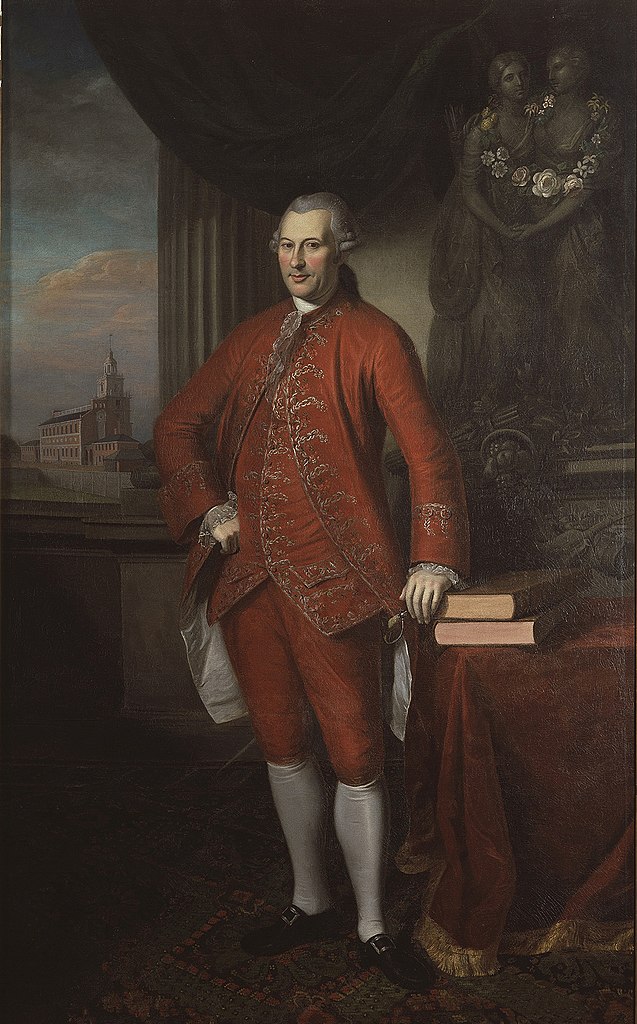
Conrad Alexandre Gérard, Philadelphia 1779
The 100.000th item was created by Bruno Belhoste who began to fuse the Francophone Harmonia Universalis database into FactGrid from where the Mesmerism of 1780s and 1790s Paris will now radiate outwards and into the network of its French and continental adherents. J.J.C. Bode brought these spheres into exemplary contact on his journey to Paris in the summer of 1787 – in the journey that marked the end of the Illuminati since he subsequently declined to resume his work as the last active secret superior when he returned home later that year. Mesmerising is the right word – a word derived from Franz Anton Mesmer, who will stand in the centre of the exceptional scene that is unfolding here.

FactGrid was established in order to give historical data a wider outreach and deeper impact. It is living up to its promise. We welcome joint ventures between platforms. We love to give data an additional outreach. We hope that we can give data sets wider connections and place them within unexpected and exciting contexts of research; and we hope that we can bring research teams together on this mission. Wikibase is designed to encourage this mission.

Looking back: we grew much faster than expected

Bruno Belhoste’s (and David Armando’s) project will deserve a longer blog post in 2020; it will take him another two or three months to feed all his data into the database and to be able to offer more substantial and significant insights; the present input is just preparing the basic structures one can then begin to interconnect. The 100,000th item is more of an opportunity to look back and to speak about the future as far as we can see it from our current vantage point.

Collective editing on FactGrid started on June 11, 2018. We began with data from the two Illuminati research projects that have dominated the scene since the late 1990s. The Illuminati will remain a construction site as we hope to bring online the entire “Swedish Box” (the core collection of Illuminati documents as amassed by Bode from 1782 until 1789). Berlin’s Lodge “To the Three Globes” and the Privy State Archive in Berlin have given encouraging signs that they would support the digitisation and detailed cataloguing. We will need three years of public funding for a project of these dimensions.

The Wikibase installation also invited local low-level projects that were open to testing and developing this resource. Would the “citizens” of Gotha be able to work on one and the same platform used by scholars in their wider international projects? Gotha’s City Church Archive was willing to bring its catalogue online on FactGrid. Heino Richard of the city’s Genealogy Association began an enormous project and has already transferred about two thirds of the “Pfarrerbuch”, volume one of the former duchy of Gotha’s pastors, into structured database information. The former duchy’s 140 pastorates are the project’s backbone; more than 2000 pastors filled the positions since the Reformation. The database has linked them to their parents, their spouses, their respective families, and Heino Richard is now on his way to add all the children — work which will eventually comprise over 15.000 data sets. Here is a perfect opportunity for scholarly professionals since we are dealing here with a tight network of families marrying among each other for over five centuries. We will add information about the professions to allow the sociological evaluation of these family ties.

The Illuminati allowed for the database to grow and merge with Freemasonry — after all this was what they were doing in the 1780s: infiltrating lodges in the German speaking territories. Hermann Schüttler had already identified members of some 130 lodges. Christian Wirkner brought his dissertation on Göttingen’s two late 18th century lodges into the database with some 800 biographies which inspired Martin Gollasch to widen the scope with his own research on the beginning of German’s student fraternities. We are now beginning to understand how the “Landsmannschaften” and a wider spectrum of quasi masonic organisations which recruited students in the central Protestant university cities, laid the ground on which the early 19th-century “Burschenschaften” emerged in the years of the Napoleonic wars. Martin Gollasch’s data sets are enriched by information about all the smaller, more intimate circles of friends which traveled through these wider organisations as he has been mining contemporary “books of friends”, the “Stammbücher” in which students collected entries from their dearest friends.

Bruno Belhoste’s and David Armando’s Harmonia Universalis data will widen the spectrum. One thing has already happened with this new project: Bruno Belhoste has effectively turned the entire site into a trilingual project: All our properties are now available in German, French and English. The interface is already speaking Russian and Chinese (and more than 100 other languages), so there remains some work to be done.

We would love to turn Magnus Manske’s Reasonator into the standard — multi-lingual — interface for simply viewing FactGrid data; that, however, will need a bit of more work from different sides.

One of the projects is hibernating at the moment: Tim Herb made it possible to quote the entire (Protestant) Bible on FactGrid down to the level of the individual verses. The central idea was here to connect all the people and places mentioned in the Bible and the Quran and thus to transform the Biblical historicity and genealogy into structured information. The project is daunting: Wikibase allows contradicting statements. How would a database fare with the competing chronologies of modern and early modern historians? Our predecessors saw the Bible with its succinct 6000 years of Universal history since the creation of the world as the ultimate historical source. When they made the comparison to the Greek and Roman sources, it seemed to them as if the pagans had nourished blatant mythologies. How would the project develop if it was widened into the Quran? The Bible and Quran project is an open challenge at this point. Being able to quote the Bible down to the level of verses has, in the meantime, the charm of offering concise intertextual connections: We might develop a new focus on “Early Modern Networks of Religious Dissent”. The protagonists of this scene had their favorites among the Biblical Books — Daniel, the Prophets, the Apocalypse. Collecting the references we should be able to see how the Bible was used by competing groups on their respective missions, so there is potential here.

The shadow of history: All the GND’s Masonic lodges on a map. The former German speaking regions are coming back to life. We have to get beyond this map – and our map should have historical layers.

Our work on Freemasonry is ultimately as much of a challenge: We could theoretically invite lodges from all over the world to map their historical membership lists and their institutional networks of affiliations and systems back in time. FactGrid should allow visualisations of the spread of Freemasonry on timelines and maps. We are presently at about 850 lodges mostly in the former German speaking territories thanks to a test input of GND data, and these data are broadly unconnected so far — an invitation to dream of the far bigger project that could explore Freemasonry as part of early modern globalisation.

…and ahead: a year of massive challenges

2019 was still a year of cautious consolidation. We have grown faster than expected but we remained a platform of projects that worked silently side by side and in a spirit of open-minded friendship, interlocking knowledge here and there. All data on FactGrid is so far hand picked in tremendously time-consuming work. The GND-input should change the work flow and it should invite projects to start right in the middle of publicly available knowledge. Ten million data sets of people, organisations and places will create a landscape ripe for immediate cultivation.

A lot of questions are still open in this project: Shall we include the whole GND in order to operate as a complete DNB-filial project? Our initial idea was to restrict FactGrid to the early modern period but even such self-imposed and somewhat arbitrary limitations were open to later revision. 1900 had been the line we would draw back in 2018. Today we are confronted with ideas to open FactGrid for research on the entire range of data harvested at the German National Library. How could we deal with personal information of living people without the National Library centre that is responding to requests to modify these data? The opposite threat is just as crucial: And how will we make sure that the input (no matter where it ends) does not turn FactGrid into an agglomeration of data that only a few SPARQL-specialists will be able to mine and which we can hardly keep fresh and alive on our site?

We will have to generate a wider community. We will have to advertise the project in the wider field of Wikimedia projects in order to attract fans of open knowledge from Wikidata and from the different Wikipedia history projects. We will need technical help during the input and we will need a community that adopts this mass of data and that transforms the massive mound of date into a vibrant intellectual playground.

As FactGrid is not exactly a grass roots project we will have to make sure that historical research, archives and libraries will see us as a resource and as a site of collective work. If you belong to the wider world of historians, librarians and archivists and if you are interested in big data you should feel challenged by a project that will turn public data into a treasure one can now, all of a sudden, revise, enrich and explore with unprecedented freedom.

The project will need a more solid technical basis on this course. We need an interface to meet the wider public: an interface which anyone can handle without SPARQL. The interface should be multilingual and it will look more like the Reasonator than our present Wikidata-style pages, which want to be edited rather than looked at.

So, some quite daunting challenges ahead – but we expect it to be inspiring to confront and eventually master them. The software is incredibly cool. It has been opening doors to us during its first one and a half years and we have every reason to think that it will continue to demonstrate this potential for the next years. Wikibase is on its way to become the software of a wide network of Wikibase instances and we should try to become a research platform in this network.

Eine Sitzung der Gothaer Illuminaten von 1786 — rekonstruiert für die “Lange Nacht der Wissenschaften” der Uni Erfurt, 2019

[kollektive Arbeit Erik Liebscher, Markus Meumann, Olaf Simons] Am 8. November 2019 inszenieren Mitarbeiter und Promovierende des Forschungszentrums Gotha anlässlich der Erfurter “Langen Nacht der Wissenschaften” 2019 eine Sitzung des Illuminatenordens aus dem Jahr 1786 – eine Zeitreise und ein Blick in den geheimnisumwobenen Alltag des Ordens. Wenn die Illuminaten auch ein Geheimorden waren und wenn freimaurerische Riten auch der Öffentlichkeit nicht erklärt werden, so sind wir im doch Rückblick ausnehmend gut in der Lage, zu erfassen, was in den Sitzungen zumindest in der letzten Ordensprovinz „Ionien“ (Thüringen) in den 1780er Jahren geschah. Der Orden hatte eine ausgefeilte Bürokratie. Man protokollierte die Sitzungen und archivierte die vorgetragenen Aufsätze. Die Rituale waren dabei an der Freimaurerei geschult, die man von zwei Seiten organisatorisch umschloss – von unten, indem man Jungmitglieder rekrutierte und auf die Freimaurerei mit drei Schulungs-Graden vorbereitete und von oben, indem man auf die drei Johannisgrade der Freimaurerei ein eigens Hochgradsystem aufsetzte, dessen Mitglieder sich wiederum eigens, außerhalb der infiltrierten Loge trafen. Wir sind Stefan Sarrach von der “Grossen National-Mutterloge zu den drei Weltkugeln” dankbar dafür, dass er mit uns gemeinsam einen Blick in die „Rituale“ warf, die vorgaben, wie Sitzungen regulär zu gestalten waren. Die Bewegungen und Handlungsschritte blieben hier mit Wissen des Freimaurers zu erschließen.

Die Sitzung, die wir auswählen, fand am 28. Dezember 1786 statt, wie immer im zum Park hin vor dem Schloss gelegenen Haus des Obergärtners Wehmeyer. Details sprachen für die Wahl dieser Sitzung: Wir suchten ein Treffen mit überschaubarer Teilnehmerzahl (und müssen in der ausgewählten Sitzung noch immer auf drei Statisten verzichten) und mit spannenden Beiträgen. Die ausgewählte Sitzung war dabei besonders: Einer der „Minervalen“, der 26jährige Johann Georg Geißler („Quintus Cicero“ in Gothas Ordensniederlassung) hatte selbst ein Thema gestellt. In der Regel gaben die Ordensoberen die Arbeiten vor. Geißlers Thema war dabei tiefsinnig:

Soll ich meinem Freunde absichtlich Äuserungen entlocken deren Bekanntwerdung er fürchten muß, um ihn dadurch zu Beförderung eines moralischen guten Endzweckes desto fester an mich zu ketten?

Geißlers Rückblick auf die Geschichte seiner Themenstellung zeigt, dass die Mitbrüder sein Thema erst einmal „dunkel“ fanden. Brisant war es zudem im Orden, in dem doch gerade die geheime Organisation den besonderen Raum für eine vertrautere Freundschaft schaffen sollte, in der sich dann Freiheit des persönlichen — auch einmal gefahrvollerem — Denkens herausfordern ließ. Kann man frei sprechen, wenn man riskiert, dass man damit erpressbar wird? Kann man in einem Orden frei sprechen, der alle Beiträge akribisch auswertet und archiviert und nachher schriftliche Dokumente gegen einen in der Hand hat? Die Fragen stehen im Raum werden aber in dieser Brisanz nicht angesprochen.

Wir wissen, dass Geißlers Aufsatz mit Applaus diskutiert wurde, im Gegensatz zum dem seines um drei Jahre jüngeren Mitbruders August Ludwig Hoppenstedt (Ordensname „Diognet“). Sein Aufsatz ging erst in der zweiten Fassung, die er zum 21. März 1787 vorlegte, zu den Akten, weshalb wir nicht mehr genau erfassen konnten, womit Hoppenstedt Kritik auf sich zog.

Welche Punkte der Ordensstatuten in der Sitzung verlesen wurden, ist nicht exakt notiert. Wir wählten gleich die ersten aus, da sie genau auf das Thema zugeschnitten sind. Unklar bleibt auch wie viel aus Schillers philosophischen Briefen zwischen Julius und Raphael an jenem Spätnachmittag des Jahres 1786 zum Vortrag kam – der Text der Seiten 117 und folgende des dritten Hefts der Thalia schafft mit seinen Erwägungen zum göttlichen höchsten Wesen jedenfalls ein elegantes Gegengewicht zur Ode, die Schack Hermann Ewald (Cassiodor) der Seele widmete.

Wir haben die Texte für die Aufführung im Rahmen der „Langen Nacht“ etwas gekürzt; das Publikum soll hier zwischen vielen Veranstaltungen sich hier zwischen vielen Veranstaltungen hin und her bewegen können. Im Folgenden das Protokoll mit dem Sitzungsablauf und Links zu den archivierten und von uns ausgewerteten Beiträgen, wie sie die „Gotha Illuminati Research Base“ im Erfurter FactGrid erfasst.

Die Teilnehmer

  1. Christian Georg von Helmolt (Chrysostomus), der Superior [Markus Meumann]
  2. Christian Heinrich Wehmeyer (Cleobolus), der Censor [Olaf Simons]
  3. Schack Hermann Ewald (Cassiodor), Quaestor [Martin Mulsow]
  4. Christoph Friedrich Chrysostomus Schenk, Sekretär (Robertus Stephanus) [Marian Hefter]
  5. Johann Georg Geißler (Quintus Cicero) [Erik Liebscher]
  6. August Ludwig Hoppenstedt (Diognet) [Marie Nosper]
  7. Johann Gottfried Bohn (Spanheim) [Rolle nicht besetzt]
  8. Carl Friedrich Ernst von Helmolt (Guido della Torre) [Rolle nicht besetzt]
  9. Friedrich Ernst Carl Mereau (Thuanus) [Rolle nicht besetzt]
  10. Hans Ulrich von Gadow (St. Evremont) [Rolle nicht besetzt]

Das überlieferte Sitzungsprotokoll

Sitzungsprotokoll der Sitzung der Gothaer Minervalkirche vom 28. Dezember 1786.

Die vorgetragenen Texte

Was in der Aufführung nicht ganz erkennbar sein wird

Mehr…

Wikibase Inspiration Panel at WikidataCon, Berlin, 2019-10-25

The recent WikidataCon in Berlin had a special panel on Wikibase installations outside Wikidata. Below the video recording of the session embedded from https://media.ccc.de/

This is the list of the talks with the list of the speakers:

  1. Anila Angjeli + Benjamin Bober, Assessing Wikibase as the core of the French National Entities file
  2. Barbara Fischer + Sarah Hartmann, Authority control meets Wikibase – The German National Library and Wikimedia Deutschland Quest
  3. David Fichtmueller, Using Wikibase as a Platform to Develop a Semantic Biodiversity Standard
  4. Stuart Prior, Wikibase and building a community in Artists’s Publishing
  5. Olaf Simons, Using a Wikibase platform outside the Wikidata environment – why it is cool and where things get difficult


Featured Image: Wikidata Birthday Cake Cutting at WikidataCon 2019-10-25, by Ranjithsiji, Wikimedia Commons

The Illuminati Correspondence Fast Forward

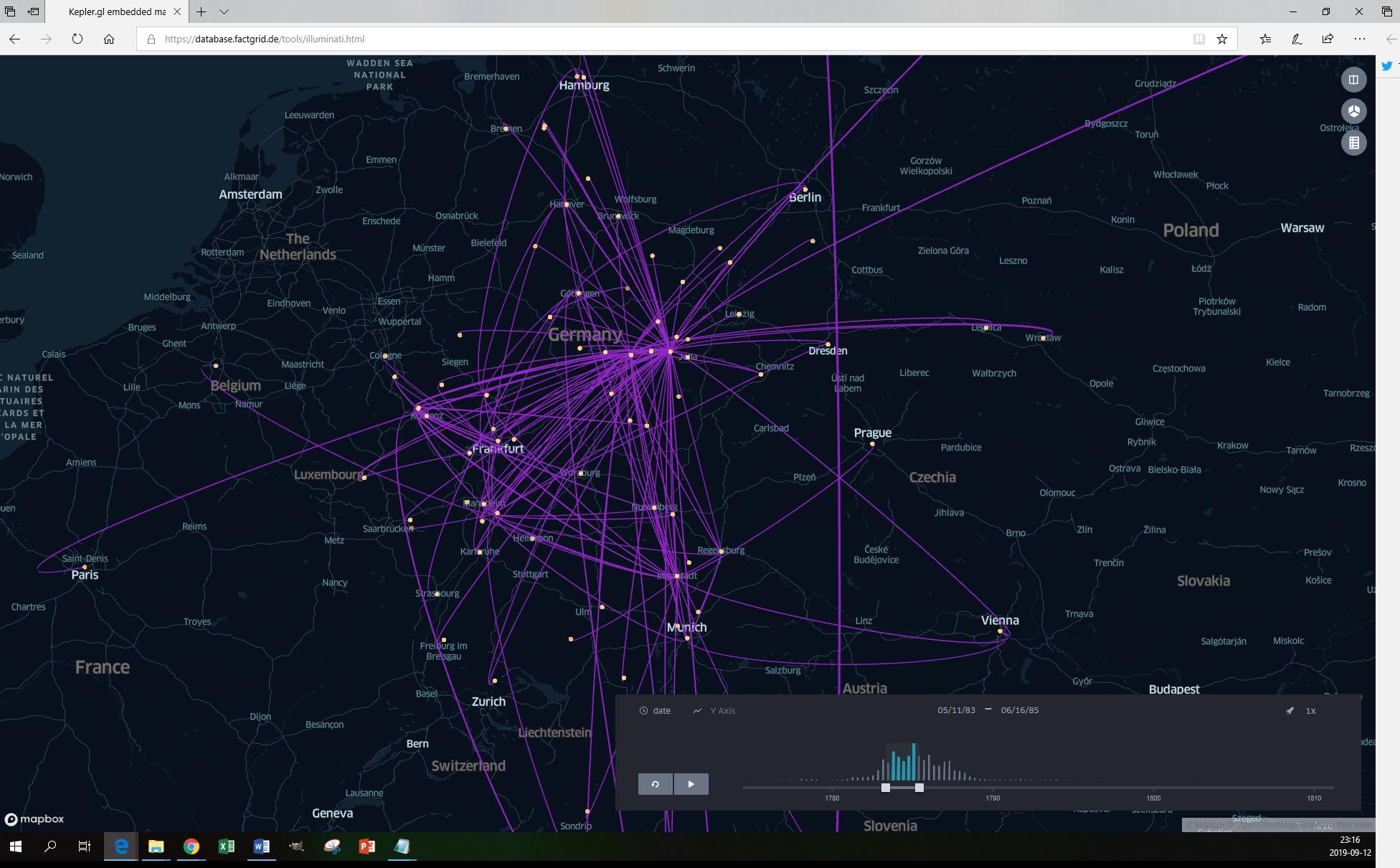
Paul-Olivier Dehaye scripted this visualisation for us (using Uber’s http://Kepler.gl). An html-file that captures all the Illuminati exchanges from the 1770s into the 1790s as far as we have spotted them (there are some misfits in this visualisation which we can now suddenly identify and which need to be eliminated on the database; the visualisation itself is basically a screenshot, it does not adapt to changes in the database).


<click to play>

The idea to represent letters in lines on a map together with a timeline on which the user can set a span that can then be shifted through the timeline – has become a classic in recent years: The Stanford Republic of Letters project seems to have been the first to come up with this visualisation ten years ago

Nodegoat is offering this visualisation as a standard aplication.

The visualisation is cool for correspondences since letters happen to travel on maps from senders to recipients (or to multiple recipients as soon as letters are forwarded – a standard procedure in all hierarchical Illuminati exchanges).

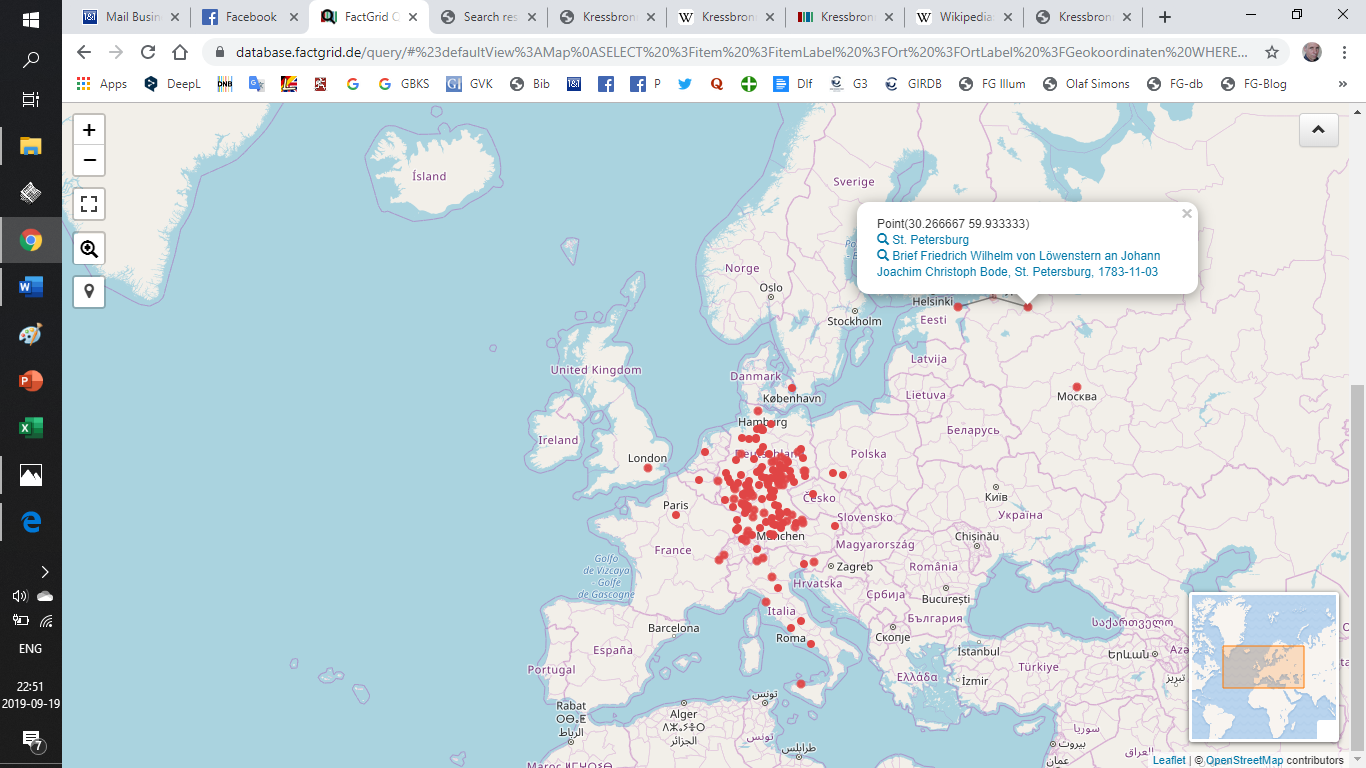
The simple visualisation which the SPARQL query service had yielded was already interesting to look at:

Illuminati Letters – sent from where?

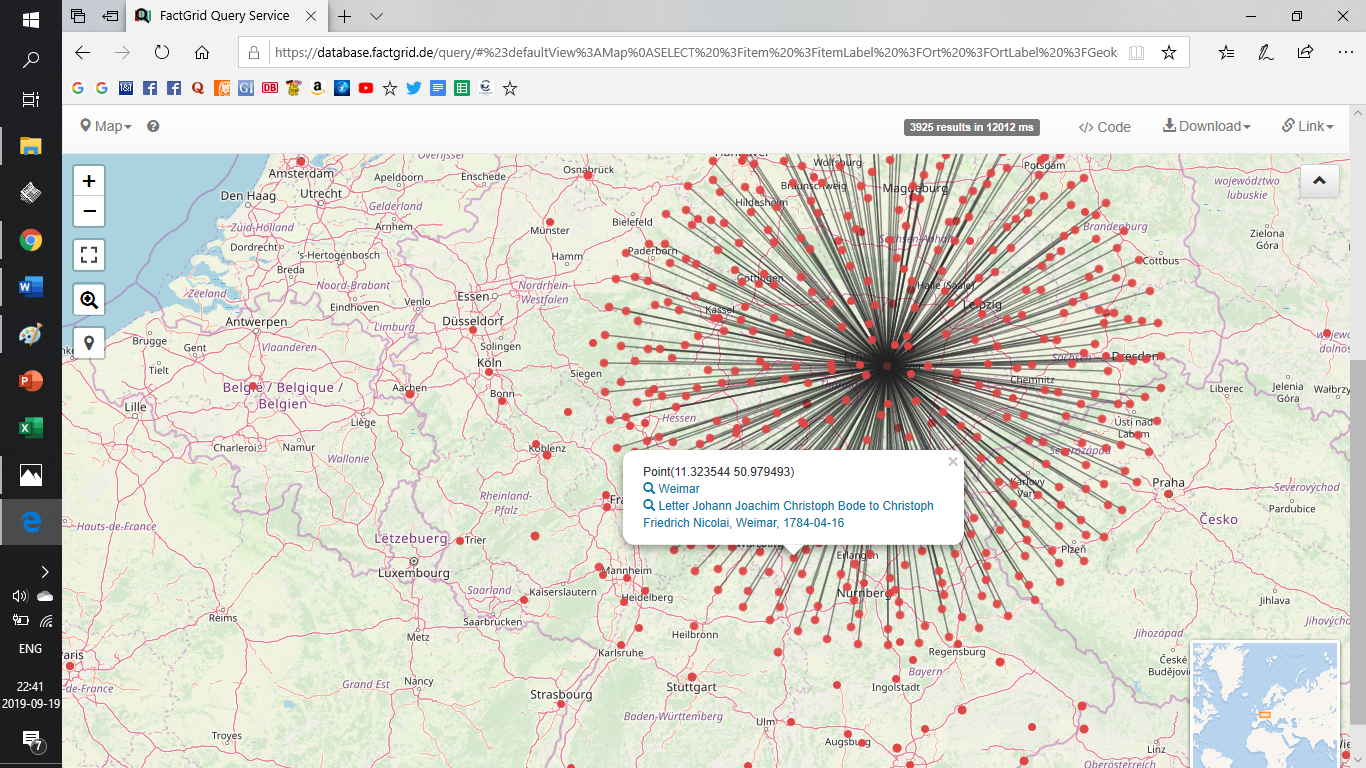
It showed the sender’s places of all known Illuminati letters and vaguely hinted at the Illuminati centres in Germany. But the picture remained static. It lacked the directions and the historical drama. You got more information if you clicked at an individual dot – usually this would open just a speech bubble with information about the particular letter that created this dot. But here and there one would see far more: a dot sparkling a fireworks of dots as in the case of Weimar (from where Christoph Bode organised the Order as the de facto leader after 1785/86). The beautiful bouquet is otherwise misleading – the dots do reach out to the various destinations; they stand for quantities which you only see if you hit the right dot (and which then obliterate much of the rest of the picture).

Bode’s Weimar correspondence – a nice representation of the number of documents but not much more.

Letters – that is the charm of the more refined temporospatial visualisation – tend to come in correspondences and these evolve, they stretch out, they blossom, and they die eventually.

The Illuminati are an almost ideal object for this particular visualisation as they present a full case to study. The “Republic of Letters” had remained out of reach for the Stanford project. The thing which we today prefer to call “academia” or “scientific community” was far bigger than the carefully selected and spectacular cases that created the first visualisations in 2009 — and only the whole picture would have revealed the evolution of our present academic debates between the 1480s and 1800. Regions and emerging nations brought forth increasingly scattered cultures of learning and they invented modern national topics such as our present debate of (usually national) literature. The spectacular exchanges could not possibly reveal these developments.

The Illuminati correspondence is, admittedly, no longer complete. We are looking here basically at the archives of Weishaupt and Bode and the Bavarian publications of 1787 – but it is even in this selection a clearly and well defined object. You know when you have an Illuminati letter in front of you: The author uses code names and the (messy) Illuminati-Persian calendar. The Organisation created complete genres of letters such as the monthly “Quibus Licet” which every member had to hand in and which would be answered with a “Reproche” signed by “Basilius” two months later. The genres are as remarkable as the internal affairs discussed in these letters.

The Order itself was at the same moment basically a complex correspondence: an organisational construct that generated a particular and unstable flow of information. Paul’s time lapse encapsulates the history and the drama of the Illuminati: For about two years – from 1776 to 1778 – we see very little: Ingolstadt is the place where Weishaupt’s “Perfectibilists” could organise most of their affairs in face to face meetings.

The situation changed dramatically in 1778: The Illuminati opened a lodge in Munich and started to infiltrate the masonic world.

Again two years later, in 1780, we see Adolph Freiherr von Knigge rising with exchanges he is now maintaining from Frankfurt and then from Heidelberg.

Knigge wins Bode for the Order in September 1782 and Bode in turn resolves the escalating conflict between Knigge and Weishaupt in 1784 and 1785: Knigge is forced to withdraw but Weishaupt does not regain his former position as the head of the organisation. Bavaria exposes the Order in 1786/87 with the first two editions of intercepted Illuminati documents. Weishaupt flees to Regensburg and then to Gotha where he ends in personal ignominy while it remains Bode’s part to come to the conclusion that he would not reform the secret organisation which could no longer claim to be a secret society.

You can pinpoint the individual letter to see who was writing here to whom with what letter exactly

Paul’s abstract movie wants to be explored. You can define the time frame and push it manually through the timeline, and you can click at each line to see whose letter is creating it. We can now see the overall quantities and the processes, the organisation’s actual growth and collapse on the map.

Far from perfect

The visualisation is state of the art and yet not much more than a show case at the moment. It is neither created in ever fresh queries nor can you use the html-page without some coding for your own questions.

The message, however is clear: The interface one would love to have with this visualisation could be far more simple than the present SPARQL query service. One would design it to always explore “correspondences” (P122Q11243) and one would ask the user for simple P—Q specifications of his or her desired visualistion. In the Illuminati case this would be:

  • Research Interest (P97) — Illuminati (Q10677)

One might just as well ask for “author” and name a couple of authors, or for recipients, but the Interface would do the rest and run the SPARQL query of correspondences to generate a list of the letters in question with senders’ and receivers’ places and dates.

Paul’s message is that this can be done: The centre of his html file is basically a SPARQL-search from our database. Maybe someone will script the interface during the Wikidata.con next month in Berlin.

And one would love to have more…

  • Think of a visualisation that tracked the movements of people on maps and that captured the moments when people (could have) met.
  • Think of a visualisation of the dissemination of objects – like copies of a specific edition.
  • Think of the spread of an organisation like Freemasonry with its mother lodges and filial branches.
  • Imagine a visualisation that traced your ancestors with a look at genealogical data.

Wikibase instances should invite the production of interfaces that can do certain jobs without bothering the user with SPARQL or Java proficiency. The cool thing about Wikidata or FactGrid is that these instances develop their (more or less) static ways to organise core data. We get more data but we continue to make the same useful statements especially if we have visualisations asking for these statements to be made with certain P- and Q-numbers.

Nodegoat would not lose any its charm if we began to offer similar visualisations; it will remain the software for the vast majority of projects that prefer the exclusive environment on which they can run exclusive and definitive presentations of their data. Wikibase instances are already very different beasts: They invite projects that want an open and growing landscape of data, and these projects will show the far bigger need of standard visualisations (i.e. of visualisations that use existing data and existing data structures). Projects on FactGrid or Wikdata need interfaces that already speak SPARQL. Time then to look at the more complex visualisations that are already running in environments such as the Stanford Republic of Letters Project or the Cultures of Knowledge Project in Oxford. We should act as the coolest competitors in this field, gather inspiration with the aim to inspire in turn.

FactGrid FAQ – Why should I use FactGrid for my research project?

Jack Kirby, "The Fourth Dimension is a many splattered thing!" from Alarming Tales, 1 (September 1957).

auf Deutsch
en français
magyarul

What is FactGrid?

FactGrid is a Wikibase installation — that is is both, a regular wiki and a database which you can use to make statements about objects of your interest — statements which you can then handle in practically any language in big data sets.

The platform is run by the Gotha Research Centre and hosted by the ThULB Jena. It addresses projects with a specific interest in historical data and is part of the German National Research Data Infrastructure NFDI4Memory.

In joint ventures with Wikimedia Germany and the German National Library’s GND we are trying to bring this platform into the upcoming consort of federated Wikibase instances as a resource for research data.

Why should I use FactGrid for my own research?

The biggest argument for a FactGrid account is the unbeatably flexible software, Wikibase, which we have managed to implement in a pilot project with the help of Wikimedia Germany – outside its primary location, Wikidata:

  • You are looking for a software that speaks practically any language — a platform on which you can enter data in your language and allow others to read your data in their languages? Wikibase is this software.
  • You are looking for software in which you can transparently coordinate a whole team? In Wikibase this is as easy as in the Wikipedia software MediaWiki .
  • You are looking for a database software that can do everything Digital Humanities databases normally want to do: network analysis, map representations, complex linked searches, timeline representations (in various formats) – a software that almost acts like human language yet provides full database services? Wikibase is this software.
  • You have data from previous projects which you want to build on? Wikibase has large-scale automatic input options.
  • You want to make sure that that other projects will actually use your data? Use a platform that allows the download and further work with your data offline in Excel or online in ever new projects.
  • You want to ask entirely new questions in your research? In Wikibase you can link any sort of objects with any kind of statements of your interest.
  • You are worried what will happen to your data and presentations once your funding is over? Work on a platform where you do not stay alone and where, thanks to the CC0 license you are using, you encourage colleagues to continue right were you stopped!

If you are looking for a long term perspective this is what we are trying to offer in our present joint venture with the German National Library. We will base our platform on GND data in order to serve as a broad public tool and with the aim to become a player in the emerging landscape of “Federated Wikibase installations”.

Why not use Wikidata right away?

That is a legitimate question to ask. There will be projects (projects that are mainly using data) for which Wikidata will be the better platform. The FH Potsdam’s “Archivführer zur deutschen Kolonialzeit” has demonstrated the beauty of working directly on Wikidata; we talked about this with Uwe Jung, who demonstrated the technical solutions they have chosen in Potsdam.

On the other hand, there remain basically two things which you will not be able to do on Wikidata or on a platform like the GND: Wikimedia projects (and the GND) have strict “No original Research” policies and observe fundamental decisions to operate on “criteria of notability“, which will not allow the arbitrary opening of database objects and the innovative object relationships researchers would like to test.

Wikidata and the GND focus on information that has already been published and on non-research workers who feed the respective databases from published research. You will not be allowed to state a “working hypotheses” of “your research” on these platforms. You will not be able to create entities with the aim to run “nothing but a statistical analysis” on them at a far later stage of your work.

In FactGrid we encourage the use of the platform as a heuristic research tool.

  • Create database objects on the platform, no matter what their relevance in an encyclopedia or in library catalog could be.
  • Risk provisional chronologies as working hypotheses along with your personal assumptions.
  • Use FactGrid in order to make unconventional statements that are presently interesting only in your research project – the software gives you this freedom.
  • Create specific database objects that state your research in all the data sets which you have substantially modified and become able to submit your research with the particular item as the envelope to your funding institution.
  • Risk any new thesis on the platform and state your respective view with a database object number as a “micro-publication” in order to claim your ingenuity on the data base.

FactGrid is free – how does it work?

The software is freely available and under development in the larger community of Wikimedia projects and among the institutions which are going to use Wikibase over the next years.

The FactGrid platform is presented by the Gotha Research Centre on a virtual server of Jena’s University Library free of charge.

All the Wikidata-tools are available to our users. These include all the standard applications of regular Digital Humanities projects.

With both software and tools being open source you can use any favorite software company you are working with, to generate the specific application which you feel you need.

If you feed your tools into the open compound this will be your best way to make sure that future projects will continue their development.

If you aim at technical solutions which you want to sell with financial profit that again will not be restricted by the software license. You can freely commercialize whatever you create on the basis of the open software.

What do I do with unorthodox research interests?

Wikibase is groundbreaking in its data modelling. Essentially you are only creating relations between Q-numbers (or relations between Q-numbers and dates, Q-numbers and space coordinates, Q-numbers and media files, Q-numbers and URLs).

The software does not know what kind of relationships you are stating – these again are just P-numbers: Q1 – P1 – Q2 is a “triple” and can mean “Johann Sebastian Bach (Q1) is the father of (P1) Carl Philipp Emanuel Bach (Q2)”; it can mean just as well “This letter which I found in the archive with the shelf mark XYZ (Q1) has allegedly been sent from (P1) Munich (Q2)”

Q-numbers can be assigned to anything imaginable – people, documents, events, ideas… You decide what kinds of P-numbers you need in order to make statements of your interest. You do not define objects in a system of fixed categories; your statements are adding colour and solidity to whatever object you create as you go along. Do not worry if you do not have the data model on day one. Make statements when you suddenly want to make them and see how they gain the critical mass that can eventually be evaluated.

All statements can be “qualified” – “Johann Sebastian Bach (Q1) was married to (P2) Maria Barbara Bach (Q2) beginning on (P2) October 7, 1707 (date) ending (P3) about July 5 1720 (date).” All of these statements can in turn be equipped with references : “this is clear from (P4) the church book of… (Q3)”,”this is stated in (P5) the well known Bach biography XYZ (Q4)”.

The system allows competing claims at any time. They are simply introduced with their different sources and can be balanced against each other.

You can create practically any normal language statement with triples of this depth of specificity; but above all, this opens the door to the world of statements in all the various languages you might want to speak: The system operates with Q- and P-numbers; the rest is labels in languages which you want to offer to your users. The software will in addition translate dates and quantities into other formats; this is basically the secret that makes it possible for Wikibase platforms to be edited by people in their own languages and to be read by the world in practically any other language.

Which tools does the software provide?

Database entries can be made one by one: Open the object-id in question, go to the bottom of the input page and click the “add statement” link. You will now be asked for the statement you want to make. You do not need to know the P-number. State the property in the language you are using and click at the auto complete you are eventually being offered. The platform will now use the P-number of that statement for you. Complete in the next box that opens your statement. You will again get suggestions to use as you are typing.

Database entries can also be created and substantiated in automated inputs from Excel or CSV lists. (This is the input mask and this is the short guide to it.)

Database queries have to be formulated as “SPARQL” queries, a search language that is (unfortunately) not that easy to use, but that is eventually as complex as the searches you might want to perform.

SPARQL users do not necessarily know how to write SPARQL source code. You usually use sample queries that tell you where you have to change the input in order to run your particular search.

If you know exactly which type of search queries your users should run you can create your own input masks just as you know them from conventional online library interfaces, which will then speak SPARQL with the database.

The software package includes illustrations on maps, timelines, networks, genealogical relationships, graphs, and so on. You do not need to download particular applications. You will ask SPARQL to produce the representation you are trying to get. The Scholia project on Wikidata has a beautiful first presentation of some of the visualisations.

What do I do if I want to give my very own data representations on my own platform?

That should not be a technical problem. Uwe Jung demonstrated how the FH Potsdam interface uses Wikidata as its data repository, without letting users see the database they are accessing.

There is nothing wrong with using FactGrid as an external repository and building up your own research project on the server of your home university, where you can offer targeted database accesses under a typical search template of your choice.

FactGrid basically licenses data to CC0 – does that not mean that I give up all rights to my research?

Opting for the Creative Commons 0 license means essentially that you continue to be free to do whatever you want with your data – you, and not your publisher or the platform that received your data under a scheme, continue to control. But above all, the CC0 license means that your data becomes freely usable and that you can thus reduce the danger of obsolete research in the longer run – others will continue to root out the ugly mistakes you could not hope to correct.

Some basic considerations: CC BY 4.0 is at first glance the license that scientists will prefer: It allows the free further use as long as it receives the accurate citation. In practice, this will work for texts (such as this blog post); here it is clear how one would like to see the text cited: with a reference to one’s own name, with the title of the publication, the place of publication and the date. But do you want your data quoted let us say in a visualisation? A letter sent from Paris to Berlin in June 1753 will be a line on a map and how should this line be properly annotated? How do you want to be quoted if you only improved a data set? “Share alike” licenses are even more problematic: “These data are freely available if the subsequent users keep it just as freely available.” That sounds like the ultimate plea for free use. But how can a sub-user ensure that his sub-users, in turn, will respect your license agreement (especially if this sub-user is offering his data on CC0)? Sub-users are well advised not to use data from CC-BY or CC Share-Alike platforms.

Our joint ventures with Wikidata and the German National Library left us only only one option: to make our data as freely available as our partners: CC0, that is without ensuring that subsequent users will still specify exactly who collected the data, and what third-party users are allowed to do with that data.


In practice, the maximum open license does not mean that FactGrid data is data without authorship, quite the contrary. We suggest that research is cited and assume that Wikidata and the GND are only too happy to state research from our platform. All changes are linked to respective the author names. If research projects have worked more substantially on a data set, they will have stated this in a separate note on the data set that can now be adopted with the data transfer.

Databases like Wikidata or DNB’s GND are in fact interested to quote research – it boosts their data solidity, and FactGrid is here in the unique position to give both institutions a platform on which people can do what they cannot do on the respective larger platforms.

What happens if I want to continue working with my data on another platform?

Since you entered your data without a copyright restriction, you are free work with them on any other project of your interest. We actually like to be “just an incubator” for research data.

What happens when FactGrid users argue about a “correct” date?

The software makes it possible to handle contradictory data. This is particularly interesting in the field of historical research, where we often have conflicting documentary evidence without being able to determine the correct statement after so much time. The software makes it possible to reproduce such a contradictory situation. Numerous statements can be given side by side with their various respective sources. You can then still balance the statements against each other – either by turning one of them into the statement to privilege in future searches and/or by adding qualifying statements with your personal evaluations.

If two researchers come to different results, think of it as the situation you should actually be interested in. It is far worse that you have made mistakes on a platform where they will never be corrected and where they eventually discredit all your work as obsolete beyond repair.

Why should I risk transparency in my project right from the start?

This is likely to be the toughest issue that currently prevents projects from using the resource which we have opened. The alternative is the resource, which is accessible to the team only under passwords until the publication deadline is reached almost at the end of the project. No competing project can snatch away findings, so the theory. No one sees where you have initially made a mistake. Nobody records what assistants are typing in and where the project leader is involved – such are the presumed advantages of non-transparent working on a platform that will only go online at the end of your funding.

Transparent research offers its own securities: If you find a groundbreaking document and establish a decisive connection, then this is your chance to fix the statement to your name and project. If someone makes the same discovery tomorrow in the archive you have just visited, tough luck. You will have recorded your observation with a link in the version history which your rivals will not be able to deny.

At the same time, the collective platform expresses the invitation to cooperate. Make it clear to other teams what you are working on and allow them to contact you on the platform!

The risks of the allegedly secure website, which is only going online at the end of the project’s funding, are serious: The time for an exchange with users is over. The internet presence goes online in the heated final weeks while the project is totally unable to react with more conceptual changes. If you have done research solely for a book publication, it will remain unclear what you and your team should do with the data, you have still collected in Word files, and Excel spreadsheets. Nobody will be able to feed all these data into any resource – the harmonisation at this late stage will be an insurmountable obstacle. You can only hope that readers of your book will scan all your footnotes for corrections that should reach our library catalogs and the various Wikipedia projects. The risk is here the book that has no influence on the collective data base and of DH projects that become obsolete right after their publication.

The future should lie in a new attitude toward the public data base. Researchers should be able to correct and to further widen this base wherever they access it. The incentive and the security they will need here is the research environment in which they can mark their work and make it citable. For this Wikibase is better equipped than any other software.

How do I get my project accepted on FactGrid?

The FactGrid platform has no invisible deeper layer. Anyone can query the database and the queries will give the same information whether you are logged in or not. Your personal user account just has the advantage that you can now switch to your favorite language when looking at data, and that you see the edit link on each statement.

If you want to feed your own data into the platform and if you want to run a project on the the platform, you will need an account. These are given under real names by the administrators. The software provides an “account request” link. You can also contact us via email. Project leaders can receive administrative accounts which they use to assign to team members and users of their interest.

Once logged in, you can enter data in bulk or make specific corrections wherever you feel like. Any input will be connected to your user account. Others can undo your edits but not without leaving a documented mark of that intrusion in the version history – visible to all the world.

If you want to work on a more complex project —

  • that can be personal family research,
  • it can be a single visualization you need in a seminar paper,
  • it may just as well be the input of thousands of records in a 5-year research project

— speak with those on board and those organising the platform. We will not (necessarily) be interested to sign a public memorandum of understanding with you but it might be cool to advertise your project on the blog and to make it known on the entire platform. Your work becomes exciting, where you modify the work others have already done and where you encourages players from other projects to adopt good models which you are introducing. You do not need to discuss data models with all the others but using models with all the others is also a way to spread your work and to make it appear in queries composed by others, and visualizations you did not think of.

The software is designed to manage both: unique statements which only you are interested in and statements that will spread far beyond your own initial research interest as you are now feeding the unforeseen queries which others will run on their and your data.

Jack Kirby, "The Fourth Dimension is a many splattered thing!" from Alarming Tales, 1 (September 1957).
Jack Kirby, “The Fourth Dimension is a many splattered thing!” from Alarming Tales, 1 (September 1957).

FactGrid FAQ – Warum sollte ich das FactGrid für die eigene Forschung nutzen?

Jack Kirby, "The Fourth Dimension is a many splattered thing!" from Alarming Tales, 1 (September 1957).

in English
en français
magyar nyelven

  1. Was ist das FactGrid?
  2. Warum sollte ich das FactGrid für die eigene Forschung benutzen?
  3. Warum nicht gleich Wikidata benutzen?
  4. Das FactGrid kommt kostenfrei – wie geht das an?
  5. Was mache ich mit unorthodoxen Forschungsanliegen?
  6. Welche Tools stellt die Software mir zur Verfügung
  7. Was mache ich, wenn ich ganz eigene Datendarstellungen auf meiner eigenen Plattform realisieren will?
  8. Das FactGrid lizenziert Daten grundsätzlich CC0 – heißt das nicht, dass ich alle Rechte an meiner Forschung aufgebe?
  9. Was geschieht, wenn ich mit meinen Daten auf einer anderen Plattform weiterarbeiten will?
  10. Was passiert, wenn es zwischen FactGrid-Benutzern zum Streit über ein “korrektes” Datum kommt?
  11. Warum sollte ich in meinem Projekt Transparenz schon von Anfang an riskieren?
  12. Wie nutze ich das FactGrid konkret?

Was ist das FactGrid?

Das FactGrid ist eine Wikibase-Instanz, die, vom Forschungszentrum Gotha aus organisiert, an der ThULB Jena gehostet wird.

Wikibase ist die Software, die hinter Wikidata läuft. Die Instanz will historischer Forschung einen eigenen Freiraum zur Verfügung stellen und im Verlauf technisch in der Lage sein, mit der GND und mit Wikidata laufend Daten auszutauschen — Daten, die aus dem FactGrid heraus international als Forschungsdaten zitierbar werden. Seit dem 5. November 2022 ist das FactGrid — als global agierende Plattform — offizielles Repositorium im Spektrum der deutschen Nationalen Forschungsinfrastruktur, NFDI4Memory.

Sehen Sie hierzu auch den Beitrag zu den Zielerwägungen, den Barbara Fischer für die GND und Jens Ohlig für Wikimedia am 9. Mai 2019 im Wikimedia Blog veröffentlichten.

Warum sollte ich das FactGrid für die eigene Forschung benutzen?

Dafür spricht erstens die unschlagbar flexible Software, Wikibase, die wir im Pilotprojekt mit Wikimedia Deutschland bahnbrechend außerhalb ihres eigentlichen Orts, Wikidata, zum Laufen brachten:

  • Sie suchen eine Software, die praktisch jede gängige Sprache spricht und in der sich Daten in jeder Sprache eingeben und in danach in beliebigen anderen Sprachen ausgeben lassen? Wikibase ist diese Software.
  • Sie suchen eine Software, in der Sie ein ganzes Team transparent koordinieren können? In Wikibase ist das so einfach wie in der Wikipedia Software MediaWiki.
  • Sie suchen eine Datenbank-Software, die alles kann, was Datenbanken der Digital Humanities normalerweise können: Netzwerkanalysen, Repräsentationen auf Landkarten, komplex verknüpfte Recherchen, Timeline-Darstellungen (in verschiedenen Datenformaten), und die sich dabei einem Umgang mit normalen Aussagen annähert? Wikibase ist diese Software.
  • Sie haben Datenmengen aus vorheriger Forschung, auf die Sie aufbauen wollen? Wikibase erlaubt den großflächigen automatischen Input.
  • Sie wollen sicherstellen, dass Ihre Daten nachnutzbar werden? Wikibase ist genau darauf eingestellt.
  • Sie wollen neuartige Fragen an Material stellen? In Wikibase können Sie beliebige Objekte mit beliebigen Aussagen Ihres Interesses verknüpfen.
  • Sie fragen sich, was nach Ihrer Projektlaufzeit mit Ihren Daten und Ihren Präsentationstools noch geschieht? Setzen Sie auf eine Plattform, auf der Sie nicht allein arbeiten und auf eine Datenlizenz, die es anderen ermöglicht, Ihre Arbeit wirklich risikolos zu nutzen und fortzuentwickeln!

Für das FactGrid spricht im selben Moment, dass wir im Interesse am breiten und offen bleibenden Datenaustausch in einer Kooperation mit der Deutschen Nationalbibliothek die gesamte Plattform soeben auf GND-Daten aufsetzen, um das Projekt in seiner größeren Breite in der entstehenden Landschaft von “Federated Wikibase Platforms” zu verankern.

Warum nicht gleich Wikidata benutzen?

Das ist eine gute Frage, die man sich stellen sollte. Es wird Projekte geben (die hauptsächlich Daten nutzen), für die Wikidata die bessere Plattform ist. Für die FH-Potsdam demonstrierte dies der „Archivführer zur deutschen Kolonialzeit“; wir sprachen darüber mit Uwe Jung, der die technischen Lösungen vorstellte, die man dort realisierte.

Zwei Dinge, gibt es, die es andererseits interessant machen, gezielt eine (Wikidata und die GND beliefernde) eigene Plattform aufzubauen: Die Wikimedia- (und GND–) spezifische “No Original Research” Grundregel und die fundamentale Entscheidung für Relevanzkriterien auf beiden Plattformen, die das beliebige Aufmachen von Datenbankobjekten und Objektbeziehungen ausschließt.

Wikidata und die GND richten sich auf bereits publizierte Information aus und auf Bearbeiter außerhalb der Forschung, die Publikationen auswerten und Daten eingeben. Unmöglich wird es bleiben, auf diesen Plattformen Arbeitshypothesen zu riskieren, Datierungen, die erst einmal auf Probe gestellt sind, Personeninformationen, die später in einer Publikation nur statistisch ausgewertet werden sollen.

Im FactGrid ermuntern wir zur Nutzung der Plattform als heuristischem Forschungstool.

  • Legen Sie hier Datenbankobjekte an, die Sie weit später erst auswerten wollen, egal welche Relevanz diese in einer Enzyklopädie oder in Bibliothekskatalogen gewinnen können.
  • Riskieren Sie provisorische Datierungen – als Arbeitshypothesen zusammen mit Ihren persönlichen Annahmegründen.
  • Wagen Sie im FactGrid unkonventionelle Aussagen, die erst einmal nur in Ihrem Forschungsprojekt interessant sind – die Software erlaubt es Ihnen.
  • Bauen Sie eigene Datenbankobjekte zu Ihren Forschungsprojekten und verknüpfen Sie diese mit allen Datenbankobjekten, an denen Sie arbeiteten, um so Ihrem Geldgebern die eigene Forschung im Paket der Datenbeziehungen vorlegen zu können.
  • Riskieren Sie im FactGrid Thesen und führen Sie diese in der Datenbank als “Mikro-Publikationen” mit eigenen Datenbank Objekt-Nummern.

Das FactGrid kommt kostenfrei – wie geht das?

Die Software ist frei verfügbar und befindet sich in einer von großen Communities getriebener Entwicklung im Wikimedia-Bereich und in Zukunft in hinzukommenden Institutionen wie denen der europäischen Nationalbibliotheken, die soeben eigene Wikibase Instanzen und Tools bauen.

Das FactGrid selbst läuft unter Ägide des Forschungszentrums Gotha auf einem virtuellen Server der Universität Erfurt. Für die deutsche URL fallen jährlich €36 Domaingebühren an, die vom Forschungszentrum Gotha getragen werden.

Nutzern stehen alle Tools aus dem Wikidata Projekt zur Verfügung. Mit ihnen sind die Standardanwendungen gängiger Humanities Projekten erst einmal abgedeckt.

Da die Software open source ist, können Projekte eigene Software-Etats gezielt in Tools und Präsentationen investieren, um die es ihnen in der eigenen Forschung geht. Arbeiten Sie gerne mit einer favorisierten Softwareschmiede zusammen, so wird diese, was den Quellcode der laufenden Software anbetrifft, vor offenen Türen stehen. Bieten Sie Ihre eigenen Entwicklungen offen zur Weiterentwicklung an, und Sie können darauf vertrauen, dass Visualisierungen auch nach Ihrer Projektförderung noch fortentwickelt werden. Streben Sie dagegen eigene Softwarelösungen mit dem Ziel einer kommerziellen Vermarktung an, so bindet Ihnen die Software-Lizenz hier nicht die Hände: Sie erhalten die bestehenden Softwarelösungen frei und können eigene darauf aufbauenden Tools jederzeit kommerziell verwerten.

Was mache ich mit unorthodoxen Forschungsanliegen?

Wikibase ist bahnbrechend offen in den mit dieser Software möglich werdenden Datenbankanwendungen. Letztlich werden hier nur Beziehungen zwischen Q-Nummern hergestellt (respektive Beziehungen zwischen Q-Nummern und Daten, Q-Nummern und Raumkoordinaten, Q-Nummern und Mediendateien, Q-Nummern und Internetadressen).

Was das für Beziehungen sind, das ist für die Software irrelevant. Q1 – P1 – Q2 ist ein “Triple” und kann bedeuten “Johann Sebastian Bach (Q1) ist der Vater von (P1) Carl Philipp Emanuel Bach (Q2)”; es kann genauso gut bedeuten “Der Brief des Archivs X mit der Signatur YZ (Q1) notiert als Absendeort (P1) München (Q2)”

Q-Nummern können für alles nur Denkbare vergeben werden – Personen, Dokumente, Ereignisse, Ideen… Sie selbst legen fest, was für P-Nummern Sie definieren wollen, um Aussagen Ihres Interesses zu Ihren Datenbankobjekten zu treffen. Im System kristallisiert sich letztlich erst mit den Aussagen, die Sie zu Ihren Objekten treffen, heraus, welcher Art Objekte das sind. Das heißt: Sie benötigen kein Kategoriensystem, das Ihnen im Vorhinein klar sein muss, um mit der Datenbank zu arbeiten. Sie treffen Aussagen dann, wenn Sie sie plötzlich setzen wollen, und sehen zu, wie sich diese zu einer kritischen auswertbaren Masse akkumulieren.

Alle Aussagen lassen sich “qualifizieren” – “Johann Sebastian Bach (Q1) war verheiratet mit (P2) Maria Barbara Bach (Q2) mit Beginn am (P2) 7. Oktober 1707 (Datum) bis zum (P3) ca. 5. Juli 1720 (Datum).” Alle diese Aussagen lassen sich wiederum beliebig mit Quellenaussagen versehen – “das geht hervor aus (P4) dem Kirchenbuch von… (Q3)”, “das wird so behauptet in (P5) der Bach-Biographie XYZ (Q4)”.

Das System lässt jederzeit konkurrierende Behauptungen zu. Sie werden einfach mit ihren unterschiedlichen Quellen eingebracht und können dabei beliebig untereinander bewertet werden. In ihrer weiteren Nutzung im System gewinnen sie ihre eigentliche Bedeutung.

Letztlich lassen sich auf damit beliebige normalsprachliche Aussagen generieren; vor allem aber öffnet dies die Tür in die Welt global handhabbarer Aussagen. Für das System spielen sich alle Aussagen nur als Verknüpfungen von Q-Nummern mittels P-Nummern ab. Sie selbst belegen die Q- und P-Nummern mit “Labeln” in den Sprachen, in denen Sie kommunizieren (Datums- und Mengenangaben verwaltet das System bereits in beliebigen globalen Standards mit automatischer Umrechnung in jede Richtung); so das Geheimnis, das es möglich macht, dass auf Wikibase Plattformen Autoren in ihrer jeweiligen Sprache eingeben und andere Nutzer diese Informationen in beliebigen Sprachen auslesen.

Welche Tools stellt die Software mir zur Verfügung

Datenbank-Eingaben können sukzessive erfolgen: Sie wollen über ein Objekt eine neue Aussage treffen? Rufen Sie das Objekt auf, gehen Sie ans Ende der Eingabe-Seite, wo “Aussage hinzufügen” steht, und beginnen Sie die Aussage in Ihrer Lieblingssprache – das System ergänzt mit Auto-Complete die gesuchte Aussage und sucht sich die P-Nummer dieser Aussage heraus. Tippen Sie in das sich nun eröffnende Feld ein, auf welches andere Objekt diese Aussage laufen soll oder auf welches Datum (in Ihrer Sprache) und die Software macht ihnen immer präzisere Vorschläge, noch während Sie tippen.

Datenbank-Eingaben können zweitens massenweise und automatisiert in gängigen Formaten aus Excel-Listen oder CSV-Listen erfolgen. (Dies ist die Eingabemaske und dies die kurze Anleitung dazu.)

Datenbankabfragen geschehen im Gegenzug mit “SPARQL“, eine Such-Sprache, die (leider) nicht einfach zu bedienen ist, die es jedoch nun erlaubt, die Datenbank beliebig komplex zu befragen – komplexer als jede Standard-Suchmaske Ihnen das erlauben würde. SPARQL-Nutzer müssen nicht unbedingt den SPARQL-Quellcode schreiben können. Man bedient sich in der Regel einer passenden Musterabfrage, die man in einer Sample-Queries-Liste findet, und tauscht hier die Suchbegriffe aus.

Weiß man exakt, welcher Art Suchanfragen Benutzer des eigenen Projektes durchführen können, so lassen sich Suchschablonen wie in herkömmlichen Katalogen bauen, die die Anfragen an das System unterhalb der Benutzeroberfläche in SPARQL formulieren.

Im Software-Paket finden sich Darstellungen auf Landkarten, Timelines, in Netzwerken, genealogischer Beziehungen, Diagramm-Darstellungen und so fort. Für diese Anwendungen müssen keine Softwarepakete eigens installiert werden. Sie formulieren in Ihrer SPARQL Anfrage, was für eine Darstellung Sie wünschen.

Einen sehr schönen Überblick über Visualisierungen gibt das Scholia Projekt auf der Wikidata Plattform.

Was mache ich, wenn ich ganz eigene Datendarstellungen auf meiner eigenen Plattform realisieren will?

Das sollte technisch kein Problem sein. Uwe Jung demonstrierte, wie eine Benutzeroberfläche der FH Potsdam Wikidata als Datenrepositorium benutzt, ohne dass die Benutzer mitbekommen, auf welche Repositorien die Abfragen zugreifen.

Nichts spricht dagegen, das FactGrid als ein externes Repositorium zu benutzen und das eigene Forschungsprojekt auf dem Server der Heimat-Uni aufzubauen und dort die Benutzer mit gezielten Datenbankzugriffen unter einer typischen Suchschablone zu bedienen.

Das FactGrid lizenziert Daten grundsätzlich CC0 – heißt das nicht, dass ich alle Rechte an meiner Forschung aufgebe?

Positiv gesprochen bedeutet die Entscheidung für die Creative-Commons-0-Lizenz, dass Sie die vollen Rechte an allen (Ihren) Daten behalten. Vor allem aber bedeutet die CC0-Lizenz, dass Ihre Daten frei nutzbar werden und damit weniger Gefahr laufen, als Forschung obsolet zu werden.

Einige grundsätzliche Erwägungen dazu: CC BY 4.0 ist auf den ersten Blick die Lizenz, die Wissenschaftlern näher liegt: Man gestattet die freie weitere Nutzung, wenn man dafür fachgerecht zitiert wird. In der Praxis lässt sich diese Lizenz bei Textveröffentlichungen (wie diesem Blogbeitrag) noch gut durchsetzen. Hier ist es klar, wie man den Text, den man verfasste, und Thesen, die man bahnbrechend formulierte, zitiert sehen möchte: Mit einem Verweis auf den eigenen Namen, mit dem Titel der Publikation, dem Publikationsort und dem Datum. Wie aber soll das Datenzitat (etwa die Information, dass ein Brief im Juni 1753 von Paris nach Berlin ging) innerhalb einer Visualisierung erfolgen, auf Strichen, die auf einer Landkarte erscheinen? Wie sollen Benutzer Datensätze zitieren, wenn diese nur zum Teil Informationen aus Ihrem Forschungsprojekt enthalten, zum größeren Teil jedoch andere Datenbankinformationen etwa aus einer öffentlichen Archivdatenbank bieten, die Sie einspielten? Noch größere Probleme stellen sich bei Daten mit Lizenzen, die eine “share-alike” Klausel bergen: “Diese Daten sind frei verfügbar, wenn die Nachnutzer sie genauso frei verfügbar halten.” Das klingt erst einmal nach nachdrücklicher freier Nutzung. Wie aber soll ein Nachnutzer sicherstellen, dass wiederum seine Nachnutzer sich an die von Ihnen gewünschte Lizenzvereinbarung halten (insbesondere, wenn dieser Nachnutzer auf CC0 geht)? Nachnutzer sind gut beraten, keine Daten aus CC-BY oder CC Share-Alike Lizenzen zu verwenden.

In der Praxis der größeren Kooperationen mit Wikidata und der Deutschen Nationalbibliothek kann es darum nur eine Option geben: Genauso frei Daten zur Verfügung zu stellen, wie die Kooperationspartner diese tun: CC0, das heißt ohne, dass sichergestellt wird, dass Nachnutzer noch exakt angeben, wer die Daten einzeln erhob, und was Drittnutzer wiederum mit diesen Daten tun dürfen.

 
Die maximal offene Lizenz heißt in der Praxis durchaus nicht, dass FactGrid Daten Daten ohne Autorschaft sind, ganz im Gegenteil. Wir legen es nahe, Forschung als Forschung zitierbar zu machen und gehen davon aus, dass Wikidata und die GND Zitiervoschläge gerne übernehmen. Alle Datensatzänderungen werden von der Software für alle Nutzer sichtbar an bei uns Real-namentlich gebunden. Haben Forschungsprojekte substanzieller an einem Datensatz gearbeitet, vermerken Sie dies jederzeit mit einer eigenen Notiz Ihrer Arbeit im Datensatz. Jeder kann die Datenbank danach befragen, welche Datensätze im Rahmen eines bestimmten Projektes bearbeitet wurden.

Tatsächlich ist es für Datenbanken wie Wikidata oder die Gemeinsame Normdatenbank der DNB, die GND, ungemein interessant, Daten aus dem FactGrid als dort erstmals publizierte zitieren zu können – es steigert die eigene Datensolidität, wenn sich Forschung benennen lässt und es gibt beiden Institutionen eine Plattform auf der möglich wird, was auf der eigenen Plattform ausgeschlossen bleibt.

Was geschieht, wenn ich mit meinen Daten auf einer anderen Plattform weiterarbeiten will?

Da Sie Ihre Daten ohne Copyright-Aufgabe einpflegten, können Sie sie in beliebig vielen anderen Projekten parallel laufen lassen. Wir sind hier gerne “nur” ein “Inkubator” für Forschungsdaten.

Was passiert, wenn es zwischen FactGrid-Benutzern zum Streit über ein “korrektes” Datum kommt?

Die Software lässt es zu, einander widersprechende Daten zu handhaben – das ist gerade im Feld der Geschichtswissenschaften interessant, wo wir oft dokumentarisch belegte divergierende Informationen haben, ohne noch ermessen zu können, welches die korrekte Aussage ist. Namen werden in verschiedenen Schreibungen gehandhabt; Geschichtsschreiber widersprechen einander.

Die Software erlaubt es, die widersprüchliche Lage abzubilden; sie erlaubt es, Objekte mit Dutzenden Namensschreibweisen zu belegen – es sind nur verschiedene Schreibweisen zu ein und derselben Q-Nummer.

Divergierende Aussagen lassen sich unterschiedlich einstufen – etwa als das derzeit autoritative Datum gegenüber Varianten, für die allein die verschiedenen einander widersprechenden Quellen sprechen.

Sollten zwei Forscher zu unterschiedlichen Befunden kommen, so ist das letztlich der Fall, auf den es jedes Projekt anlegen sollte. Das viel größere Risiko ist die hypothetische Entscheidung, die Sie in Ihrem Projekt treffen, während ein Projekt auf einer anderen Plattform das Rätsel löst und mit dem belastbaren Datum weiterarbeitet, ohne dass Sie davon auch nur erfahren, geschweige denn die Korrektur Jahre nach Ihrer Projektlaufzeit noch einpflegen können.

Warum sollte ich in meinem Projekt Transparenz schon von Anfang an riskieren?

Das dürfte die härteste Frage sein, die Projekte im Moment davon abhält, sich der eröffneten Ressource bereits zu bedienen. Die Alternative ist die Ressource, die bis zum Publikationstermin gegen Projektende nur unter Passwörtern dem Team zugänglich ist. Kein Konkurrenzprojekt kann Ihnen in der verdeckten Arbeit an Ihrer Plattform Befunde wegschnappen, so die Theorie. Auch sieht niemand, wo Sie erst einmal Fehler machten, die Sie erst im Verlauf korrigierten. Niemand erfasst, was Hilfskräfte eingaben und was dagegen Sie als Projektleiter verantworten – so die Vorteile des intransparenten Arbeitens auf einer Plattform, die erst am Projektende online geht und die keinen Blick in die Versionsgeschichten der Datensätze zulässt geschweige denn in die tägliche Projektarbeit.

Die transparente Forschung, zu der das FactGrid einlädt, bietet indes ganz eigene Sicherheiten: Wenn Sie bahnbrechend ein bestimmtes Dokument auffinden und einen bestimmten Zusammenhang herstellen, dann ist der Editiervorgang, mit dem Sie den Datensatz mit Aussagen bestücken, Aussage um Aussage datiert und jeweils mit Ihrem Namen verbunden. Macht morgen jemand im selben Archiv dieselbe Entdeckung, werden Sie im FactGrid nachweisbar und fälschungssicher notiert haben, dass Sie den Zusammenhang schon einen Tag zuvor öffentlich zugänglich machten.

Die kollektive Plattform spricht im selben Moment die Einladung zur Kooperation aus. Machen Sie anderen Teams klar, woran Sie arbeiten und erlauben Sie noch auf Ihrer Plattform die Kontaktaufnahme mit Ihnen!

Die Risiken des vermeintlich sicheren und erst am Ende der Projektzeit online gehenden Internetauftritts sind gravierend: Die Zeit für einen Austausch mit den Nutzern ist mit der finalen Publikation abgelaufen. Der Internetauftritt erfolgt in den letzten Wochen Ihres Projektes, währen alle anderen letzten Arbeiten laufen und für konzeptionelle Änderungen kein Raum mehr bleibt. Ist überhaupt kein Digital Humanities-Part in der Forschung einkalkuliert, so bleibt unklar, was mit den Daten noch geschehen soll, die Mitspieler in Word-Dateien, Excel-Listen oder eigenen Softwarelösungen ganz für sich sammelten – sie noch irgendwo einzupflegen, hat niemand mehr die Kraft. Man kann nur noch hoffen, dass Leser der abschließenden Buchpublikation in dieser alle Fußnoten auf Korrekturen hin durchkämmen, die im öffentlichen Informationsstand nötig werden und diese dann in allen Bibliothekskatalogen und in den verschiedenen Wikipedia-Projekten durchführen. Das Risiko sind hier Bücher, die an der kollektiven Datengrundlage vorbeigehen und DH-Projekte, die nach ihrer Publikation mangels weiterer Pflege in wenigen Monaten veralten.

Die Zukunft sollte darin liegen, dass wir die Datenlage, derer wir uns selbst in der Forschung bedienen, eigenverantwortlich bearbeiten können. Um dies wiederum ohne Gefahr der Aufgabe wichtiger Befunde tun zu können, müssen wir es Forschern erlauben, ihre Forschungsleistung transparent und zitierbar sichtbar zu machen. Hierfür ist Wikibase besser als jeder andere Software ausgerüstet.

Wie nutze ich das FactGrid konkret?

Das FactGrid hat keine unsichtbare Tiefenschicht. Jeder kann die Datenbank befragen und die Abfragen bieten dabei eingeloggten Benutzern dieselben Antworten wie fremden. Alle Datensätze sind in allen Versionsstufen öffentlich präsent. Der eigene Benutzeraccount bietet beim puren Auslesen von Daten nur den Vorteil, dass Nutzer nun die Software auf die eigene Sprache umstellen können.

Wer eigene Daten einspeisen und mit ihnen auf der Plattform arbeiten will, benötigt dagegen einen Account. Diese werden unter Klarnamen von den Administratoren vergeben. Die Software bietet ein Link zur Account-Anforderung. Wir vergeben ansonsten Accounts auf (Email) Anfrage. Projektleiter erhalten administrative Zugänge, mit denen sie selbst Benutzerkonten vergeben können.

Einmal eingeloggt kann man sowohl Daten in Massen eingeben wie an beliebiger Stelle Datenkorrekturen vornehmen. Alle Eingaben werden an den Benutzer-Account gebunden, der sie tätigt, und können von jedem anderen zurückgenommen werden, was wiederum als exakt diese Rücknahme namentlich dokumentiert und mit einem Zeitstempel versehen wird – für eingeloggte und nicht eingeloggte Benutzer gleichermaßen sichtbar.

Wer an einem komplexeren Projekt arbeiten will —

  • das kann die persönliche Familienforschung sein,
  • das kann eine einzelne Visualisierung im Rahmen einer Seminararbeit sein,
  • das kann genauso gut eine Eingabe von Tausenden von Datensätzen in einem auf mehrere Jahre laufenden Forschungsprojekt mit mehreren Mitarbeitern sein

— ist gut beraten, noch bei der Account-Eröffnung den Austausch mit der Plattform zu suchen. Eine Kooperationsvereinbarung kann dem eigenen Projekt Rückhalt gegenüber Geldgebern geben; doch kann auch einfach nur ein Blogbeitrag mit einer Projekteröffnung interessant sein. In jedem Fall sollten andere auf der Plattform von Ihnen wissen. Spannend wird die kollektiven Datenbank, wo man die Vorarbeiten anderer nutzt und Mitspieler aus anderen Projekten anregt, gute Modelle zu übernehmen. Nötig ist die Abstimmung nicht; praktisch aber trägt sie zur Verbreitung der eigenen Arbeit bei – zu Suchanfragen, die man selbst so schnell nicht zu formulieren weiß, zu Visualisierungen, an die man nicht dachte, zu Hilfe, wo man sie benötigt.

Die Software verspricht eine neugierige Nutzung im breiten Netz und dieses Netz sollte man mit Forschung ansprechen.

Jack Kirby, "The Fourth Dimension is a many splattered thing!" from Alarming Tales, 1 (September 1957).
Jack Kirby, “The Fourth Dimension is a many splattered thing!” from Alarming Tales, 1 (September 1957).

Memorandum of Understanding between the University of Erfurt and the German National Library – to base the FactGrid on GND data in a joint project

German Version

We are proud to announce a new and massive Wikibase project that should keep a large community busy for far more than a year: Last month the president of the University of Erfurt, Prof. Dr. Walter Bauer-Wabnegg, and Dr. Elisabeth Niggemann, director-general of the German National Library in Frankfurt and Leipzig (DNB) signed a memorandum of understanding that aims to bring GND data into the FactGrid – on a grand scale.

The GND, the German Integrated Authority File, is an authority file of millions of persons plus corporate bodies, conferences and events, geographic information, topics and works – designed to shape the exchange between libraries, archives and academic projects in the DACH countries of Germany, Austria and Switzerland.

integrating the GND into the FactGrid had been our constant topic of discussion during the last year. A Wikibase instance becomes a cool thing to contribute to, as soon as it becomes the research tool that you would use yourself in your research. GND data links into the world of open data; they clarify who or what you are speaking of in your research in all German-language contexts – and they will reach out to the other global authority files and to the universe of library data.

In April 2018 it became clearer that the FactGrid would eventually be one of several Wikibase instances which could and should in this case aim for a larger federation. Early in June it transpired that the German National Library was on its way to test Wikibase in a software evaluation, with the aim to run possibly about ten Wikibase instances in a constant exchange with each other. That was when we contacted the DNB with our own agenda to import their data. We wanted to try, so that our proposal, could become a platform for “original research” – a platform without GND or Wikidata criteria of notability – in the evolving network of Wikibase platforms. Users will be allowed to create Q-Numbers for infants who died right after birth on FactGrid, and the GND and Wikidata will be free to decide under their criteria of notability and relevance, whether they would like to use our information – information they can now quote as original research from the FactGrid platform (with the detailed information of the projects behind this research).

Whilst the GND is CCO and free to be copied, the open joint venture with the German National Library aims to bring transparency into the data input. The more transparency we can bring into all the design decisions in this early stage, the better the wikibase platforms we are heading towards, will eventually be able to communicate with each other.

Now a team has to be formed. The German National Library and the Gotha research institutions of the University of Erfurt will send members into the team. The question is: Will we be able to broaden this team? We should have experts from the Wikimedia communities on board – people who know Wikibase and Wikidata, people who are used to community work on a regular wiki.

  • We would like to attract people who know how to formulate SPARQL searches and who will be able to test data models and make suggestions for the improved data models we should use, in order to handle the massive data sets we are expecting.
  • We’re looking for Wikibase experts who know how to bring in tens of millions of records into a Wikibase installation, and who know how to interconnect these records with genealogical and geographical links.
  • We do not yet know how we will keep the FactGrid manageable with respect to the wave of doublets and name parallels we are facing: The GND has these name parallels in unprecedented numbers. We will have to find ways to quickly inform researchers whether a person they have found in a document is already on the FactGrid or whether they will have to create the item. The hunt for items to be merged will become a permanent issue and we do not yet know how to technically support a community on this collective quest.
  • We will create new and complex fields of expertise: Millions of personal data sets will come with career statements. The FactGrid will turn all these statements into Q-Items, which we will have to organise in order to allow sociological searches for instance. The FactGrid project on historical jobs and their evolution will be only one of these projects.
  • We need players with Wikipedia experience: Though we will restrict ourselves to clear name accounts, we widely invite users with professional to private ambition to join the platform with their projects – whether they are focused on private genealogy or on publicly funded historical research.
  • We will have to provide a simplified FactGrid user interface that will bypass the SPARQL QueryService and the mushrooming Wikibase input pages. Magnus Manske’s Reasonator might become our standard interface for regular users, who will access the FactGrid as if they are accessing library catalogues – through organsied input forms.
  • We will eventually need help with database maintenance. It is particularly unfortunate that our project is primarily the work of historians, who do not always have a keen eye on how to optimally supply this technology.

The FactGrid will grow – and it will offer plenty of space for people to develop their own projects within this growth.


Scan of the Memorandum of Understanding (in German)


More

  • Barbara Fischer & Jens Ohlig, “Neues Testfeld für Wikibase: Eine Bundesbehörde geht auf Expedition im Wikiversum.” 2019-05-09 at https://blog.wikimedia.de

Memorandum of Understanding zwischen der Universität Erfurt und der Deutschen Nationalbibliothek – das FactGrid wird in einem Gemeinschaftsprojekt auf GND-Daten aufgesetzt

English Version

Das FactGrid-Projekt steht vor zwölf Monaten neuer Herausforderungen: Mit ihren Unterschriften vom 15. und 25. März 2019 unterzeichneten der Präsident der Universität Erfurt, Prof. Dr. Walter Bauer-Wabnegg, und Dr. Elisabeth Niggemann als Generaldirektorin der Deutschen Nationalbibliothek in Frankfurt und Leipzig ein Memorandum of Understanding, das in großem Umfang GND-Daten ins FactGrid bringen soll – Daten zu mehreren Millionen Personen und Körperschaften. Noch ist nicht klar, aus welcher Datenquelle wir die Ortsinformationen einspielen werden, die wir zudem benötigen werden.

Für die FactGrid-Projektbeteiligten lag hier noch nach der ersten Berührung mit der Software das sich abzeichnende große Desiderat: Eine Wikibase-Instanz wird zum interessanteren Werkzeug, wenn sie Benutzern Recherchen abnimmt und Wissen anbietet, auf das Forschung unmittelbar aufbauen kann. Die GND stand im selben Moment als die Datenquelle im Raum, aus der die Geisteswissenschaften im deutschsprachigen Raum sich in jedem Fall zu bedienen hätten. Von einem GND-Input aus könnte man beliebig weiterdenken, mit dem Blick auf die Verzeichnisse deutscher Drucke oder auf komplementäre internationale Normdaten.

Klar wurde im April 2018, der Europeana Workshop in Antwerpen war hier eine Wegscheide, dass soeben allerorten erste unabhängige Wikibase-Instanzen entstanden; sie würden im optimalen Fall eine „Föderation“ anstreben. Die Deutsche Nationalbibliothek würde, so der Informationsstand nur zwei Monate später, eigene Wikibase-Instanzen aufbauen — erst einmal in einer Software-Evaluation. Das FactGrid-Projekt stand damit vor Entscheidungen: Entweder setzten wir auf eine Plattform, die sich spezialisierte und noch im Frühstadium isolierte und nutzten GND-Daten nur für uns oder wir riskierten eine Ressource, die sich im Verlauf zwischen der GND und Wikidata als Plattform für „Original Research“ anbieten kann. Unser spezielles Angebot lässt sich benennen: Wir werden nicht die GND- oder Wikidata-Relevanzkriterien übernehmen. Bei uns wird man Datensätzen zu Säuglingen anlegen können, die nach der Geburt verstarben, um ein klareres Bild von Säuglingssterblichkeit im historischen Längsschnitt zu gewinnen. Wir werden der GND und Wikidata im selben Moment anbieten können, nach ihren eigenen Relevanzkriterien Informationen von uns zu beziehen — Informationen, die wir als Forschungsbeiträge zitierbar machen.

In welche technische Lösungen sich das übersetzen wird, sprich: wie Wikibase-Instanzen in Zukunft miteinander kommunizieren werden, ist noch offen. Jetzt jedoch schon können wir eine Instanz zur Verfügung stellen, auf der sich die GND in einer Wikibase-Version bearbeiten lassen wird.

Eine solche GND-Version gemeinsam mit der Deutschen Nationalbibliothek zur Verfügung zu stellen, hat vor allem den Zweck, Erfahrungen dabei unter allen Beteiligten verfügbar zu machen. Von der Transparenz der Design-Entscheidungen wird abhängen, wie gut die hier entstehenden Instanzen später miteinander kommunizieren werden.

Ein Team wird jetzt zu sammeln sein — aus den beteiligten Institutionen der Deutschen Nationalbibliothek und der Gothaer Forschungseinrichtungen der Universität Erfurt und, hier soll das unten publizierte Memorandum of Understanding Klarheiten schaffen, aus den Commmunities des Wikimedia-Umfelde, die mit Wikibase und mit Wikis im Moment entschieden vertrauter sind als wir.

  • Wir suchen SPARQL-Bewanderte, die Datenmodelle austesten und Vorschläge für geschicktere Datenkonfigurationen machen werden, mit denen man die auf uns zukommenden großen Informationsmengen intuitiv und fruchtbar handhaben wird.
  • Wir suchen Wikibase-Kenner, die wissen, wie man Mengen von mehreren Millionen Datensätzen in eine Wikibase-Instanz hineinbringt, und diese Datensätze dabei mit genealogischen und räumlichen Vernetzungen durchdringt.
  • Uns fehlt Expertise darin, wie wir das FactGrid in der Woge der Doubletten und Namensgleichheiten handhabbar halten, die nun auf uns zurollt: Die GND birgt Namensgleichheiten in bislang nicht dagewesenem Maße. Wir werden Wege finden müssen, wie man Forschenden in diesem Meer schnell Überblick gibt, ob die Person, die sie in einem Dokument genannt finden, schon über einen Datensatz verfügt oder neu angelegt werden muss. Die Doublettenfahndung wird zum Dauerthema werden, und wir wissen im Moment noch nicht, wie wir sie auf eine interessierte Community ausrichten und diese dabei technisch unterstützen.
  • Eigene diffizile Fachgebiete werden bei uns entstehen: In Millionen der GND-Personeneinträge finden sich Berufsangaben; bei uns wird aus jeder solchen Angabe ein Datenbankobjekt werden, zu dem nun eigene Aussagen zu machen sind. Wir werden hier Fachleute in verschiedensten Gebieten anziehen müssen, die derartige Felder zu durchdringen und zu erschließen wissen.
  • Wir brauchen Mitspieler, die schlicht Community-Erfahrung haben: Das FactGrid visiert die breite Nutzung an, auch wenn wir dabei auf die Verwendung von Klarnamen setzen. Im gelingenden Fall wird das FactGrid in den Wikipedia-Geschichtsprojekten beliebt werden und Accounts an Universitäten, in Bibliotheken und Archiven vergeben. Lokale Geschichtsvereine und Internet-Genealogie-Projekte sollten an der entstehenden Ressource mit ihren komplexen Vernetzungsangeboten Interesse gewinnen.
  • Wir werden das FactGrid mit einer Benutzeroberfläche ausstatten müssen, die technische Laien am SPARQL-QueryService und an den wuchernden Wikibase Eingabeseiten vorbeiführt. Suchmasken, die vermutlich direkt auf Seiten unseres (im Moment noch nicht sonderlich gut funktionierenden) Reasonator-Angebots führen, das Benutzer in beliebigen Sprachen mit strukturierten Datenblättern bedienen wird, könnten der Zielpunkt sein.
  • Wir werden schließlich Hilfe in der Datenbank-Betreuung benötigen. Hier ist ganz besonders misslich, dass unser Projekt im Moment vor allem die Arbeit von Geschichtsfachleuten ist, die nicht in jedem Moment bereits im Blick haben, wie sie die Technik optimal beliefern.

Das FactGrid wird wachsen und Mitspieler brauchen, die in diesem Wachstum vor allem Raum für ihre ganz eigene Projekte entdecken werden.

Mehr

  • Barbara Fischer & Jens Ohlig, “Neues Testfeld für Wikibase: Eine Bundesbehörde geht auf Expedition im Wikiversum.” 9. Mai 2019 at https://blog.wikimedia.de

Nachfolgend der Text der getroffenen Vereinbarung:


Memorandum of Understanding

zwischen

Deutsche Nationalbibliothek, vertreten durch die Generaldirektorin, Frau Dr. Elisabeth Niggemann
Adickesallee 1
60322 Frankfurt am Main

Universität Erfurt, vertreten durch den Präsidenten, Herrn Prof. Dr. Walter Bauer-Wabnegg
Nordhäuser Straße 63
99089 Erfurt

ausführende Einrichtungen:

Forschungszentrum Gotha der Universität Erfurt
Schlossberg 2
99867 Gotha
im Folgenden: FZG

Forschungsbibliothek Gotha der Universität Erfurt
Schloss Friedenstein
99867 Gotha
im Folgenden: FBG

Präambel

Die Deutsche Nationalbibliothek hat die Aufgabe, lückenlos alle deutschen und deutschsprachigen Publikationen, Tonträger und Musikalien (einschließlich Netzpublikationen und digitaler Objekte) ab 1913, im Ausland erscheinende Germanica und Übersetzungen deutschsprachiger Werke sowie die zwischen 1933 und 1945 erschienenen Werke deutschsprachiger Emigranten zu sammeln, dauerhaft zu archivieren, bibliografisch zu verzeichnen sowie der Öffentlichkeit zur Verfügung zu stellen.

Die FBG und das FZG sind zentrale wissenschaftliche Einrichtungen der Universität Erfurt. In ihrer Arbeit sind sie auf der einen Seite auf die Gothaer Bestände ausgerichtet; über ihre Stipendienprogramme und Forschungsprojekte, mit Schwerpunkten in der Erforschung der Frühen Neuzeit und der Globalisierung des 19. Jahrhunderts, andererseits international aktiv.

Die nachfolgenden Vereinbarungen betreffen die vom FZG initiierte und vom Universitätsrechen- und Medienzentrum der Universität Erfurt unter der URL https://database.factgrid.de gehostete Wikibase-Instanz, die seit dem August 2017 in einer Kooperation zwischen dem FZG und Wikimedia Deutschland aufgebaut wurde, um historischer Forschung insbesondere im Interesse an der internationalen Zusammenarbeit wissenschaftlicher Projekte zur Verfügung zu stehen.

Dies vorangestellt, treffen die DNB und die Universität Erfurt folgende Absichtserklärung:

§ 1 Gemeinsame Vorstellungen

Wikibase, die für Wikidata genutzte Software, soll sich in Zukunft zu einem funktionsfähigen Werkzeug für Wissenschaftler und wissenschaftliche Projekte entwickeln, mit dem in eigenen Installationen Daten offen und kollaborativ geteilt werden können.

Die gemeinfreien Daten der Gemeinsamen Normdatei (GND) – speziell die Daten für Personen und Körperschaften – sollen hierzu in der bestehenden Installation die Datengrundlage bieten, die es Wissenschaftlern erlaubt, Informationen in der Datenbank zu verknüpfen und anzureichern.

Für die GND liegt hierin ein erster Testfall einer größeren Datenintegration in eine Wikibase Instanz. Größere Aufgabenfelder werden im Rahmen dieser Vereinbarung im Blick zu halten sein: Wie lässt sich eine Wikibase Instanz in einen kontinuierlichen Datenabgleich mit Schwesterprojekten bzw. anderen Wikibase Instanzen bringen? Wie lassen sich etablierte Nutzungen der GND auf Seiten von Anwendern und Recherchierenden in neuer Systemumgebung realisieren?

§ 2 Gemeinsame Ziele

Die Partner wollen – im Rahmen ihrer Ressourcen und Möglichkeiten – im Erfahrungsaustausch miteinander die bestehende FactGrid Wikibase-Instanz mit Personen- und Körperschaftsdaten der GND befüllen.

Folgendes soll in diesem Projekt umgesetzt und evaluiert werden:

  1. Import von GND-Datensätzen in die (Factgrid-)Wikibase-Instanz
  2. Anforderungserhebung zur Synchronisation von Daten verschiedener Wikibase-Instanzen
  3. Anforderungserhebung für das Retrieval
  4. Evaluation bestehender Werkzeuge zur Qualitätssicherung und zur Präsentation der Daten
  5. Dokumentation der Projektarbeit und der Evaluationsergebnisse

§ 3 Aktivitäten

Zusammenarbeit

Die Partner stellen ein Team zusammen, das sich im ersten halben Jahr nach Vereinbarungsabschluss mindestens alle sechs Wochen in Treffen und Video-Konferenzen koordiniert und Aufgaben unter sich aufteilt.

Bis zum März 2019 streben sie die Erstellung eines Arbeitsplans mit Aufgabenverteilungen an.

Die DNB erhält Zugriff auf die Datenbank und administrative Benutzer-Accounts im FactGrid.

Die Partner dokumentieren im Blick auf spätere Datenbankverbindungen zu Wikidata und eventuellen DNB-Wikibase-Instanzen ihre Designentscheidungen und Arbeitserfahrungen.

Kommunikation

Die DNB und das FZG/FBG benennen einander je einen Ansprechpartner für alle im Rahmen der Zusammenarbeit abzustimmenden Angelegenheiten. Die Beteiligten sorgen dafür, dass sie sich regelmäßig gegenseitig über Vorhaben und Projekte in den gemeinsamen Arbeitsbereichen informieren.

Die Partner nutzen die ihnen zur Verfügung stehenden Kommunikationskanäle, um die Öffentlichkeit und ihre Communities über gemeinsame Aktivitäten zu informieren. Kommunikation nach außen, die das gemeinsame Vorhaben betrifft, wird vor Veröffentlichung immer zwischen den Partnern abgestimmt.

Für die Außenkommunikation räumen sich die Partner wechselseitig das nicht-ausschließliche, zeitlich auf die Laufzeit dieser Vereinbarung begrenzte und nur mit vorheriger Zustimmung übertragbare Recht ein, die von dem jeweils anderen Partner zur Verfügung gestellten Logos-, Namens-, Bild- oder Markenrechte zum Zwecke der Durchführung der vorliegenden gemeinsamen Ziele zu nutzen; dies gilt nur, soweit dies rechtlich zulässig ist und keine Rechte Dritter entgegenstehen. Die für die vereinbarten Zwecke benötigten Materialien, Abbildungen etc. werden kostenfrei vom jeweiligen Partner zur Verfügung gestellt. Die Partner verpflichten sich, die graphischen Gestaltungsvorgaben des jeweils anderen zu erfüllen.

§ 4 Dauer

Diese Vereinbarung tritt mit ihrer Unterzeichnung in Kraft. Sie gilt zunächst für 12 Monate und kann danach jederzeit unter Einhaltung einer Frist von 30 Tagen zum Ende eines Kalendervierteljahres einseitig gekündigt oder im beiderseitigen Einvernehmen vorzeitig beendet werden.

§ 5 Sonstiges

Durch diese Vereinbarung entstehen der DNB und der Universität Erfurt keine finanziellen Verpflichtungen. Die Partner stellen jeweils die auf ihrer Seite notwendigen Personal- und Sachleistungen zur Verfügung und tragen die ihnen dadurch entstehenden Kosten selbst. Wechselseitige Schadensersatzansprüche sind ausgeschlossen. Bei Ansprüchen Dritter haftet der Verursachende allein und ausschließlich.

Frankfurt am Main,
den 25.03.2019
Dr. Elisabeth Niggemann
Erfurt,
den 15. MRZ. 2019
Prof. Dr. Walter Bauer-Wabnegg


Scan der originalen Vereinbarung