How to map itineraries on FactGrid — and Robinson Crusoe’s eight voyages

William Taylor’s typesetter stumbled over the date which Robinson Crusoe’s manuscript was spelling out for his page 46: 1659, “the same Day eight Year that I went from my Father and Mother at Hull“. Either this was a mistake or he had been wrong with the date that was now stated on page 7. There Crusoe was claiming that he had left his parents in 1661. Everyone was in a hurry, so he left two blanks for further clarification, the readers would be able to insert the right date once that was clearer.

First edition of Robinson Crusoe, 1719, omitted dates on p. 46.

The Errata at the end eventually settled the question: It should have been 1651 on page 7. No one had the nerves to replace 16 octavo pages for the correct reading.

The book that was to become a bestseller within less than two weeks was packed with historical detail. If indeed the author was born on the 30th of September 1632, he had to be a man of 86 years by now (DeFoe was in his late 50s, just by the way). Crusoe’s eight voyages came with numerous internal dates and even with geographic coordinates where the author had to spot his island for instance.

The itineraries are a good test ground for visualised searches on FactGrid.

Q219323 is our item for the volume as it was published on the 25h of April 1719. To avoid the interlacing of information I generated an item for the book, an item for Crusoe, the man (Q230282) eight items for his voyages (Q393587 to Q393594) and even an item for Crusoe’s island. All these items have specific context statements on them that allow to single them out as a rather fictional subject matter. Creating the individual items has, at the same moment, the charm to allow the use of all the properties we have created for “real” things.

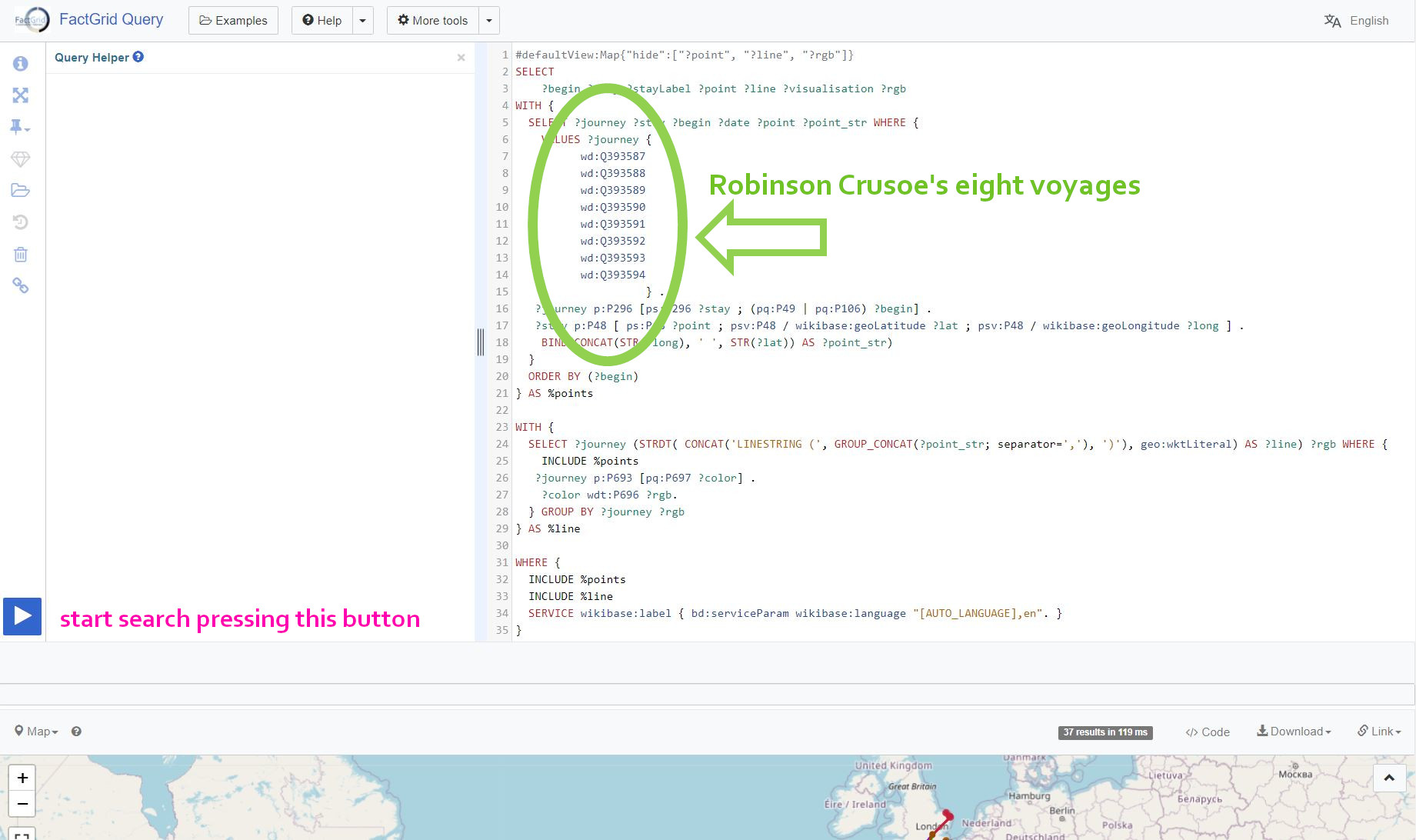
James Heald and Bruno Belhoste provided the script I am employing in the following searches. Ignore the script’s complexity. The nice thing about this script is that you can modify it to run it on your own Q-numbers. This jpg shows you where you will have to list your items:

SPARQL script to bring Robinson Crusoes first eight voyages onto a map

No need to copy the script by hand. This is the search: Crusoe’s first eight voyages, that opens the Query Service with this very script. Press the blue button and you get the map of all eight journeys in one picture. Replace the Q-numbers and you will have your own itineraries on the map.

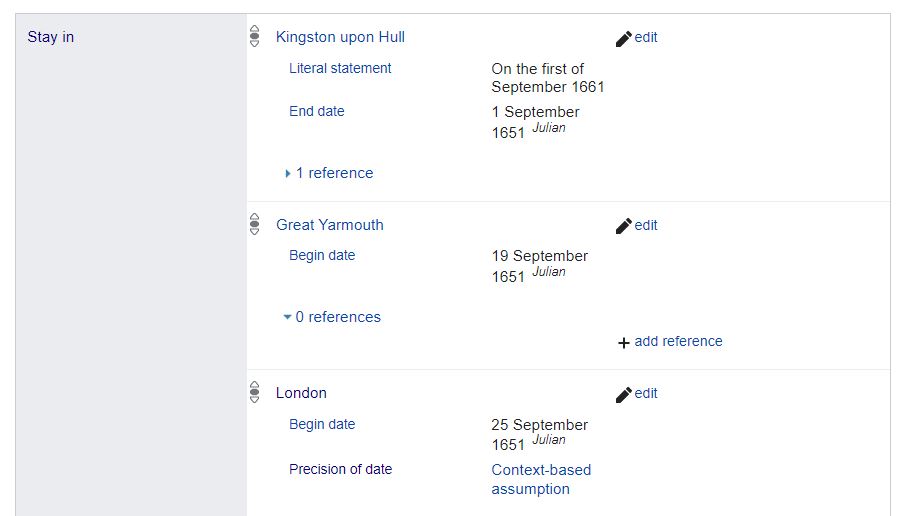
The script is looking into the items listed in lines 7-14. On these items it is looking for P296 statements where the person or group of travellers were staying. The query goes from there into these places to collect the various geographic coordinates. The visualisation will connect these with lines in the sequence of dates that should be given on the various stays, whether as dates of departure (P50), of arrivals (P49) or just as dates (P106) — all three properties are taken into account in line 16. Take a look into the item for the first voyage to see how you have to inform your item(s).

Screenshot FactGrid item with dates

And this is the picture which the query will create:


All eight voyages of Robinson Crusoe’s volume 1 in one picture.

You can change the colours: The information for them is on each item (where you will find a map link with the colour in plain text).

Where do I get the code to embed such an image on web pages?

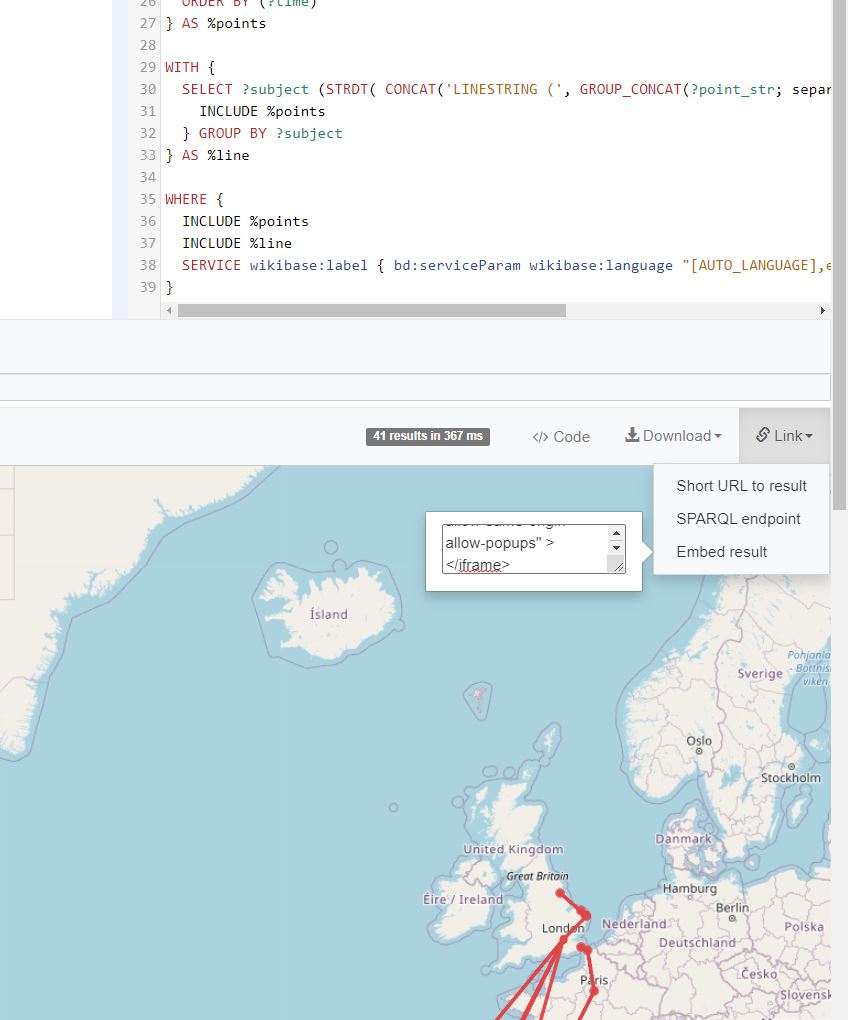
The picture above was not a jpg. You could zoom in and even edit the SPARQL query that generated the visualisation. Whenever you perform a search on FactGrid you cannot only download the data, but you can also get the query as embedded code:

Screenshot, where the embedded code is to be found.

And if your author does not give any dates, just the different places one by one? — like Gil Blas (Q390697) in his history? No problem. You can sort the locations with P499 statements one by one or create any kind of superior sort string as I did in the following Gil Blas search. I am using here the book’s segmentation: 1-1-14 is volume 1, book 1, chapter 14. Replace the P49, P50, P106 date properties for the P499 (number) or P101 (sort string) query to get the respective series of events.

The visualisation is, as I see it right now (on 4 February 2022), incomplete. I am still reading these books slowly whenever I have nothing better to do, and Gil Blas has just left Madrid. I choose this example as it demonstrates the advantage of embedded code.


Tracking Gil Blas of Santillana.

The embedded visualisations always give their pictures as the database provides them the moment the page is opened. The windows are communicating with the database — what is even better: you can communicate with the database right here on this WordPress blog, as the each of the embedded images comes with a menue (on its right hand side, hover over it) that gives you direct access to the SPARQL search engine. Correct or add data on the database (you need an account to do that) and the new information will appear wherever an embedded visualisation will be checking the database — today or over the next years.

More than aesthetics…

One would love to give such visualisations on old maps. click the following link for the visualisation of Crusoe’s eight voyages on https://mappingwriting.com/. My Guinea has moved from the present Republic of Guinea to the early-18th-century location as given on the maps DeFoe could get in London:

“Negroland and Guinea with the European Settlements, Explaining what belongs to England, Holland, Denmark, etc”. By H. Moll Geographer (Printed and sold by T. Bowles next ye Chapter House in St. Pauls Church yard, & I. Bowles at ye Black Horse in Cornhill, 1729, orig. published in 1727)

A line from DeFoe’s London to this Guinea has the smell of modern air traffic. Crusoe’s captains were travelled along the coast lines wherever they could. Yet following their practices is ugly as we do not have these routes in the machine. We are connecting locations, and here I have already interpolated two costal places and two groups of islands to avoid the straight trans-African passage without a conformation from the book.


Crusoes first two journeys.

The nice thing about creating all this on FactGrid is that you can add any amount of further information on these stays and journeys, like the page references, connections to other items or in depth information on places. So lots of things to play with and to do with your own data on FactGrid.


See also

  • “Art collectors and the Holocaust: itineraries from birth to death”, at Open Art Data… Linking Databases To Detect Looted Art, Dec 19, 2021 https://www.openartdata.org/2021/12/art-collectors-and-holocaust.html
  • A Quarter of a Million Items on FactGrid – just a brief reflection

    Germany’s national author Johann Wolfgang von Goethe called it a “masquerade in red and white”, but was himself a member (just as he became a member of the Illuminati a little bit later; it made sense to join such organisations and to know from within what they were all about). Freemasonry was in its most idealistic terms an updated edition of the brotherhood of men united under a simple and strikingly anti aristocratic system: the system of the old craft guilds. With their three degrees of apprentice, fellow and master there was no room for privilege of birth. German masonry evolved from the late 1730’s through the 1750’s principally as a system of four degrees, with Scots Master at the apex and the development did not stop there. The chivalric degrees of the 1760’s and 1770’s gave way to increasingly complex systems, overgrowing this initial construct. These high-degree systems claimed roots in the middle ages if not deeper pasts, synthesising Christianity with alchemy, magic, and theosophy. Masonic entrepreneurs travelled through Europe selling secrets which they would convey in extraordinary lodges. What they offered would have been considered heresies only a generation before, and now became a market of esotericism – a market that turned the masonic world into its first framework and distributor. The Strict Observance or Order of the Temple, the masonic high-grade-system founded by Carl Gotthelf von Hund und Altengrotkau in Germany in 1751 was the biggest player on this stage in central Europe – the system of red and white, the colours of the Knights Templars.

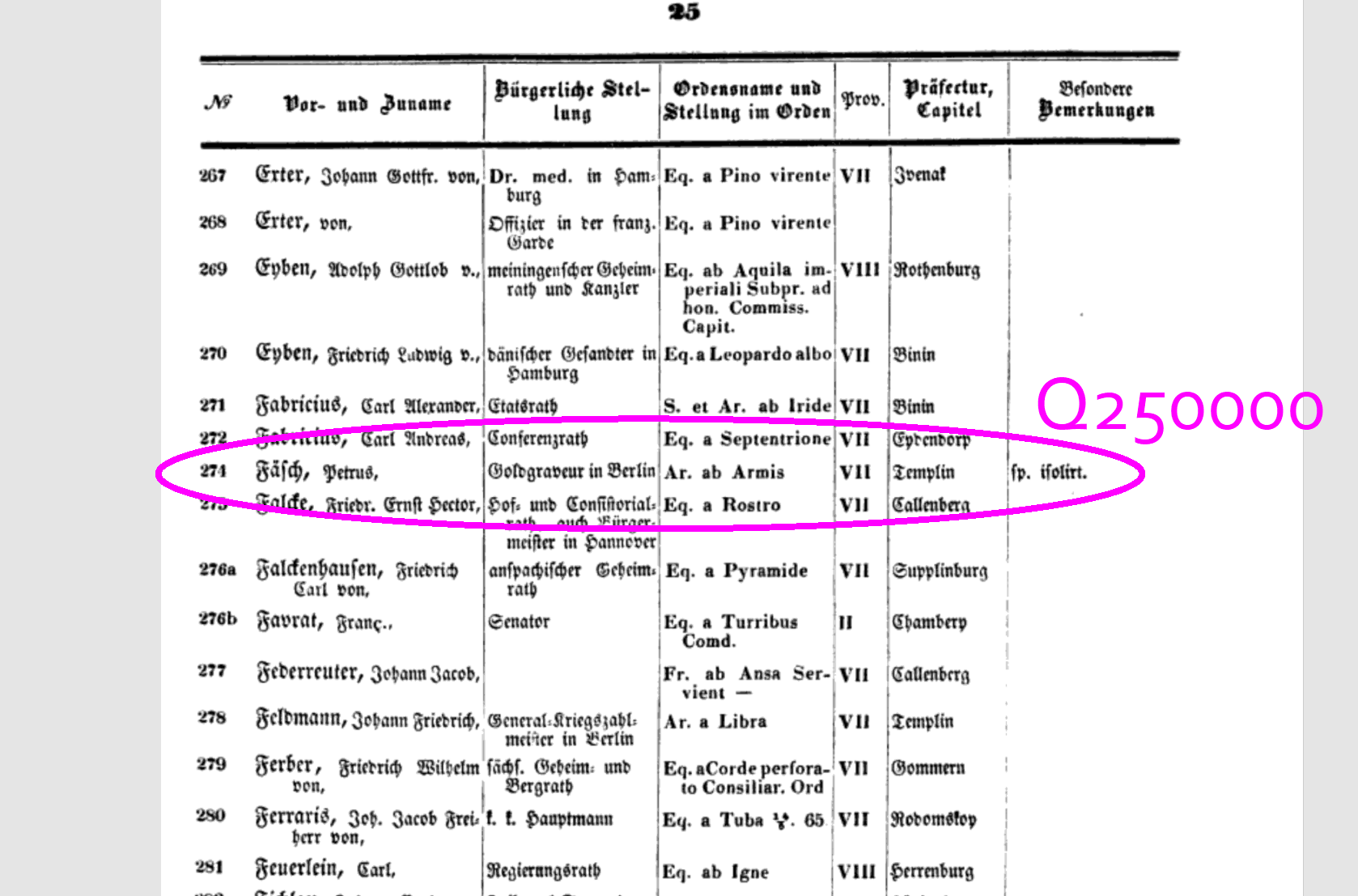
    Q250000 is the FactGrid item number of Pierre Faesch, a Frenchman, by profession a gold engraver, who settled in Berlin where he and some of his friends eventually founded their own lodge “Indissolubilis”. He was number 274 in von Lindt’s list of the members of the Strict Observance, published 1846 – number 274 of the 1,266 members he could establish.

    Josef Wäges broke the quarter of a millionth item with the input of this list on May 10, 2021 at 7:20 (EST). FactGrid became immediately the most interesting environment for this dataset. 180 of his 1,266 records were old acquaintances: members who already had their Q-numbers on FactGrid. But the new data set which anyone can now create on FactGrid is substantially bigger: it lists 1,595 members with interesting overlaps of projects that have been working on FactGrid over the last three years:

    Josef Wäges will publish a more detailed article on the dataset in a lavishly illustrated blog post. The links to the Illuminati are perhaps the most interesting thing to explore in this data set. Von Hund’s claim that the Strict Observance had its roots in the order of the Knights Templar had been both immensely attractive and explosive. The heads of the medieval Order had burned on the stake on May 12, 1310 – but the organisation had gone underground and fused into Scotland’s crypto Catholicism, so the story goes, including the idea that the “Pretender” (to the British throne) was the secret leader of the organisation. The Strict Observance soon expanded from Germany to France, Sweden, Italy, the Baltics and Russia. State leaders became Knights of the Order and met in fancy costumes while members like Goethe or Christoph Bode could easily cast doubts on the historical construct. Von Hund died in 1776 without having given the final proof of the legacy. The organisation itself was by that time in financial troubles over plans to create an insurance system for its members on a foundation of factories, which were to be built under command of the Order on the eve of industrialisation, an organisation that was not really established in the world of modern capitalism.

    The internal conflicts culminated in the summer of 1782 when the rank and file of the Observance met at their last convention in the resort of Wilhelmsbad near Frankfurt am Main. The alleged history stood in the centre of the debates and tore the Order apart while a new organisation was secretly emerging behind the scenes: the Order of Illuminati, both as an antithesis and also as a potential heir of the entire infrastructure. They too were by 1782 a masonic high degree system, and they infiltrated lodges far more cunningly from below than from above. With the help of young “Minervals” which they tunnelled from below into the lodges of their interest, and from above with the help of masonic functionaries in the Illuminati leadership. The fascinating thing about the Illuminati was that all the bombastic narratives were handled as little more than a Machiavellian façade by those who acted as “Unknown Superiors” in the hidden centre of this organisation.

    Our critical mass: strange organisations of the second half of the 18th century

    FactGrid is growing fast. We are doubling our numbers almost every year; that is the more superficial message of the Q250000 jubilee. The more complex message will be: We are (thus far) growing particularly well where we reached our particular critical mass. Entries like Pierre Faesh are the almost ideal subject matter for a Wikibase installation. No portrait has survived, we know little about the biography but we can produce some interesting details with far reaching network information. A genealogy software would not be versatile enough to handle such knowledge. A regular Wiki, with its focus on articles to be written, would on the other hand need to be filled with desolate fragments of repetitive information – we do not know enough to write interesting articles about these people. Using a Wikibase we can easily turn the few points of data we have into an asset. If you want to know more about the “Strict Observance” we can offer the sociological details, networks of the members, family ties, knowledge of the organisation and its surroundings: We can list the various organisational ties of these members and we can – theoretically – give a picture of the landscape of Masonic organisations as they grew and changed from the 17th into the 19th century.

    Not quite the software of citizen science: Our Gotha specialisation

    At an early point we decided to test the software on the wider audience in a local experiment. Gotha is a small town of some 45,000 inhabitants. We could easily give database courses at the Research Centre. The local project developed with mixed success: Gotha’s Archive of the Lutheran City Church embraced the offer of the free database. Heino Richard of Gotha’s genealogical society entered this project and created its biographical backbone with some 20,000 biographical records linked to the archive’s work and to the city’s history. The integrative appeal remained, however, comparatively weak.

    The Wikibase conclusion so far, is interesting in the hands of researchers who are delighted about the flexibility they get with this software. The same tool remains opaque in wider use. We will need interfaces for genealogists and archivists to make broad editing easier, and these interfaces will come.

    Novels, religious dissidents, medieval codices and Nazi concentration camps – leaving our comfort zone

    We are, nonetheless leaving our comfort zone, the zone of late 18th-century biographies, and this is challenging wherever it leads into fields of information without more comfortable background knowledge:

    • Marie Gunreben of the University of Konstanz has started a project on German novels 1670 to 1750. We have widened this project. We should get the European flow of developments into the picture, the exports and imports, the flow of translations and influences across the European borders. The move is an immense theoretical challenge: We are using a software that creates essential notions of sameness wherever it sets a Q-number. The modern English “novel” should, of course, be the modern French or German “Roman”. But the conceptual equivalents do not really lead us back into the early 18th century. The English “novel” was back then what we will today call a “novella”. Robinson Crusoe, if anything, was a “romance” – a spectacular move in 1719 as the romance had just been pronounced dead, finished by the modern novel(la). How should we handle different conceptual developments in different languages? We are experimenting with set language Items and with Q-items that use the modern conceptual frame as an alleged continuum. It remains to be seen how this will work.
    • Lionel Laborie is about to open the long-expected section on Early Modern religious dissent which our present data have been calling for for the last three years. Freemasons, Rosicrucians and Illuminati, quasi-religious associations built upon a new consensus that their members would leave all their confessional controversies aside and focus on a truth beyond. The result was not exactly deism that shined through all the allusions to God as the master builder and supreme architect. It was rather a competition of increasingly eclectic historical constructs of diverse religious dimensions – of heresies in the old terms of the Catholic or Lutheran orthodoxy and these new orthodoxies emerged within this spectrum with different systems that would not necessarily acknowledge each other. If successful we should be able to eventually give a sketch of the changing map – now with a perspective on the biographies that travelled on this map of ever changing options.
    • Isabella Schwaderer already wrote about her project. She mapped the members of the first two years of the German Schopenhauer Society founded in 1912. The project that began as an experiment led to experiments: Isabel Heide and Martin Gollasch introduced a couple of bigger data sets with the prominent prisoners of Theresienstadt, the map of German concentration camps, and the list of German university academics who signed the declaration of allegiance to the new Regime in 1933. These sets have not yet gained a greater depth of information. They were rather created in order to break the ground for new projects that will discover with a look at early 20th-century networks.

    Steps into uncharted territories are a challenge on a Wikibase. You want to augment and to interconnect known objects, you want to work on the basis of our collective present knowledge and suddenly you have to create ever new objects that need ever new objects in order to make sense.

    The Middle Ages – the new territory where we will see the biggest growth on our course to Q500000

    We will enter new fields and Q500000 is already knocking at our doors. Led by Charles Faulhaber the trilingual PhiloBiblon project has decided to fuse their data into FactGrid – 450.000 items of (late) medieval Iberian books and manuscripts. The project will be a test. We might arrive at the conclusion that the global text production deserves its own Wikibase. It might just as well dissolve the present demarcation lines between archives and libraries on the one hand and historical research on the other. Historical information is in its last consequence not much more than an interpretation of remaining textual and documented evidence. We will bring the evidence and the interpretation onto the same platform.

    FactGrid will learn Spanish and Portuguese in the course of this project. The PhiloBiblon group arrives as a team of superbly informed people with different specialisations from data management and librarianship to (literary) history. The technical aim will be to create a user interface on the specific material base that will communicate with the database. FactGrid will act here in the background – nothing to regret, rather the model to go for: The model of a single compound of knowledge that serves various projects as the reservoir of broader collective knowledge.

    In the middle of technical developments

    Wikibase is not yet a widely used software – it has the potential to become this software. The problem is apparent in any imaginable “normal” use case. You search something – but how do you search anything on the SPARQL Query Service? – on a Query Service that expects you to know what you can search and how you would ask for it – without giving you the slightest hint on either question.

    You can use the Wiki surface but here again you will be puzzled. What exactly is the message of these Item pages that collect various statements without order and cohesion? Even if you arrive at a complex item like Q133, Christoph Bode, that item will not tell you half of the story – it does not tell you that this man is the author of hundreds of letters stored in this database, and the recipient of as many – who is mentioned in hundreds of other sources the database has registered.

    Markus Manske’s Reasonator gave a glimpse of what one could do with a Wikibase such as Wikidata: One could produce well-structured pages of information automatically in hundreds of languages. The Reasonator did not make it into the software package nor is it easy to use on an external Wikibase.

    We will get such browsers – not in the singular but in the plural of general and specific purposes and two of these have entered a test phase last month: Bruno Belhoste’s “FactGrid Viewer” and Michael Ringgaard’s “SLING Browser”. Both seem to do pretty much the same job, but they are doing it differently, opening doors into quite different future developments.

    Bruno Belhoste’s FactGrid Viewer (you have been using it over the last minutes wherever you followed the Item-links in this article) is drawing its information straight from the database as you see it. Change data on FactGrid and you will see the new situation with the next browser update. You can switch languages. You get a history of your movements on the site and you get an idea of where you are with a specific item as the object is connected to “what links here?” information.

    You can implement Bruno Belhoste’s viewer – pure Javascript – on any website anywhere in the world to see your choice of FactGrid data – the solution for projects who want to use the FactGrid database simply as their database without a further interest in the broader platform.

    Michael Ringgaard’s SLING Browser works on the basis of the data dump which FactGrid supplies every evening around 21:15 CET. A new edition of the SLING browser’s presentation of information is created every day. The potential is visible in an intricate detail: The Q-Numbers of SLING browser searches are not necessarily FactGrid Q-Numbers (Christoph Bode our Q133 is on the SLING Browser Q213880). If there is information about the same object available on Wikidata the SLING Browser will give it under the Wikidata Q-Number, and this is only the beginning of the upcoming development: We will eventually see pages that accumulate information from various Wikibases – not in a show of serialised harvests but in a single coordinated representation that accumulates information and that marks the differences only where it arrives at disagreeing statements. This is a tremendous step into the world of “federated Wikibases” that will eventually present the best information of specialised platforms that all speak a common language of triple based statements.

    Both browsers are part of the FactGrid-menu-structure but not yet the breakthrough to a simple widespread use of our data. The big issue is at the moment the missing search interface. Google will lead you straight into our items – where you will be lost before you understand how you can navigate on such a platform. The two browsers do not give you a better search interface than the input field on the database’s wiki. If you have just the last name of a person and a rough idea of where they lived that will not help you here or there. You will get to the family name without a hint of how to find those who lived with this Family name. Future Wikibase browsers will have to overcome these dead ends of the individual browsing histories; they will need an advanced search to access data in the first place and internal information that shows why the database has listed the particular object. We will see these interfaces becoming available in a variety of technical options and a broad range of integrations over the next few years.

    Integrating FactGrid: NFDI-4Memory participant and GND partner project

    We have been surfing a wave of success over the last three years – the wave which Wikibase was creating, the software that is about to be used by national libraries worldwide and in “National Research Data Infrastructures” all over the world.

    The reason why National Libraries are experimenting with Wikibase platforms is simple: They have all created authority control data to run the various catalogues that use these data. Humans can understand that Death in Venice was written by Thomas Mann, the 1929 Nobel Prize in Literature laureate. Fresh publications under the same name must have other authors of the same name and this is where databases need a superior form of knowledge. They will handle the 28 authors under that name in a combination of unique identifiers (supplied for instance by the German National Library’s GND’s) and specific biographic background information detailed enough to define who is who in this mess. The system has been working well in its various national boundaries but it was difficult to tell who a specific Thomas Mann was on the BnF’s complementary cataloguing system. It is this riddle that Wikidata has begun to solve. Not only does Wikidata interconnect the up to 300 Wikipedia articles that exist on the various language projects on “the same” entities. The respective Wikidata items will also clarify who these people, organisations and places will be on hundreds of external databases – from the GND to the BnF catalogue.

    Historians should states these references on all data they are producing (wherever available) since this is the only way for anyone using their data to automatically check who is who in the different sets they are merging.

    The easiest thing FactGrid could do is offer simply all the GND items in the basic pool of objects available on the site to link to. Yet the easiest thing will not be the best thing here. As the National Libraries are about to create and to interconnect their own Wikibases we should enter this compound more as a partner than an interested user. “Our” data should profit from corrections made elsewhere in the wider environment. Corrections made on FactGrid should in return enter the global exchange with information about the research that led to these changes.

    We are still living in a world in which DH projects are basically transferring their view of the book world into the new medium of the internet. Books have to be quoted as do web projects – so the common logic, that is creating ever new islands of information on isolated web-platforms.

    The future is not the web project quoted in a book or by another web project. The future is in data ready to be downloaded and used in ever new environments. We will need authority to control data, to ensure that those who use our data know what they have downloaded, and we will need collective platforms to offer data in an environment in which the augmentation and further development of information can take place.

    https://4memory.de/

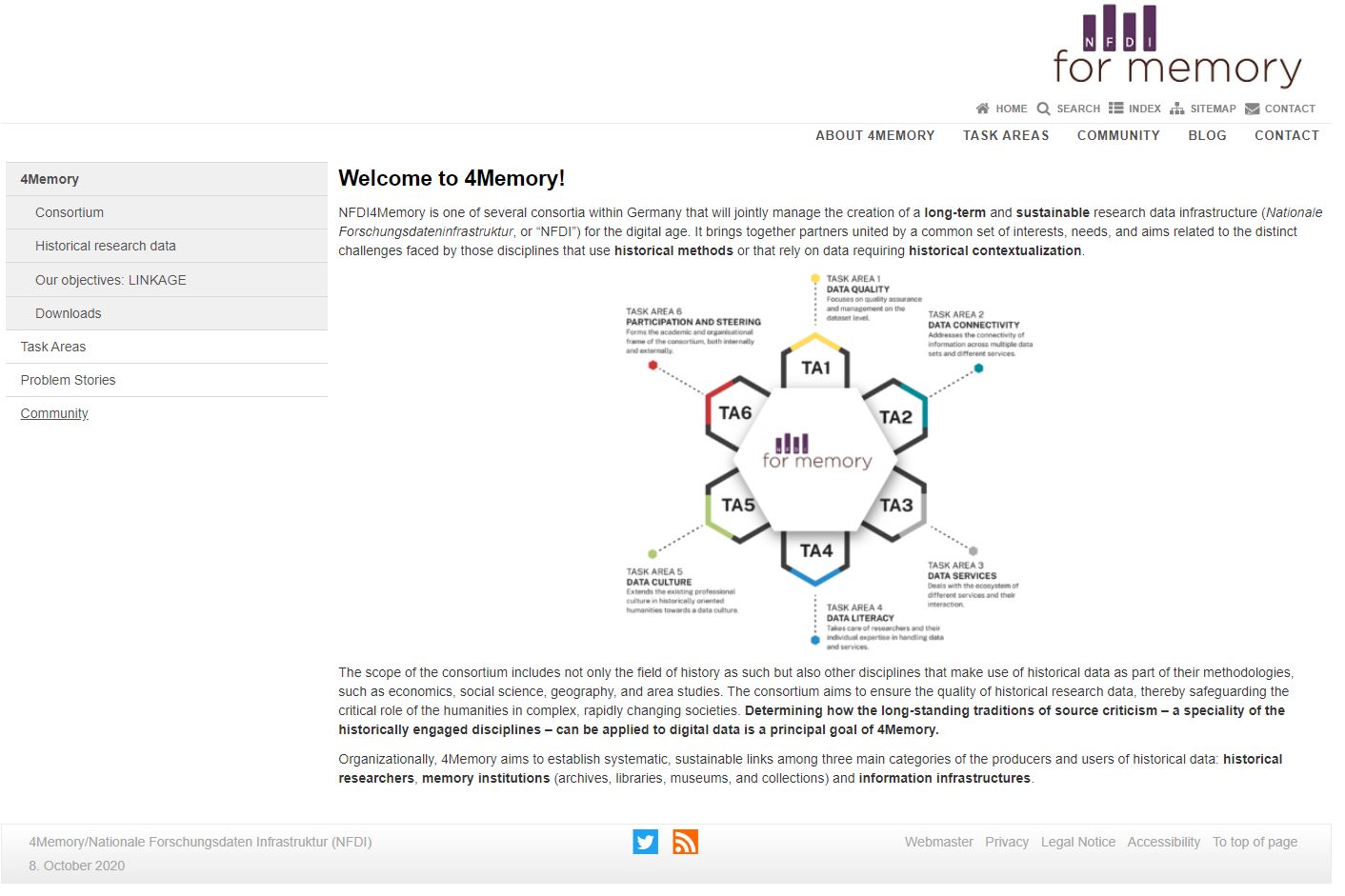
    It was therefore paramount for us to enter Germany’s present NFDI process. The process is on a trajectory of creating research data repositories in all the fields of the sciences and academic studies – repositories, that will eventually present their data under a broader search engine. We have entered this development as a “participant” of the NFDI’s upcoming 4Memory compound (the compound of the studies that are dealing with historical data).

    Our present consideration is how to balance such an integration as a decidedly international site. We will need an international board of FactGrid Stakeholders since this is what we have become over the last three years: an international platform using a multilingual software in order to interconnect research across the borders.

    Ein Best-Practice-Szenario für die Erschließung historischer Wissens- und Gebrauchsliteratur als Open Data

    In Wikiversity erstveröffentlichter Wikimedia-Wettbewerbsbeitrag

    Projektbeschreibung

    Das Wissen über die Welt und den menschlichen Umgang mit dieser, über praktische Fähigkeiten und theoretische Erkenntnisse, wurden über Jahrhunderte in Handschriften gesammelt und verfügbar gemacht. Die ältesten deutschen Wissens- und Gebrauchstexte stammen noch aus Althochdeutscher Zeit (8. – 11. Jahrhundert) und besonders in Frühneuhochdeutscher Zeit (ca. 1350¬1650), wächst die Anzahl der Texte und Themengebiete rapide. Immer neue Wissensbereiche wurden in deutscher Sprache erschlossen und ein Großteil der spätmittelalterlichen deutschen Handschriften enthält Wissens- und Gebrauchstexte. Dennoch stehen diese Texte nicht im Zentrum germanistischer Forschung und sind – auch aufgrund ihrer Diversität und Komplexität – wesentlich schlechter erschlossen als literarische Texte. In meiner Forschung versuche ich diese Wissenslücke zu schließen und bislang vernachlässigte Textsorten, wie etwa Losbücher, Kalender, Geomantien, Textamulette, Tintenrezepte oder Anleitungen zur Dämonenbeschwörung (auch hier, hier und hier) so zu erschließen, dass sie von Fachkollegen, aber auch einem größeren Publikum, aufgefunden, gelesen und verstanden werden können. Dies soll auch dazu dienen die Überlieferung dieser Texte und damit die geographische wir soziale Verbreitung historischer Wissensbestände nachvollziehbar zu machen. Ein großes Problem ist dabei die mangelnde Referenzierbarkeit der Texte, die aufgrund ihrer Form (bspw. Rezepte) oder ihre Unbekanntheit keine etablierten Titel haben, in den einschlägigen Fachlexika (Verfasserlexikon) nicht erfasst sind und auch innerhalb der Forschungsliteratur unterschiedlich bezeichnet werden. Im digitalen Umgang mit diesen Texten verstärkt sich dieses Problem, da handschriftlich überlieferte deutsche Texte überhaupt nur in Ausnahmefällen über Normdaten oder andere Linked-Open-Data-Formate erschlossen sind.

    Im Rahmen des Fellow-Programm Freies Wissen soll ein Best-Practice-Szenario für die Erschließung historischer Wissens- und Gebrauchsliteratur als Open Data entwickelt werden. Dieses schließt an bisherige Arbeiten zu den Losbüchern und Chiromantien sowie der laufenden Katalogisierung der illustrierten mantischen Prognostiken für den Katalog der deutschsprachigen illustrierten Handschriften an und soll die deutschsprachigen mantischen Texte des Spätmittelalters einem breiteren Publikum erschließen und Forschungsdaten nachnutzbar machen. Dazu ist eine Kombination aus Open-Access-Forschungsbeiträgen, der Überarbeitung von Wikipedia-Artikeln, der Veröffentlichung von Handschriftenabbildungen (im Archive und in Wikimedia Commons) sowie der Generierung von offen zugänglichen Erschließungsdaten vorgesehen. Dabei sollen Erschließungsdaten zu deutschsprachigen Wissens- und Gebrauchstexten des 14. bis 16. Jahrhunderts erstmals in der FactGrid-Datenbank und damit auf einer Wikibase-Instanz erfasst werden. Über die FactGrid-Datenbank sollen nicht nur einzelne Texte dauerhaft und eindeutig identifizierbar gemacht, sondern auch verschiedene digitale (Handschriftendatenbanken, Bibliothekskataloge, Handschriftendigitalisate) und analoge (Forschungsliteratur) Angebote vernetzt werden, sodass Informationen zu einzelnen Texten zentral auffindbar sind. Gleichzeitig ermöglicht die Erfassung von Textereignissen einzelner Handschriften und Werken in FactGrid auch eine maschinelle Auswertung und Visualisierung dieser Daten.

    Im Projektzeitraum der Fellow-Programm steht vor allem die Aufbereitung der bereits erschlossenen Daten zu den Losbüchern und Chiromantien für das FactGrid-Repository und die Entwicklung von Arbeitsroutinen zu Integration der Daten im Vordergrund. Über Vorträge, unter anderem im Netzwerk Historische Wissens und Gebrauchsliteratur soll das Projekt während dieser Zeit bekannt gemacht und mit einem Beitrag in der Open-Access-Zeitschrift „Mittelalter. Interdisziplinäre Forschung und Rezeptionsgeschichte“ vorläufig abgeschlossen werden.

    Meilensteine

    1. Entwicklung eines Modells der Datenstruktur für die Einträge in FactGrid
    2. Entwicklung eines Routine zur Aufbereitung und Intergration der Daten
    3. Intergration der Daten zu den Chiromantien [student. Hilfskraft]
    4. Intergration der Daten der Dissertation (Das Losbuch. Manuskriptologie einer Textsorte des 14.-16. Jahrhundert. 2018) [student. Hilfskraft]
    5. Zeitschriftenbeitrag zur Überlieferung der deutschsprachigen Chiromantien bis ca. 1520
    6. Überarbeitung des Wikipedia-Artikels ‘Chiromantie’
    7. Zeitschrftenbeitrag über Projekt

    Zwischenbericht Oktober/November 2020

    Die Monate Oktober und November dienten vor allem zur organisatorischen Vorbereitung der Forschungsarbeit:

    1. Personal:

    Zunächst war unklar, ob und auf welche Wiese eine studentische Hilfskraft eingestellt werden kann. Dies ist nun über den Lehrstuhl für Ältere Deutsche Literatur der RWTH Aachen möglich. Der Abschluss eines Arbeitsvertrags ist aber erst dann sinnvoll, wenn die gesamt Summe des Stipendiums ausgezahlt wurde. Ansonsten wäre die Laufzeit zu kurz.

    2. Forschungscommunity:

    Aus einer seit 2019 bestehenden losen Forschergruppe heraus, haben wir am 4.10.2020 den Verein Netzwerk Historische Wissens- und Gebrauchsliteratur] (HWGL) gegründet und ich habe dessen Vorsitz übernommen. Der Verein organisiert regelmäßig Netzwerktreffen, in denen auch die kollaborative Datenspeicherung abgesprochen wird. Es besteht bereits ein von mir betriebenes Wiki. Ob sich FactGrid als Erweiterung desselben eignet, soll in diesem Projekt erkundet werden.

    3. Datenmodell/Workshop:

    Das Datenmodell soll gleichzeitig praktikabel und theoretisch fundiert sein. Es muss daher mit der Forschungscomunity abgestimmt werden. Einen ersten Entwurf werde ich am 10.12.2020 auf dem 1. HWGL-Abendkolloquium vorstellen. Auf einem Workshop im Rahmen des (virtuelles) Netzwerktreffen Historische Wissens- und Gebrauchsliteratur (08.-11.01.2021) soll der praktische Umgang mit diesem erprobt werden. Ich bin auch an der Organisation beider Veranstaltungen beteiligt. Bei der Gestaltung des Datenmodells sind auch rechtliche Aspekte wichtig. Ursprünglich war ein Import der gesamten Datenbestände des Handschriftencensus angedacht. Dies ist aus rechtlichen Gründen (Unterschiede in der Lizensierung), jedoch nicht möglich. Ein Import von Daten scheint mir nur dann rechtlich zulässig, wenn das Datenmodell der FactGrid Datenbank sich wesentlich von dem des Handschriftencensus unterscheidet.

    4. Thematisch relevante Publikationen:

      • Zu den Artikel ‘Sortes’ und ‘German Texts on Superstition’ des Handbuchs Prognostication in the Medieval World mussten noch die Fahnen korrigiert werden. Das Handbuch ist am 09.11.2020 erschienen.
      • Das Manuskript eines Beitrags zur Analyse von handschriftlich Überliefertem mittels Graph-Datenbanken, habe ich im September abgeschlossen. Dieser Beitrag hat Einfluss auf das Datenmodell in FactGrid, denn die dort entwickelten Analyseprozesse sollen auch mit den späteren FactGrid-Daten möglich sein. Der Artikel wird in der Zeitschrift für digitale Geisteswissenschaften erscheinen und wird derzeit redaktionell eingearbeitet.
      • Gemeinsam mit Björn Reich und Matthias Standke gebe ich einen Sammelband mit Editionen früher gedruckter Losbücher heraus. Die eingereichten Texte werden von uns redigiert. Die Erschließungsdaten der Losbücher, die ich hauptsächlich bereits in meiner Dissertation erfasst habe, werden einer der ersten Datenbestände sein, die in FactGrid importiert werden.
      • Die Erschließungsarbeit für den Katalog der deutschsprachigen illustrierten Handschriften der Bayerischen Akademie der Wissenschaften läuft weiter. Auch die Dabei gewonnenen Daten sollen in FactGrid importiert werden.

    5. Wissenschaftskommunikation:

    Meine Mentorin Anita Runge hat mich durch ihre Perspektive auf meine Forschung davon Überzeugt, dass deren Gegenstände und Ergebnisse auch für ein breiteres Publikum interessant sind. Ich versuche mich daher stärker im Bereich Wissenschaftskommunikation zu engagieren.

      • Bereits seit Anfang des Jahres läuft die Zusammenarbeit mit dem Germanischen Nationalmuseum in Nürnberg zur Ausstellung Zeichen der Zukunft. Wahrsagen in Ostasien und Europa, die eigentlich Anfang Dezember 2020 eröffnet werden sollte. Für den Katalog zur Ausstellung habe ich drei Artikel verfasst.
      • Im Januar werde ich für eine Folge des Podcasts Anno PunktPunktPunkt zum Thema Zukunftsprognostik im 15. Jahrhundert zwischen Aberglaube, Wissenschaft und Spiel. Zur Beziehung zwischen Diskurswandel und Medienwandel interviewt. Die Folge soll im Februar 2021 erscheinen.
      • An der Universität Salzburg werde ich am 13.1.2021 einen Gastvortrag zum Thema Kristallsehen. Praktiken und Erklärungsmodelle von der Antike bis heute halten.

    Bild:

    Konrad Bollstatter: ‘Complexiones-Würfelbuch’
    Augsburg 1455
    Schreiber: Konrad Bollstatter, Illustrationen: Werkstatt Johannes Bämler
    München, Bayerische Staatsbibliothek, Cgm 312, fol. 51v-52r
    (Bild: Bayerische Staatsbibliothek, Montage: Marco Heiles, Lizenz: CC BY-NC-SA 4.0)

    Einblicke in das interne Berichtswesen des Illuminaten-Ordens. Aus der Hand Hermann Schüttlers: 71 Dokumente der Jahre 1781 bis 1785

    Die folgende Materialpräsentation ist das Ergebnis eines zweimonatigen Praktikums im Forschungszentrum Gotha. Mein Projekt war es, der Forschung Vorarbeiten zu einem unvollendet gebliebenen Buchprojekt Hermann Schüttlers datenbankgestützt auf den FactGrid-Seiten zugänglich zu machen. Es handelte sich hierbei um Transkriptionen von 71 Dokumenten aus dem inneren Machtzirkel des Illuminatenordens der Jahre 1781 bis 1785. Im Gegensatz zu den von Hermann Schüttler und Reinhard Markner zuvor bereits vorgelegten Bänden der Illuminatenkorrespondenz steht hier das interne Berichtswesen des Ordens im Zentrum. Das Corpus birgt:

    • 12 für den Orden verfasste (Auto-)biographien,
    • 26 Inspektionsberichte,
    • 29 Sitzungsprotokolle der bisher wenig bekannten “zweiten” Minervalkirche Frankfurts; zu ihnen kommen drei Protokolle der Gothaer Minervalkirche und eines aus Weimar.

    Es galt dabei erstens, die unterschiedlich umfangreich verfußnoteten Transkripte im Gesamtumfang von bislang 237 Seiten von ihren Word-Dateien in Wiki-Seiten des FactGrid zu überführen, sie dabei mit kurzen Einleitungen zu versehen und die Fußnotung an die Datenbank anzukoppeln oder in einem Großteil der Dokumente erst durch eigene Recherche zu erstellen – bei den Inspektionsberichten kamen im Extremfall über 200 Fußnoten im Einzeldokument in den Blick. Zu allen Dokumenten waren im zweiten Schritt Datenbankobjekte anzulegen, die die Transkripte grundlegend erschließen und Datenbankrecherchen zugänglich machen. Zentral war hier die Erfassung von Autor, Entstehungsort und -datum; erwähnten Personen, Orten und Themen. Zu den Protokollen von Sitzungen wurden zudem Ereignis-Datenbankobjekte angelegt, an die sich nun eigene Fragen, etwa zu Nachweisen persönlicher Begegnungen von Sitzungsteilnehmenden, stellen lassen.

    Nachfolgend:

    1. Einige erste inhaltliche Ausführungen zu den hiermit zugänglich gemachten Dokumenten
    2. Einige Bemerkungen zur technischen Realisation und zu Problemstellen der Datenbanksoftware, die hier zur Nutzung kommt
    3. Alle Dokumente, Transkripte und Ereignis-Datensätze dieses Projektes chronologisch sortiert

    Wissensakkumulation in der Phase des rasant wachsenden Geheimordens

    In die erste Phase des Illuminatenordens – die Phase des primär bayerischen Ordens unter der unmittelbaren Führung Adam Weishaupts – gaben 1787 die Aktenveröffentlichungen des Bayerischen Staates Einblick, die den Orden noch im Sommer 1787 im Raum der deutschen und österreichischen Territorien kollabieren ließen. Über die Spätphase des Ordens, in der unter Johann Joachim Christoph Bode Thüringen zum neuen Zentrum wurde, sind wir auf der anderen Seite aus den Dokumenten der Schwedenkiste informiert.

    Die Dokumente, die Hermann Schüttler vorliegend transkribierte, stammen vor allem aus dem Nachlass Adam Weishaupts und dem Sonderarchiv Moskau. Einige Dokumente der Schwedenkiste kamen hinzu. Zusammen geben sie einen Einblick in die turbulente Zwischenphase, in der Adolph Freiherr von Knigge für das große Wachstum des Ordens sorgte. Berichterstatter sind dabei unter anderem Johann Martin Graf zu Stolberg-Roßla, Franz Dietrich Freiherr von Ditfurth und am häufigsten Knigge selbst. Gemeinsam präsentieren sie ein multiperspektivisches Bild der mit dem Wachstum kommenden Anforderung, Überblick zu wahren. Noch in diesen Versuchen wird klarer, dass es keine gemeinsame Ordenspolitik mehr gibt und kaum noch eine Chance, intern abzustimmen, wer in diesen Orden aufgenommen wird und Karriere macht. Zerreißproben tun sich mit Einzelfällen auf, über die es zum Streit kommen würde, wenn alle Informationen im Orden öffentlich würden; der Konflikt des Ordens mit Knigge erweist sich dabei als mehr denn ein Konflikt zwischen diesem und Weishaupt, dem Ordensinitiator.

    Exemplarische Selbstauskünfte

    Alle neuen Mitglieder mussten eine Verschwiegenheitserklärung unterzeichnen: das Revers. Sie beantworteten Fragen zu ihren Erwartungen an die unbekannte Organisation, die sich ihnen damit inmitten der Freimaurerei auftat und waren aufgefordert, autobiographische Selbstauskünfte einzureichen. Zwölf dieser Selbstauskünfte umfasst die Textauswahl. Es handelt sich hierbei überwiegend um kurze Lebensläufe und um einem Frageraster folgende Reflexionen über verschiedene Aspekte der eigenen Person vom physischen Zustand bis zum politischen und moralischen Charakter. Hinzu kamen standardisierte Fragen, beispielsweise für die Aufnahme ins Schottische Noviziat, die in Stichworten beantwortet wurden. Häufig wählten die Verfasser jedoch eine freiere Form und schilderten in Fließtexten mit unterschiedlichen inhaltlichen Schwerpunkten ihre wichtigsten Lebensstationen und zwischenmenschlichen Beziehungen.

    In einem offenkundigen Zusammenhang zu den übrigen Dokumenten dieser Materialsammlung stehen die (auto-)biographischen Einlassungen Q175807 und Q175808 zu Christian Gottlob Neefe. Neefe war im hier dokumentierten Zeitraum als Gast der “zweiten” Minervalkirche Edessas/Frankfurts aktiv. Bei den Teilnehmenden aus den drei Sitzungsprotokollen in Gotha gibt es weitere Überschneidungen mit fünf der autobiographischen Texte. Zwei Autobiographien stammen von Mitgliedern aus Neuwied, die dortige Minervalkirche taucht häufig als einflussreiches Zentrum in den Inspektionsberichten auf. Bodes autobiographische Selbstauskunft rundet die Auswahl ab – der zukünftig zentrale Akteur des Ordens ist hier mit im Geflecht der Selbstaussagen vertreten.

    Besonders gewinnbringend war die Bearbeitung der autobiographischen Texte im Hinblick auf die Details, die sich aus ihnen für die bestehenden Datensätze ziehen ließen. So konnten bei jeder der Personen Aussagen zu Aufenthalten, Berufen und ähnlichem ergänzt werden. Noch spannender waren ihre Informationen für die Verdichtung von Netzwerken. Durch die Erwähnung von Verwandten, Freunden, Arbeitgebern und anderen Personen, die die eigene Entwicklung prägend tangierten, konnten viele neue Personen angelegt und in Relation zu bereits bestehenden Items gesetzt werden.

    Inspektionsberichte: Wie der Orden versuchte, Überblick in der Informationsflut zu gewinnen

    Extensive Quellen sind im Set die fünf Inspektionsberichte Stolberg-Roßlas. In ihnen fließen Informationen aus den Minervalkirchen geordnet nach den Provinzen, ihren Präfekturen und deren Minervalkirchen zusammen in einer Berichterstattung, die bis zu den einzelnen Mitgliedern an den verschiedenen Orten hinab reicht.

    Dabei steht als größtes strategisches Problem im Raum, dass im Moment mehr Orte auf der illuminatischen Landkarte der geheimen Ordensgeographie als an diesen Orten bereits arbeitende Minervalkirchen zu finden sind.

    Alle 92 Orte, die einen Illuminatenordensnamen erhielten [FactGrid Datenbankabfrage]

    Der Aufbau der Minervalkirchen verlief über Mitglieder einzelner Logen, die unmittelbar zu hochrangigen Illuminaten “ihrer” Orte wurden. Von ihnen wurde erwartet, dass sie aus ihren Logen die Mitglieder für die lokalen Minervalkirchen gewinnen. Unter den Mitgliedern machten Studenten eine große Gruppe aus. Zu den flächendeckenden Rekrutierungen kamen die individuellen Vorschläge, die alle Ordensmitglieder machen konnten und über die auf höherer Ordensebene konsistent entschieden werden sollte. Aus den Dokumenten sprechen Konflikte zwischen Beteiligten, die von der Aufnahme anderer erfuhren, mit denen sie keineswegs im selben Orden sein wollten. Gleichzeitig wird sichtbar, dass die Verantwortlichen hier längst in einem Spannungsfeld persönlicher Befindlichkeiten und Verbindlichkeiten agierten, in dem sie im Ernstfall nur noch darauf hoffen konnten, dass Konflikte im Raum des Geheimordens nicht vor der inneren Öffentlichkeit sichtbar werden. Knigge berichtet am 26. September 1782 in diesem Gewirr von Aufnahmen, für die er grünes Licht gab, obwohl er ihr Konfliktpotential absehen konnte:

    Mein Plan war, den Epictet nach und nach zu stimmen, und jedem in der Provinz eine Laufbahn zu eröffnen, welche sich nicht kreutzen könnte. Den Hrn. W[und] zu gewinnen, war um so nöthiger, da die neue Freymäurerey die Direction der VIII. Provinz nach Heidelberg verlegt, und ihm die Direction gegeben hat. Ich verlangte als erste Probe der Treue, daß er unsre Leute in der Pfalz mit zu der Sache ziehen sollte … [Tanskript]

    Deutlich zeigt sich an dieser Stelle ein nicht mehr zu lösender Widerspruch zwischen der Zentralisierung des Informationsflusses und der Freiheit, mit der die mittlere Führungsebene agieren musste und auch agierte.

    Das Berichtswesen, das mit den Dokumenten sichtbar wird, erweist sich als ausgefeilt und modern:

    Aus den Minervalkirchen trafen zu allen Personen monatliche Zeugnisse ein. Im Orden wurde, um hier den Überblick zu behalten, ein standardisierter Strichcode eingeführt, mit Hilfe dessen man auf einen Blick zu erfassen hoffte, wo sich besonders interessante Personen sammelten. Aus den Inspektionsberichten schimmert jedoch durch, dass man hier eher erfasste, wo Verantwortliche auf der mittleren Ebene ihre eigene Arbeit in ein besonders gutes Licht zu stellen suchten.

    Die Transkripte der Inspektionsberichte geben diese Strichcodes für Hunderte von Personen wieder. Greifbar wird im selben Moment der erhebliche Arbeitsaufwand, den dieses Berichtswesen auch in dieser Kondensierung noch bereitete. Die höhere Hierarchieebene musste Protokolle zusammenführen und Korrespondenzen in alle entstehenden und agierenden Filialen unterhalten. Knigge konnte man hier die Überlastung im Wachstum des Ordens anmerken:

    Noch einmal wiederhole ich, was ich nicht genug wiederholen kann: wenn wir|
    a.) Das ganze System ausgearbeitet haben,
    b.) Wenn jede Provinz ihren Provinzial hat,
    c.) Wenn über 3 Provinzen ein Inspector gesetzt ist,
    d.) Wenn wir in Rom unsere National-Direction haben:
    e.) Wenn mit diesen allen die Areopagiten nichts zu thun haben, sondern im Verborgenen das Ruder führen, folglich nicht entdeckt werden können, nicht so sehr mit verdrüßlichen Details überhäuft sind, sondern das System überschauen, verfeinern, in andere Lander ausbreiten, zur rechten Zeit der dirigirenden Classe beystehen können: – Dann, und nicht eher richten wir etwas aus. Wir bedärfen also dann keiner so lärmenden Anstalten, müßen jeden Provincial in seine Gränzen zurückweisen. – Fahren wir aber fort so in die Kreuz und Quere zu operiren, so sind wir in 3 Jahren gesprengt. Nun zu meinen Berichte… [Transkript]

    Die Protokolle der “zweiten” Frankfurter Minervalkirche und der Konflikt mit Knigge

    Die vorgelegten Protokolle aus Frankfurt ermöglichen es, den Konstituierungsprozess einer Minervalkirche exemplarisch nachzuvollziehen und geben einen vertiefteren Einblick in die Geschichte der zwei Minervalkirchen Frankfurts, zwei nacheinander aktiven, verschiedenen Gruppen mit größtenteils denselben Mitgliedern. Die Protokolle der “zweiten” Frankfurter Minervalkirche zeichnen sich dabei in der Anfangsphase durch die Regelmäßigkeit und Ausführlichkeit sowie formelle Konsistenz aus. Wie später in Gotha traf man sich monatlich in der Minervalkirche und, die höheren Mitglieder, im exklusiven Magistrat. Die Treffen lassen sich mit der Datenbank auf einen Zeitstrahl projizieren und dabei bis auf die Wochentage heranzoomen. Die Frankfurter Teilnehmendenlisten zeugen von Kontinuität und erlauben Rückschlüsse auf die Mitgliederstruktur in diesem Zeitraum. Eingehend erfasst sind in den ersten Monaten jeweils Programmpunkte wie die Planung von gemeinsamen Lesungen und inhaltlichen Diskussionen über Grundsätze der Leitlinien des Ordens, die förmliche Initiation der neuen Magistraten auf einer eigens dafür organisierten, ordentlichen Versammlung und die pünktliche Abgabe schriftlicher Ausfertigungen sowie der Austausch der Quibus Licet und Reprochen, die sich sehr ausführlich dokumentiert in den Transkripten zur weiteren Vertiefung nachlesen lassen.

    In den Protokollen werden nicht minder interne Konflikte greifbar, wie sie die Aktivität des Ordens immer wieder nachhaltig prägten. Interessant ist dabei der sich noch vor dem Zerwürfnis zwischen Weishaupt und Knigge aufzeigende Konflikt vor Ort: Am 15. Juni 1783 sollte Johann Ludwig Hetzler nach einer Anweisung der Oberen ein Treffen der vormals aktiven Mitglieder der Minervalkirche Edessa initiieren, um diese nach einem großen internen Streit, der schließlich zur Inaktivität der Gruppe führte, wiederzubeleben. Knigges Wirken stand, so lässt sich in Umrissen ersehen, im Zentrum dieses Konflikts. Nach den Aussagen der anwesenden Mitglieder hatte er versucht, heimlich alle Ordensgeschäfte vor Ort unter seine Kontrolle zu bringen und darüber hinaus eine gänzlich neue Minervalkirche unter Ausschluss der bisher Aktiven zu errichten. Die Konstituierung der neuen Minervalkirche wurde daher auch nur unter der Versicherung der Oberen vollzogen, dass Knigge nichts mehr mit der Präfektur zu tun haben werde (Vgl. J.P.C. Müllers Bericht vom 15.6.1783).

    Ihr Gegengewicht finden diese Dokumente in der vorliegenden Textauswahl mit den vier von Frankfurt aus verfassten Inspektionsberichten Knigges aus den Jahren 1781 und 1782. Im Juli 1781 berichtet er bereits, dass die meisten Mitglieder der örtlichen Minervalkirche, die beinahe ausnahmslos deckungsgleich mit den Aktiven und der Führungsebene 1783 sind, unbrauchbar für den Orden seien. Einzig lobend hebt er Simon Friedrich Küstner und Johann Friedrich Piehl hervor (Vgl. Knigge, Inspektionsbericht vom 11.7.1781). Während Ersterer später in der “zweiten” Frankfurter Minervalkirche im Amt des Sekretärs aktiv im Magistrat der Gruppe mitwirkt, erklärte Letzterer noch zu Beginn der neu konstituierten Kirche, dass er, ehemaliger Censor und Teil der bisherigen lokalen Führungsriege, künftig nichts mehr mit dem Orden zu tun haben wolle (Vgl. J.P.C. Müllers Bericht vom 23.6.1783).

    Im September 1781 schien sich die Lage noch deutlicher zugespitzt zu haben, denn nun verkündete Knigge, dass er wegen einer generellen Nachlässigkeit aller Mitglieder der Minervalkirche diese verlassen habe und keine Quibus Licet mehr von ihnen annehmen werde, bis eine deutliche Besserung eingetreten wäre. Darüber hinaus hoffe er mit der Hilfe Leonhardis und Küstners, bald eine neue Gruppe ohne die anderen bisherigen Mitglieder aufbauen zu können (Vgl. Knigges Inspektionsbericht vom 10.9.1781). Beide sollten zwei Jahre später höhere Ämter in der “zweiten” Minervalkirche innehaben.

    In den Berichten Knigges vom Oktober 1781 und August 1782 findet sich kein Wort mehr zu der Minervalkirche in Frankfurt, obwohl er in beiden Fällen noch vor Ort lebte und im Orden für die Provinz zuständig war. Ab Februar 1783 kamen seine Inspektionsberichte aus Heidelberg. An diesen Weggang knüpfen jedoch drei Inspektionsberichte Stolberg-Roßlas ab März 1783 an. Dieser erwähnt explizit in dem ersten Inspektionsbericht vom 5. März 1783 über den vorherigen Monat, dass sich Knigge künftig nicht mehr mit Edessa abgebe (Vgl. Stolberg-Roßlas Inspektionsbericht vom 5.3.1783.

    Stolberg-Roßlas Berichte geben weiteren Aufschluss über die Entwicklung vor Ort. Auch er kritisiert die lokale Niederlassung und die aktiven Mitglieder stark und spricht ihnen direkt oder indirekt durch die Einschätzungen Dritter den Wert für den Orden ab. Besonders deutlich wird dies durch Zeilen wie:

    Alles lesen wollen, über alles lachen, alles tadeln und doch nichts thun, ist, nach Valerius [i.e. Ditfurth], der Geist der Edesser. [Stolberg-Roßla, Inspektionsbericht vom 27.3.1783]

    oder

    Das alte Elend! Alles ist confus. […] Alle Bbr. sind gegen einander, fast alle kalt, aufgebracht. Mittelmäßige Leute stehen oben, und andre, die ich aus Briefen als kluge und wohldenkende Männer habe kennen lernen, stehen unten und werden versäumt. Kurz der Geist der Verwirrung herrscht da im höchsten Grade. [Stolberg-Roßla, Inspektionsbericht vom 5.3.1783]

    Konkreter werden die Konfliktlinien und die Probleme vor Ort indes nicht benannt, es findet sich nur eine Andeutung Hetzlers, dass in der Gruppe zu viele Reformierte seien, die herrschen wollten und ein vager Verweis auf Schwierigkeiten mit München. Im selben Bericht schreibt Stolberg-Roßla, dass alles so schön angelegt sei, den Orden auf ewig aus dieser Stadt zu verbannen und ergänzt im folgenden Bericht, Ditfurth und er kämen darüber hinaus zu dem Schluss, dass keinem Edesser, insbesondere nicht Hetzler, der Priester- und Regenten-Grad gegeben werden solle. Dem steht entgegen, dass Knigge nach Stolberg-Roßlas Kenntnisstand schon längst für diese um Erlaubnis gebeten hatte (Vgl. Stolberg-Roßlas Inspektionsbericht vom 27.03.1783). Im April 1783 berichtet Stolberg-Roßla weiter, dass Johann Leopold Bleibtreu, wie schon im März angekündigt, nun vor Ort sei und sein Möglichstes versuche, Ordnung zu schaffen (Vgl. Stolberg-Roßla, Inspektionsbericht vom 18.4.1783).

    Berichte zum Konvent von Wilhelmsbad

    Eine Gelenkfunktion gewinnen im hier vorgelegten Materialcorpus die Berichte rund um den Konvent von Wilhelmsbad bei Hanau im Sommer 1782. Für die kontinentaleuropäische Hochgradfreimaurerei wurde der mehrwöchige Kongress zur inneren Zerreißprobe, die die Strikte Observanz – gestützt auf nicht länger haltbaren Behauptungen von Wurzeln im Templerorden der Kreuzzugszeit, war sie das große Hochgradsystem der letzten beiden Jahrzehnte gewesen – nicht überleben sollte. Um das Geschichtsangebot, welches die Ursache des Streits war, ging es dabei nur zum Teil. Die Darlegungen drehen sich um Betrüger in der Freimaurerei, um Schwärmerei und damit um bislang in den Konfessionen ausgetragene Konflikte. All dies überlagert von persönlichen Befindlichkeiten zwischen hochrangigen Teilnehmern, die sich gegenseitig nicht angemessen respektiert sahen und mitten im Zusammenbruch der Strikten Observanz um den Zuschnitt zukünftiger Provinzen rangen.

    Im ausgewählten Materialkomplex stehen hier Knigges Beobachtungen unmittelbar neben denen Franz Dietrich Freiherr von Ditfurths. Beide waren hochrangige Illuminaten, die mit ihren Berichten direkt an Weishaupt rapportierten – und die, wie aus den Dokumenten sichtbar wird, einander mit deutlicher Skepsis beobachteten. Knigge sollte am Rand des Konvents bahnbrechend J.J.C. Bode für den Orden gewinnen, der im Auftrag Ernst II. von Gotha am Konvent teilnahm, und Bode sollte wiederum im Verlauf Ferdinand von Braunschweig und Carl von Hessen-Kassel, die führenden Repräsentanten der Strikten Observanz auf dem Konvent, in den Illuminatenorden bringen und damit den Orden in eine innere Zerreißprobe führen.

    In Ditfurths Bericht tauchen all diese Beteiligten auf – nun kritisch von Ditfurth beobachtet, dessen Wirken Knigge kritisch kommentiert. Ditfurths Bericht wird sich so schnell nicht zusammenfassen lassen. Auf 34 Seiten Manuskript wurde hier, ohne sichtbare Gliederung, eine Aneinanderreihung von Augenblickswahrnehmungen und Gesprächsfetzen, die den Autor aufrüttelten, sowie Charakterisierungen der Teilnehmer Weishaupt vorgelegt. Bode erscheint in diesem Gewirr als pragmatischer Politiker, der den ganzen Kongress rettet, als er allen nahelegt, hier erst einmal frei zu sprechen und später für sich zu entscheiden, welchem maurerischen System sie in Zukunft anhängen wollen. Mit Ferdinand von Braunschweig und Carl von Hessen-Kassel gerät Ditfurth in den unter höflichen Repliken verborgenen offenen Konflikt. Knigge als über Dritte informierter Beobachter nimmt Ditfurth inmitten dieser Konflikte als jemanden wahr, der sich öffentlich unmöglich macht.

    Für den Illuminatenorden wurde der Konvent ein heimlicher Wendepunkt. In Knigges Bericht für den Januar 1783 wird das spektakulär deutlich. Während Ditfurth sich, so Knigges (mit Vorsicht zu lesende) Darstellung, mit seinem konfrontativen Auftreten erst einmal unmöglich machte, soll doch seltsam verbreitet bekannt gewesen sein, dass es den Orden gab, so bekannt, dass er, Knigge, am Rande von allen möglichen Seiten aus kontaktiert und mit Aufnahmeanträgen überhäuft worden sei:

    Mit den Cheffs des Zinnendorfischen Systems nahm ich Gelegenheit, einen Briefwechsel anzufangen, den ich auch noch jetzt fortsetze. Die Emissarien anderer Gesellschaften forschte ich theils durch andere Wege aus, theils hatten sie selbst das Zutrauen zu mir, sich mir zu entdecken, weil sie von mir wußten, daß ich mich nicht aus Eigennutz, sondern aus Eifer für die gute Sache dabey interessiere. Die Deputierten im Wilhelmsbad aber kamen fast alle zu mir, und da sie | (ich weiß nicht woher) Nachricht von der Existenz unsrer Verbindung hatten; so bathen sie mich alle, auch der [Prinz Carl] von H[essen], um die Aufnahme. Nun hielte ich es am beßten gethan, daß ich die Mehrsten einen Revers unterschreiben ließ, ihnen also Stillschweigen auferlegte, aber keinem einzigen von ihnen, während der Convent-Zeit das geringste schriftlich mittheilte. Dieß that ich, und redete nur im allgemeinen mit ihnen. [Transkript]

    Wollte Weishaupt seine Organisation eher aus reinem machtpolitischen Kalkül mit der Aura großer Geheimnisse ausgestattet haben, um das gegnerische Lager zu infiltrieren, so wird aus diesem Kalkül unter der Hand ein kaum kontrollierbares Anliegen – der Orden verändert sich mit der rasanten Aufnahmepraxis und droht unregierbar zu werden, nun nachdem er Regenten aufnimmt und ein ganzes, soeben scheiterndes, von “Schwärmerei” durchdrungenes System als Führungsebene importiert.

    Die Sitzungsprotokolle aus Gotha und Weimar

    Die Sitzungsprotokolle aus Gotha und Weimar tun Schritt in die letzte Phase des Ordens. Knigge hatte Bode für den Orden am Rand des Konvents von Wilhelmsbad gewonnen. Im Herbst 1782 hatte dieser Ernst II. dazu bewegt, sich auf das Experiment Illuminatenorden einzulassen. Gothas Minervalversammlung sollte der Testfall und Zentrum der Ordensarbeit in der neuen Provinz Ionien werden, die Bode binnen zweier Jahre aufbaute, und die nach seinen Planungen von Weimar regiert bis nach Berlin im Norden und Dresden im Osten reichen sollte. Während das Experiment in Gotha und im Verlauf in Erfurt, Rudolstadt und Jena glückte, sollte es in Weimar scheitern, trotz oder vielleicht gerade wegen der berühmten Teilnehmer, die hier mit Goethe und Herder die hohen Ränge der Weimarer Minervalkirche hätten bekleiden sollen. Diese Entwicklungen zeichnen sich in den ausgewählten Protokollen noch nicht ab. Sie geben Einblick in die konkreten ersten Schritte mit denen in Gotha und Weimar Minervalkirchen geplant wurden. Man agierte jeweils aus dem Magistrat von oben herab. Die Gothaer Magistratsberichte werfen dabei ein Licht auf die Infiltration, die der Orden meisterte. Es geht hier en passant um Konflikte zwischen der Gothaer und der Loge Altenburger Freimaurer-Loge. Die Freimaurerei gewinnt eine geheime Dachebene über die der Orden Einblicke erhielt. Das Protokoll vom Dezember 1784 gibt einen Einblick in die Themen der auf den Minervalsitzungen gehaltenen Vorträge und eine kurze Schilderung der Neuaufnahmen. Das Protokoll aus Weimar berichtet von der Sitzung am 17. März 1785, auf der die Verfolgungen Weishaupts, die Gründung einer Filiale in Jena, die studentische Freimaurer aufnehmen solle, und die Konstituierung der eigenen Minervalkirche in Weimar Thema waren. Die hier gegebene Auswahl ist dabei mittlerweile eingeholt von der Erschließung, mit der Markus Meumann, Olaf Simons und Christian Wirkner sämtliche Sitzungsprotokolle des 15. Band der Schwedenkiste auswerteten, um hier die behandelten Aufsätze genauer zu lokalisieren.

    Einige Bemerkungen zur technischen Realisation und zu Problemstellen der Datenbanksoftware, die hier zur Nutzung kommt

    Die Aktenlage des Illuminatenordens war für mich zu Beginn des Praktikums so neu wie die hier zum Einsatz kommende Technik. Desiderate der Plattform, die nun Zugriff auf die eingebrachten Transkripte und die mit ihnen korrespondierenden Datenbankobjekte erlaubt, sind bereits im Blog, in dem dieser Beitrag erscheint, notiert:

    Desiderat 1: Eine Präsentationssoftware, die Transkripte und Objektdaten sichtbar macht

    Wikibase verbindet ein konventionelles Media-Wiki, wie es die Wikipedien zum Einsatz bringen, mit einer Wikibase Datenbank. Das FactGrid nutzt beide Bereiche integrativ, das heißt, ich legte für die Transkripte MediaWiki Seiten mit dem aus den Wikipedien bekannten Text Markup an und koppelte diese an Datenbankobjekte, im Konkreten zu den Dokumenten und den nachweisbaren Ereignissen.

    Die Koppelung erlaubt es zwar, in der Volltextsuche auf beides, also die Datenbankobjekte zu den Dokumenten und Transkriptseiten, zuzugreifen, aber beide sind lediglich mit wechselseitigen Links aneinander gebunden. Befindet man sich auf einer Textseite, muss man über den Metadaten-Link im Seitenbeginn in den Datensatz hinüberschalten, erst dort stehen die Angaben zu Datum, Autor, Quelle und allen weiteren Informationen.

    Was der Software an dieser Stelle fehlt ist eine Präsentationssoftware, die die Informationen aus den Datenbankobjekten geordnet lesbar macht und die dabei in der Lage ist, die Transkripte sichtbar zu machen und auf Wunsch des Lesers zur Gänze einzuspielen.

    Desiderat 2: Eine Vorbefüllung der Datenbank, die großflächig Personen zur Verfügung stellt, auf die nun nur noch verlinkt werden muss

    Das wohl zeitintensivste Arbeitshemmnis des FactGrid im gegenwärtigen Zustand ist die immer noch zu geringe Anzahl der bereits vorhandenen Datenbankobjekte. Die Dichte bereits vorhandener Personen ist zwar im Projektfeld Illuminatenorden ausgesprochen hoch, doch fehlen im selben Moment kontinuierlich Personen, die hier nur am Rand auftauchen, eigentlich jedoch Schlüsselfiguren der deutschen Geschichte des 18. Jahrhunderts sind. Die Recherche dieser Personen in der GND und Wikidata war in der Regel kein Problem, die Personen mit den hier auffindbaren Daten im FactGrid als aussagekräftige Objekte anzulegen blieb jedoch mühselig und fehleranfällig. Das Problem scheint seit den ersten Editiervorgängen allen in der Datenbank vertraut – das Projekt, die gesamte GND zu importieren, trägt ihm Rechnung, doch bleibt die nützliche breite Datenlage im Moment ein Desiderat.

    Desiderat 3: Eine Benutzeroberfläche, die zu guten Datenstrukturen Rat gibt

    Wikibase ist konsequent Triple-basiert, theoretisch lassen sich ganz beliebige Aussagen zu ganz beliebigen Objekten formulieren. Tatsächlich lassen sich damit identische Sachverhalte jedoch nicht minder auch ganz unterschiedlich ausdrücken – etwa in sehr definierten Tripeln oder in allgemeineren Tripeln, bei denen man mit Qualifikatoren Kontexte näher bestimmt. Verschiedene Formulierungen von parallelen Aussagen finden sich in der Folge. Zu ihrer Vielzahl kam es offenbar vor allem, weil die Quellenlage mal die eine und mal die andere Variante einer Formulierung nahelegte und von hier aus dann als Muster auf weitere Bearbeiter wirkte.

    Dadurch, dass es keine einheitlichen Standards bei der Erstellung von Statements gibt, kam es häufiger zu uneindeutigen oder inhaltlich identischen Aussagen oder Redundanzen, deren Erfassung eine gewisse Zeit im Arbeitsprozess beansprucht. Auch gibt es keine klaren Vorgaben, welche Informationen aus Texten in welcher Form in Triples verwandelt und an anderer Stelle rezipiert werden sollen. Diese freie Gestaltungsmöglichkeit kann gleichzeitig als Vor- und Nachteil betrachtet werden, da die Software der eigenen Arbeit und Weiterentwicklung schon bestehender Arbeit in ihrer sehr offenen Komplexität kaum Grenzen setzt, jedoch im Vergleich zu sehr standardisierter Arbeit deutlich voraussetzungsreicher ist und laufende Seitenblicke auf bestehende Objekte einfordert, um einen passenden Umgang zu finden. Man lernt hier eher eine Sprache möglicher Aussagen, die jederzeit erweitert und präzisiert werden kann, als dass Eingabeschablonen abgearbeitet werden. Das Desiderat könnte an dieser Stelle ein Sowohl-als-auch sein, eine Plattform, die für erste Objekterschließungen Eingabeschablonen gibt, die grundlegend konsistente Datenobjekte in den Basisdaten herstellen, während man bei weiterer Erforschung jederzeit dazu übergehen könnte, Aussagen nach eigenem Interesse und Nutzen bei der Materialdurchdringung frei zu formulieren.

    Alle Dokumente, Transkripte und Ereignis-Datensätze dieses Projektes chronologisch sortiert

    Datum Dokument Transkript Ereignis
    1 1781-02-01 Johann Georg Wendelstadt, Autobiographisches für den Illuminatenorden, Neuwied, 1781-02. Transkript
    2 1781-02-20 Amand Philipp Ernst von Ebersberg, Autobiographisches für den Illuminatenorden, Mainz, 1781-02-20 Transkript
    3 1781-07-01 Christian Carl Kröber, Autobiographisches für den Illuminatenorden, Neuwied, 1781-07 Transkript
    4 1781-07-11 Adolph von Knigge, Inspektionsbericht für den Illuminatenorden, Frankfurt am Main, 1781-07-11. Transkript
    5 1781-09-10 Adolph von Knigge, Inspektionsbericht für den Illuminatenorden, Frankfurt am Main, 1781-09-10. Transkript
    6 1781-10-01 Adolph von Knigge, Inspektionsbericht für den Illuminatenorden, Frankfurt am Main, 1781-10-01. Transkript
    7 1781-12-31 Johann Ludwig Carl Graf von Cobenzl, Bericht für die Provinz Franken und Schwaben des Illuminatenordens, Eichstädt, 1781-12-31. Transkript
    8 1782-01-01 Johann Leopold Bleibtreu, Autobiographisches für den Illuminatenorden, Neuwied, 1782 Transkript
    9 1782-02-01 Otto von Gemmingen, Autobiographisches für den Illuminatenorden, Wien, 1782-02. Transkript
    10 1782-02-02 Costanzo Marchese di Costanzo, Inspektionsbericht für den Illuminatenorden, München, 1782-02-02. Transkript
    11 1782-07-05 Friedrich Joseph Roth von Schreckenstein, Inspektionsbericht für den Illuminatenorden, Immendingen, 1782-07-05. Transkript
    12 1782-08-01 Adolph von Knigge, Inspektionsbericht für den Illuminatenorden, Frankfurt am Main, 1782-08. Transkript
    13 1782-08-01 Johann Martin Graf zu Stolberg-Roßla, Autobiographisches für den Illuminatenorden, Neuwied, 1782-08 Transkript
    14 1782-08-07 Franz Dietrich Freiherr von Ditfurth, Inspektionsbericht für den Illuminatenorden, Wetzlar 1782-08-07. Transkript
    15 1782-08-10 Franz Dietrich Freiherr von Ditfurth, Anhang zu Inspektionsbericht für den Illuminatenorden, Wetzlar, 1782-08-10. Transkript
    16 1782-09-26 Adolph von Knigge, Inspektionsbericht für den Illuminatenorden, Heidelberg 1782-09-26. Transkript
    17 1782-09-30 Christian Gottlob Neefe, Autobiographisches für den Illuminatenorden, Frankfurt am Main, 1782-09-30 Transkript
    18 1782-10-01 Johann Joachim Christoph Bode, Autobiographisches für den Illuminatenorden. Transkript
    19 1782-11-24 Georg Ernst von Rüling, Inspektionsbericht für den Illuminatenorden, Hannover, 1782-11-24. Transkript
    20 1782-12-11 Johann Benjamin Koppe, Inspektionsbericht für den Illuminatenorden, Göttingen, 1782-12-11. Transkript
    21 1782-12-31 Christian Carl Kröber, Provinzialbericht Thessalien (Westfalen) für den Illuminatenorden, Neuwied, 1782-12-31. Transkript
    22 1782-12-31 Johann Georg Wendelstadt, Inspektionsbericht für den Illuminatenorden, Neuwied, 1782-12-31. Transkript
    23 1783-01-04 Johann Martin Graf zu Stolberg-Roßla, Illuminaten-Inspektionsbericht für den Monat Abenmeh 1152 [November 1782], Neuwied, 1783-01-04. Transkript
    24 1783-01-29 Johann Martin Graf zu Stolberg-Roßla, Illuminaten-Inspektionsbericht für den Monat Adarmeh [Dezember 1782] , Neuwied, 1783-01-29. Transkript
    25 1783-02-01 Adolph von Knigge, Ordensbefehl, 1783-02. Transkript
    26 1783-02-05 Adolph von Knigge, Inspektionsbericht über die Provinz Ionien für den Monat Dimeh 1152 [Januar 1783], Heidelberg, 1783-02-05 Transkript
    27 1783-03-07 Johann Martin Graf zu Stolberg-Roßla, Illuminaten-Inspektionsbericht für den Monat Dimeh 1152 [Januar 1783], Neuwied, 1783-03-07. Transkript
    28 1783-03-25 Johann Martin Graf zu Stolberg-Roßla, Illuminaten-Inspektionsbericht für den Monat Benmeh [Februar 1783], Neuwied, 1783-03-25. Transkript
    29 1783-04-18 Johann Martin Graf zu Stolberg-Roßla, Illuminaten-Inspektionsbericht für den Monat Asphandar [März 1783], Neuwied, 1783-04-18. Transkript
    30 1783-06-15 Johann Peter Clemens Müller, Bericht: Versammlung der Minervalkirche Frankfurt am Main, 1783-06-15. Transkript Ereignis
    31 1783-06-23 Johann Peter Clemens Müller, Bericht: Versammlung der Minervalkirche Frankfurt am Main, 1783-06-23. Transkript Ereignis
    32 1783-06-26 Johann Peter Clemens Müller, Bericht: Versammlung der Minervalkirche Frankfurt am Main, 1783-06-26. Transkript Ereignis
    33 1783-06-27 Johann Peter Clemens Müller, Bericht: Versammlung der Minervalkirche Frankfurt am Main, 1783-06-27. Transkript Ereignis
    34 1783-07-03 Johann Peter Clemens Müller, Bericht: Versammlung der Minervalkirche Frankfurt am Main, 1783-07-03. Transkript Ereignis
    35 1783-07-24 Christian Heinrich Wehmeyer, Autobiographisches für den Illuminatenorden, Gotha, 1783-07-24 Transkript
    36 1783-07-27 Johann Peter Clemens Müller, Bericht: Versammlung der Minervalkirche Frankfurt am Main, 1783-07-27. Transkript Ereignis
    37 1783-07-30 Johann Peter Clemens Müller, Bericht: Versammlung der Minervalkirche Frankfurt am Main, 1783-07-30. Transkript Ereignis
    38 1783-07-30 Simon Friedrich Küstner, Bericht: Versammlung der Minervalkirche Frankfurt am Main, 1783-07-30. Transkript Ereignis
    39 1783-08-01 Simon Friedrich Küstner, Bericht: Versammlung der Minervalkirche Frankfurt am Main, Magistratsversammlung, 1783-08-01. Transkript Ereignis
    40 1783-08-06 Christian Georg von Helmolt, Curriculum vitae, 1783-08-06 Transkript
    41 1783-08-25 Simon Friedrich Küstner, Bericht: Versammlung der Minervalkirche Frankfurt am Main, 1783-08-25. Transkript Ereignis
    42 1783-08-28 Simon Friedrich Küstner, Bericht: Versammlung der Minervalkirche Frankfurt am Main, Magistratsversammlung, 1783-08-28. Transkript Ereignis
    43 1783-09-07 Friedrich Christian Rudorf, Bericht: Versammlung der Minervalkirche Gotha, Magistratsversammlung, 1783-09-07 Transkript Ereignis
    44 1783-09-25 August Gottlob Dörrien, Autobiographisches für den Illuminatenorden. Transkript
    45 1783-09-30 Simon Friedrich Küstner, Bericht: Versammlung der Minervalkirche Frankfurt am Main, Magistratsversammlung, 1783-09-30. Transkript Ereignis
    46 1783-10-25 Simon Friedrich Küstner, Bericht: Versammlung der Minervalkirche Frankfurt am Main, Magistratsversammlung, 1783-10-25. Transkript Ereignis
    47 1783-11-10 Simon Friedrich Küstner, Bericht: Versammlung der Minervalkirche Frankfurt am Main, 1783-11-10. Transkript Ereignis
    48 1783-11-12 Simon Friedrich Küstner, Bericht: Versammlung der Minervalkirche Frankfurt am Main, Magistratsversammlung, 1783-11-12. Transkript Ereignis
    49 1783-11-17 Simon Friedrich Küstner, Bericht: Versammlung der Minervalkirche Frankfurt am Main, 1783-11-17. Transkript Ereignis
    50 1783-12-02 Simon Friedrich Küstner, Bericht: Versammlung der Minervalkirche Frankfurt am Main, 1783-12-02. Transkript Ereignis
    51 1783-12-06 Simon Friedrich Küstner, Bericht: Versammlung der Minervalkirche Frankfurt am Main, Magistratsversammlung, 1783-12-06. Transkript Ereignis
    52 1784-01-06 Simon Friedrich Küstner, Bericht: Versammlung der Minervalkirche Frankfurt am Main, 1784-01-06. Transkript Ereignis
    53 1784-01-07 Simon Friedrich Küstner, Bericht: Versammlung der Minervalkirche Frankfurt am Main, Magistratsversammlung, 1784-01-07. Transkript Ereignis
    54 1784-01-30 Simon Friedrich Küstner, Bericht: Versammlung der Minervalkirche Frankfurt am Main, 1784-01-30. Transkript Ereignis
    55 1784-02-02 Simon Friedrich Küstner, Bericht: Versammlung der Minervalkirche Frankfurt am Main, Magistratsversammlung, 1784-02-02. Transkript Ereignis
    56 1784-02-23 Simon Friedrich Küstner, Bericht: Versammlung der Minervalkirche Frankfurt am Main, 1784-02-23. Transkript Ereignis
    57 1784-03-23 Simon Friedrich Küstner, Bericht: Versammlung der Minervalkirche Frankfurt am Main, 1784-03-23. Transkript Ereignis
    58 1784-03-23 Simon Friedrich Küstner, Bericht: Versammlung der Minervalkirche Frankfurt am Main, Magistratsversammlung, 1784-03-23. Transkript Ereignis
    59 1784-04-03 Simon Friedrich Küstner, Bericht: Versammlung der Minervalkirche Frankfurt am Main, Magistratsversammlung, 1784-04-03. Transkript Ereignis
    60 1784-04-30 Friedrich Christian Rudorf, Bericht: Versammlung der Minervalkirche Gotha, Magistratsversammlung, 1784-04-30 Transkript Ereignis
    61 1784-05-07 Simon Friedrich Küstner, Bericht: Versammlung der Minervalkirche Frankfurt am Main, 1784-05-07. Transkript Ereignis
    62 1784-06-04 Simon Friedrich Küstner, Bericht: Versammlung der Minervalkirche Frankfurt am Main, 1784-06-04. Transkript Ereignis
    63 1784-06-25 Simon Friedrich Küstner, Bericht: Versammlung der Minervalkirche Frankfurt am Main, 1784-06-25. Transkript Ereignis
    64 1784-08-13 Bericht: Versammlung der Minervalkirche Frankfurt am Main, 1784-08-13. Transkript Ereignis
    65 1784-10-01 Friedrich Christian Rudorf, Mein Leben und Charakter, Gotha, 1784-10 Transkript
    66 1784-12-21 Friedrich Christian Rudorf, Bericht: Versammlung der Minervalkirche Gotha, 1784-12-21. Transkript Ereignis
    67 1785-03-01 Bericht: Versammlung der Minervalkirche Frankfurt am Main, 1785-03-01. Transkript Ereignis
    68 1785-03-17 J.J.C. Bode, Bericht Illuminatenversammlung, Weimar 1785-03-17. Transkript Ereignis
    69 1785-11-01 Heinrich August Ottokar Reichard, Autobiographisches für den Illuminatenorden, Gotha, 1785-11 Transkript
    70 1785-12-24 Schack Hermann Ewald, “Schilderung meines Charakters” und “Mein Lebenslauf” Informationen für den Illuminatenorden, Gotha, 1785-12-24 Transkript
    71 1799-03-06 Susanna Maria Neefe, Neefes Lebensgeschichte von seiner hinterlassenen Wittwe fortgesetzt, 1799-03-06. Transkript

    FactGrid GYIK – Miért használjam a FactGridet a kutatási projektemhez?

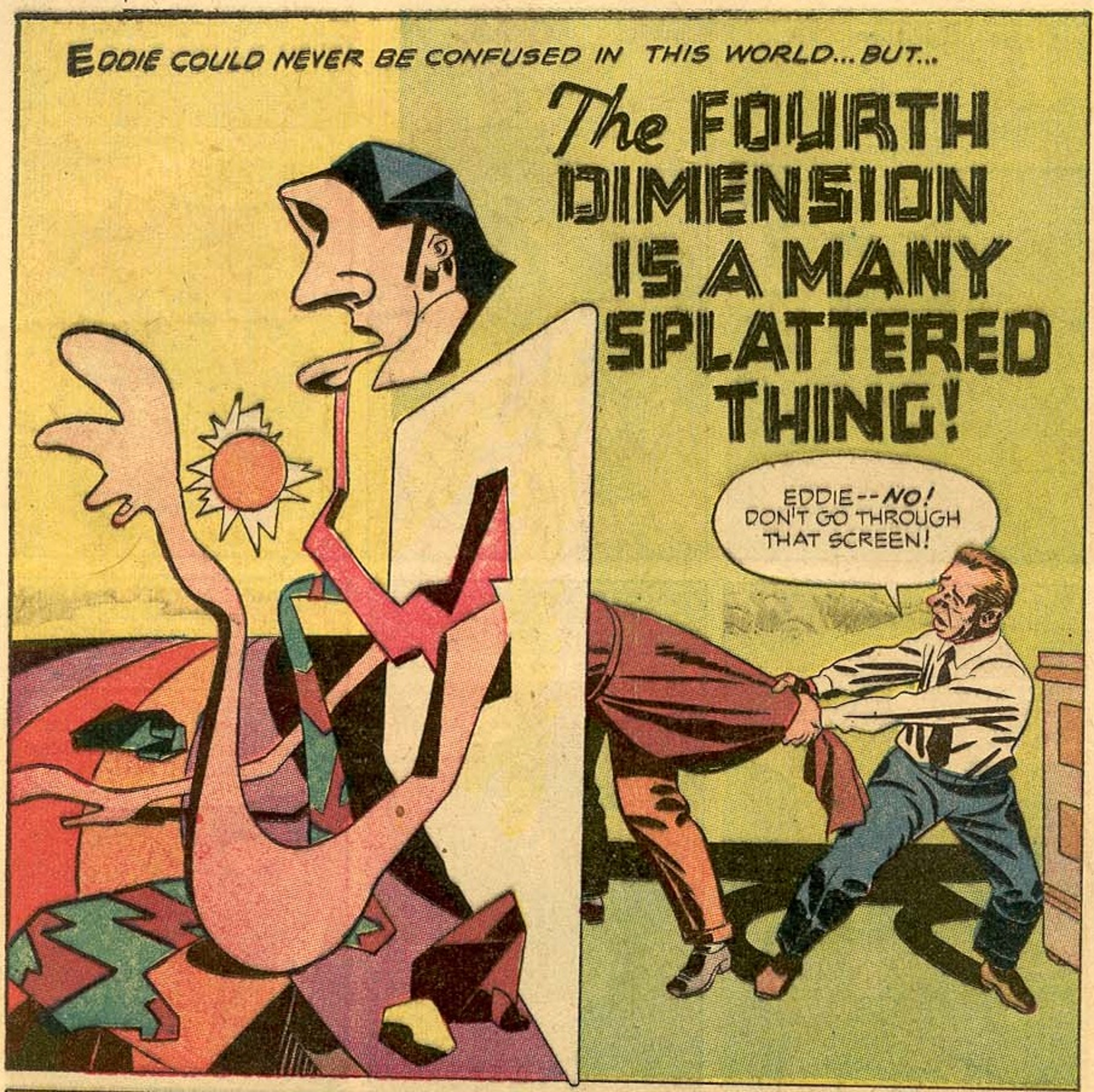
    Jack Kirby, "The Fourth Dimension is a many splattered thing!" from Alarming Tales, 1 (September 1957).

    in English
    auf Deutsch
    en français

    1. Mi a FactGrid?
    2. Miért használjam a FactGridet a saját kutatásomhoz?
    3. Miért ne egyből a Wikidatát használjam?
    4. A FactGrid ingyenes – hogy működik ez?
    5. Mihez kezdhetek az unortodox kutatási témákkal?
    6. Milyen segédeszközöket biztosít a szoftver?
    7. Mit tegyek, ha a saját platformomon szeretném megjeleníteni az adatvizualizációm?
    8. A FactGrid CC0-licenc alatt teszi közzé az adatokat – ez azt jelenti, hogy lemondok a kutatásom jogairól?
    9. Mi történik, ha szeretném az adataimmal egy másik platformon folytatni a munkát?
    10. Mi történik, amikor FactGrid-felhasználók a “helyes” dátumról vitatkoznak?
    11. Miért kockáztassam meg az átláthatóságot rögtön a projektem kezdetétől?
    12. Mi kell ahhoz, hogy a FactGrid befogadja a projektem?

    Mi a FactGrid?

    A FactGrid egy Wikibase-alapú platform történeti adatokkal dolgozó projekteknek számára, amely egyszerre hagyományos wiki és adatbázis. Az oldalon állításokat rögzíthetsz az általad feltöltött vagy téged érdeklő elemekről, majd ezeket szinte bármilyen nyelven tudod használni és megjeleníteni.

    A platform szervezője a Gotha Kutatóközpont, a szervert pedig ThULB Jena biztosítja.

    Együttműködésben a Wikimédia Németországgal és a Német Nemzeti Könyvtár GND-adatbázisával szeretnénk elhelyezni a platformot mint kutatási adatokra építkező erőforrást a kialakulóban lévő, összekapcsolt Wikibase-oldalak rendszerében.

    Miért használjam a FactGridet a saját kutatásomhoz?

    A fő érv a FactGrid mellett a verhetetlenül rugalmas szoftver, a Wikibase, amelyet a Wikimédia Németország segítségével, elsődleges felhasználási helyén, a Wikidatán kívül, egy kísérleti projekt keretében implementáltunk:

    • Egy olyan szoftvert keresel, amely gyakorlatilag bármilyen nyelven tud beszélni? Egy platformot, ahol felvihetsz adatokat a saját nyelveden, mások pedig a saját anyanyelvükön olvashatják ugyanezt, és fordítva? Ez a szoftver a Wikibase.
    • Egy olyan szoftverre van szükséged, amivel átlátható módon koordinálhatsz egy egész kutatói csapatot? A Wikibase-zel ez ugyanolyan könnyű, mint a Wikipédia szoftverével, a MediaWikivel.
    • Egy olyan adatbázisszoftvert keresel, amely tud mindent, amire egy digitális bölcsészeti adatbázisnak szüksége lehet: kapcsolatháló-elemzés, térképes megjelenítés, komplex összekapcsolt keresések, megjelenítés többféle idővonalon? Egy szoftver, amely szinte emberi nyelvként működik, és még teljes körű adatbázis szolgáltatással is rendelkezik? A Wikibase ez a szoftver.
    • Szeretnél egy előző projektedből származó adatgyűjteményre építeni? A Wikibase-en lehetséges a nagy mennyiségű, automatizált adatbevitel.
    • Szeretnél biztosra menni, hogy más projektek is hozzáférnek az adataidhoz, és ténylegesen fel is tudják használni azokat? A platformról könnyen letöltheted az összes adatot, hogy offline, Excelben vagy bármilyen más online projektben dolgozhass velük.
    • Szeretnél teljesen új kérdéseket feltenni a kutatásodban? A Wikibase-en bármelyik elemet összekapcsolhatod bármiféle állítással.
    • Aggódsz, hogy mi történik majd az adataiddal miután véget ér a kutatásod finanszírozása? Támaszkodj egy platformra, ahol nem egyedül dolgozol, ami olyan licenc alatt működik, amely lehetővé teszi másoknak is, hogy folytassák a munkát az adataiddal és eszközeiddel.

    Ha hosszú távú perspektívát keresel, akkor ezt szeretnénk nyújtani a Német Nemzeti Könyvtárral való együttműködésünkkel. A platform egyik támpillére a GND-adatgyűjtemény lesz, ami által széles körben használható eszközként működhetünk. Továbbá célunk ezzel, hogy fontos szereplőjévé váljunk az összekapcsolt Wikibase-rendszerek kialakuló világának.

    Miért ne egyből a Wikidatát használjam?

    Ez egy teljesen jogos kérdés. Vannak olyan projektek (amelyek elsősorban csak felhasználják adatokat), amelyekhez a Wikidata megfelelőbb platformot nyújt. Az FH Potsdam “Archivführer zur deutschen Kolonialzeit” nevű projektje remekül illusztrálta annak szépségét, amikor közvetlenül Wikidatára dolgozunk – erről beszélgettünk Uwe Junggal, aki bemutatta, milyen technikai megoldásokat használtak Potsdamban.

    Ugyanakkor alapvetően két dolog van, amiket nem fogsz tudni sem a Wikidatán, sem egy GND-hez hasonló platformon csinálni: a Wikimédia-projektek (és a GND) szigorú szabályokkal rendelkeznek arról, hogy nem közölhető saját kutatómunka, és döntéseiket nevezetességi kritériumok alapján hozzák meg, ami nem enged teret tetszőleges adatbázis-elemek létrehozásának vagy tárgyak közötti kísérleti kapcsolatok tesztelésének.

    A Wikidata és a GND olyan információkra koncentrálnak, amelyeket már korábban publikáltak és a kutatást nem végző alkalmazottak már közzétett kutatásokból viszik fel az adatokat. Ezeken a platformokon nem tudsz létrehozni munkahipotézisként szolgáló állításokat a kutatásodhoz. Nem hozhatsz létre elemeket kizárólag azzal a céllal, hogy majd statisztikai elemzést végezhess rajtuk a munka egy jóval későbbi szakaszában.

    A FactGriden bátorítjuk a platform használatát heurisztikus kutatási eszközként.

    • Létrehozhatsz elemeket az adatbázisban függetlenül attól, milyen relevanciájuk lenne egy enciklopédiában vagy könyvtári katalógusban.
    • Megkockáztathatsz ideiglenes kronológiákat, egyéni feltevéseket kiinduló hipotézisként.
    • Használd a FactGridet nem konvencionális állításokhoz, amelyek jelenleg csak a saját kutatási projekted számára érdekesek – a szoftver lehetővé teszi ezt a fajta szabadságot.
    • Hozz létre adatbázis elemeket, amelyek részletezik, a kutatásod során milyen adatgyűjteményeket módosítottál jelentős mértékben. Ezáltal könnyen benyújthatod ezt az adott elemet mint a kutatásodat összegző “mappát” a téged finanszírozó intézménynek.
    • A platformon megkockáztathatsz bármilyen új tézist, és egy saját adatbázis elemben összegezheted mint “mikro-publikációt”, ezáltal is láthatóvá téve a hozzájárulásod.

    A FactGrid ingyenes – hogy működik ez?

    A szoftver ingyenesen használható, és folyamatosan fejlesztik a Wikimédia projektek közösségei, illetve a Wikibase-t használó intézmények.

    A FactGrid platformot a Gotha Kutatóközpont szolgáltatja az Erfurti Egyetem virtuális szerverén. A német URL évi 36 eurós költséget jelent, ezt a Gotha Kutatóközpont fedezi.

    Az összes Wikidata-segédeszköz a felhasználóink rendelkezésére áll. Ezek biztosítják az átlag digitális bölcsészeti projekthez szükséges összes funkciót.

    Mivel mind a szoftver, mind az eszközök nyílt forráskóddal rendelkeznek, bármilyen általad kedvelt szoftverrel módosíthatod őket, ha új alkalmazási módra van szükséged.

    Ha saját eszközeiddel is hozzájárulsz a nyílt rendszerhez, biztosíthatod, hogy jövőbeli projektek is használhatják és fejleszthetik ezeket.

    Amennyiben olyan technikai megoldásokra törekszel, amelyeket később anyagi haszonért értékesíthetsz, a szoftver licence ebben sem fog meggátolni. Szabadon kereskedelmi alapokra helyezhetsz bármit, amit nyílt forráskóddal építettél.

    Mihez kezdhetek az unortodox kutatási témákkal?

    A Wikidata úttörő adatmodellel rendelkezik. A felhasználó gyakorlatilag csak kapcsolatokat hoz létre Q-számok között (vagy kapcsolatokat Q-számok és időpontok, Q-számok és földrajzi koordináták, Q-számok és médiafájlok, Q-számok és URL-ek között).

    A szoftver maga nem tudja, milyen típusú kapcsolatokat hozol létre – ezek szintén csak P-számok: a Q1 – P1 – Q2 egy ún. “triple”, ami jelentheti, hogy “Johann Sebastian Bach (Q1) fia (P1) Carl Philipp Emanuel Bach (Q2)”, de azt is, hogy “Az archívumban talált, XY raktári jelzetű levél (Q1) állítólagos feladási helye (P1) München (Q2).”

    Q-számokat bármihez hozzárendelhetünk – emberekhez, dokumentumokhoz, eseményekhez, eszmékhez… Te döntöd el, milyen P-számokra van szükséged az általad kívánt állításokhoz. Az elemeket nem egy rögzített, módosíthatatlan kategóriarendszerben kell meghatároznod, a létrehozott állításaid pedig új árnyalatot és szilárdságot adnak az új vagy meglévő elemekhez. Ne aggódj, ha nem rögtön az első napon áll össze az adatmodelled. Hozd létre folyamatosan az állításokat, amikor csak szükséged van rájuk, közben figyeld, hogy érik el a kritikus tömeget, amellyel kiértékelhetővé válnak.

    Minden állítás “minősíthető” – “Johann Sebastian Bach (Q1) felesége (P2) Maria Barbara Bach (Q2) házasság kezdete (P2) 1707. október 7. (dátum),  házasság vége (P3) 1720. július 5 körül (dátum).” Ezeket az állításokat ugyanakkor hivatkozásokkal is elláthatjuk: “erre bizonyíték (P4) XY egyházi évkönyv (Q3)”,”állítás forrása (P5) XYZ Bach-életrajz (Q4)”.

    A rendszerben lehetséges egymással versengő értékeket megadni, mindössze külön-külön forrásmegjelölést kapnak, illetve rangsorolni is lehet őket.

    Ilyen mélységben meghatározott triple-ekkel gyakorlatilag bármilyen állítást létrehozhatsz, ami viszont még fontosabb, ezzel lehetőséged nyílik állításokat létrehozni bármely nyelven. A rendszer Q- és P-számokkal működik, minden egyéb pedig címke, amit azon a nyelven adhatsz meg, amelyet fel szeretnél kínálni a felhasználónak. Ezen felül a szoftver automatikusan lefordítja a dátumokat és mértékegységeket az adott nyelv által használt formátumra. Ez a titka annak, hogy a Wikibase-platformokat mindenki a saját nyelvén szerkesztheti, miközben az egész világon olvasható szinte bármilyen nyelven.

    Milyen segédeszközöket biztosít a szoftver?

    Készíthetsz adatbázis-bejegyzéseket egyesével: nyisd meg a szerkeszteni kívánt elemet, menj a beviteli lap aljára, és kattints az “állítás hozzáadása”-linkre. Itt kell megadnod, milyen állítást szeretnél létrehozni. Nem szükséges fejből tudnod a P-számot, kezdd el begépelni a tulajdonság nevét a saját nyelveden, majd válassz a felkínált lehetőségek közül az automatikus befejezéshez. A platform tudni fogja az adott állítás P-számát. Az állítás második részét a következő szövegdobozban adhatod meg, szintén elég elkezdeni begépelni.

    Excel- és CSV-listákból, automatikus bevitellel is készíthetsz adatbázis bejegyzéseket. (Itt találod a beviteli felületet, itt pedig egy rövid útmutatót hozzá.)

    Az adatbázis-lekérdezéseket SPARQL nyelven kell megfogalmazni. Ez (sajnos) nem egy könnyű keresőnyelv, de végső soron annyira komplex, mint a futtatni kívánt keresések.

    A SPARQL-t használók nem feltétlen tudnak SPARQL-forráskódot írni. Általában keresési mintákat tudsz használni, amik megmutatják, hol kell változtatnod a bevitt szövegen, hogy lefuttathasd a saját keresésed.

    Amennyiben pontosan tudod, milyen típusú keresési lekérdezést kell futtatnia a felhasználóidnak, készíthetsz a könyvtárak megszokott online felületeihez hasonló, egyéni beviteli maszkokat, amelyek majd SPARQL-ben kommunikálnak az adatbázissal.

    A szoftvercsomag tartalmaz illusztrációs lehetőségeket térképekhez, idővonalakhoz, hálózatokhoz, genealógiai kapcsolatokhoz, grafikonokhoz, stb. Nem kell letöltened egyéb, külső alkalmazásokat. A SPARQL-en keresztül kérheted az általad kívánt reprezentáció létrehozását. Gyönyörű bemutatót láthatsz vizualizációkból, ha felkeresed a Wikidata Scholia-projektjét.

    Mit tegyek, ha a saját platformomon szeretném megjeleníteni az adatvizualizációm?

    Ennek nincs technikai akadálya. Uwe Jung demonstrálta, hogyan használja az FH Potsdam felülete a Wikidatát adattárként úgy, hogy közben a felhasználók nem látják a háttérben lévő adatbázist.

    Nincs semmi gond azzal, ha a FactGridet külső adattárként használod, és a saját kutatási projekted az egyetemed szerverén építed fel, ahol célzott adatbázis-hozzáférést teszel lehetővé saját keresősablonon keresztül.

    A FactGrid CC0-licenc alatt teszi közzé az adatokat – ez azt jelenti, hogy lemondok a kutatásom jogairól?

    Ha a Creative Commons 0-licencet választod, továbbra is teljes szabadsággal használhatod az adataidat, amire csak szeretnéd  – te irányítasz, és nem a kiadó vagy az adatokat kezelő platform. Ezen felül a CC0 azt jelenti, hogy az adataid szabadon felhasználhatóvá válnak mások által is. Mivel a közösség így bármikor kijavíthatja az észrevétlenül maradt hibákat, csökken annak a kockázata, hogy hosszabb távon elavuljon a kutatásod.

    Néhány megfontolandó tényező: Tudósok számára első pillantásra a CC BY 4.0-licenc tűnik kedvezőnek. Ez engedélyezi az ingyenes felhasználást, amennyiben az megfelelően módon megjelöli a forrást. A gyakorlatban ez működhet szövegeknél (mint ez a blogposzt), mivel itt egyértelmű, hogy milyen hivatkozást szeretnénk látni: a nevünk megadásával, a publikáció címével, a kiadás helyével és dátumával. De szeretnéd, hogy az adataid idézetként szerepeljenek, például egy vizualizációban? Egy 1753 júniusában Párizsból Berlinbe küldött levél a térképen egy vonalként szerepel – hogyan lássuk el ezt megfelelő jegyzetekkel? Hogyan idézzenek téged, ha csak javításokat végeztél egy adathalmazon? Az “Így add tovább”-licencek még problematikusabbak: ezek az adatok szabadon hozzáférhetők bárki számára, amennyiben a további felhasználók is ugyanezekkel a feltételekkel osztják meg. Ez úgy hangzik, mint a szabad felhasználás melletti határozott kiállás. De egy al-felhasználó hogyan tudja biztosítani, hogy az ő al-felhasználói is betartják a licencbe foglalt feltételeket (főleg ha ez az al-felhasználó CC0 alatt teszi közzé az adatokat)? Az al-felhasználóknak általában azt tanácsolják, ne használjanak adatokat CC-BY vagy CC Így add tovább licenccel rendelkező platformokról.

    A Wikidatával és a Német Nemzeti Könyvtárral közös vállalkozásunk egyetlen lehetőséget hagyott számunkra: hogy partnereinkhez hasonlóan szabadon felhasználhatóvá tegyük az adatainkat. A CC0-licenc által nem biztosított, hogy a további felhasználók is feltüntetik majd, ki gyűjtötte az adatokat, illetve felhasználásuk feltételeit.

    A gyakorlatban a legtágabb nyílt licenc nem jelenti azt, hogy a FactGrid-adatok szerző nélküliek, épp ellenkezőleg. Mi azt szorgalmazzuk, hogy hivatkozzunk a kutatásra, és megelőlegezzük, hogy a Wikidata és a GND is boldogan feltünteti, ha a kutatás a mi platformunkról származik.

    A FactGriden minden szerkesztéshez kapcsolva van a szerző neve. Ha egy kutatási projekt lényeges mértékben járult hozzá egy adatgyűjteményhez, akkor ezt jelezhetik egy külön jegyzetben, amelyet tovább lehet adni adatátvitelnél.

    A Wikidatához vagy a GND-hez hasonló adatbázisok amúgy érdekeltek is a kutatások hivatkozásában – ez hozzájárul az adataik szilárdságához. A FactGrid abban a különleges helyzetben van, hogy mindkét szervezet számára olyan platformot szolgáltat, ahol a felhasználók olyasmiket csinálhatnak, ami saját, nagyobb platformjaikon nem engedett.

    Mi történik, ha szeretném az adataimmal egy másik platformon folytatni a munkát?

    Mivel szerzői jogi korlátozások nélkül vitted fel az adatokat, szabadon dolgozhatsz velük bárhol máshol. Valójában örülünk is, ha afféle inkubátor lehetünk kutatási adatok számára.

    Mi történik, amikor FactGrid-felhasználók a “helyes” dátumról vitatkoznak?

    A szoftver lehetővé teszi az egymásnak ellentmondó adatok kezelését – ez különösen fontos a történelmi kutatás területén, ahol gyakran találunk egymásnak ellentmondó forrásokat anélkül, hogy biztosan tudjuk, melyikük állítása igaz. A szoftverrel reprodukálhatjuk az ellentmondásos helyzetet, az állításokat pedig külön-külön alátámaszthatjuk hivatkozásokkal. Az eltérő állításokat súlyozhatjuk is egymáshoz képest – például a jelenleg irányadó állítást az egyéb variánsokkal szemben, vagy akár minősítőkkel az egyéni kiértékeléshez.

    Tekintsük inkább érdekes helyzetként arra, amikor két kutató eltérő eredményekre jut. Sokkal rosszabb, amikor egy olyan platformon hibázol, ahol sosem lesznek kijavítva, és hitelteleníthetik az egész munkádat.

    Miért kockáztassam meg az átláthatóságot rögtön a projektem kezdetétől?

    Ez kemény dió, valószínűleg ez gátolja meg a legtöbb projektet, hogy használja a FactGrid erőforrásait. Az alternatíva egy platform, amihez csak a jelszóval rendelkező csapat férhet hozzá a projektet lezáró publikáció határidejéig. Így, szól az érv, semelyik versengő projekt sem tudja elcsaklizni a kutasi eredményeket. Senki sem látja, hol hibáztál az elején. Senki sem rögzíti, melyik adatot vitték fel asszisztensek és melyiket a projektvezető – ehhez hasonlók a feltételezett előnyei a nem átlátható munkának egy olyan platformon, amely csak a finanszírozás végével lesz online elérhető.

    Az átlátható kutatás saját biztosítékokkal rendelkezik. Ha egy találsz egy minden eddigit felülíró dokumentumot vagy rögzítesz egy úttörő kapcsolódási pontot, akkor itt a lehetőség, hogy a saját nevedhez és projektedhez kösd az állítást. Ha holnap valaki ellátogat ugyanabba az archívumba és szintén felfedezi, amit te – pech, hiába. Te már rögzítetted a megfigyelést a platformon, amit a laptörténetben lekövethető változtatás minden kétséget kizáróan bizonyít.

    Mindeközben a kollektív platform  meghívásként is működik az együttműködésre. Tedd egyértelművé a többi csapat számára, min dolgozol, hogy felvehessék veled a kapcsolatot.

    Egy elméletileg biztonságos, csak a projekt végén nyilvánosságra hozott weboldal kockázatai komolyak. A felhasználókkal ekkor már nem lehetséges ötleteket cserélni. Az internetes jelenlét időzítése a projekt rohanós utolsó heteire esik, amikor már nem lehetséges semmiféle, koncepciót érintő változtatás. Ha a kutatást kizárólag egy könyves publikációhoz végeztétek, bizonytalan marad, mihez kezdjen a csapat a Word- és Excel-fájlokban összegyűjtött adatokkal. Senki sem tudja ekkor felvinni az adatokat egy nagyobb erőforrásba – egy ilyen késői fázisban a harmonizáció szinte megugorhatatlan akadály. Csak reménykedni lehet, hogy a könyv olvasói beszkennelik az összes lábjegyzetet, hogy a bennük lévő korrigálások elérhessék a könyvtári katalógusokat és a különféle Wikimédia-projekteket. A kockázatot itt a könyv jelenti, amely semmiféle hatással nincs a kollektív adatbázisra, illetve a digitális bölcsészet projektek, amelyek publikáció után elavulnak.

    A jövő inkább egy újfajta hozzáállásban kell keresni egy közös, nyilvános adatbázis felé. A kutatóknak képesnek kell lenniük javítani és bővíteni ezt az adatbázist bárhol, bármikor hozzáférve. Az szükséges motivációt és biztonságot a kutató környezet jelenti, ahol megjelölhetik és idézhetővé tehetik saját munkájukat. Erre a Wikibase bármely más szoftvernél alkalmasabb.

    Mi kell ahhoz, hogy a FactGrid befogadja a projektem?

    A FactGrid-platformnak nincs láthatatlan mélyrétege. Bárki lekérdezhet az adatbázisból, és ugyanazt az eredményt fogja kapni akár be van jelentkezve, akár nincs. A személyes felhasználói fiók annyi előnnyel jár, hogy kiválaszthatod a kívánt nyelvet, miközben az adatokat böngészed, illetve lesz egy “szerkesztés”-link minden állítás alatt.

    Ha szeretnéd betáplálni az adataid a FactGridbe, és ha szeretnél egy projektet futtatni a platformon, akkor szükséged lesz felhasználói fiókra. Ezt a valódi neved megadásával kaphatsz az adminisztrátoroktól. Ehhez az oldalon találsz egy “Request account” (felhasználó fiók igénylése) szövegű linket. E-mailben is felveheted velünk a kapcsolatot. Projektvezetők kaphatnak adminisztratív fiókokat, amivel kijelölhetnek csapattagokat, projekthez kapcsolódó személyeket.

    Miután bejelentkeztél, felvihetsz adatokat nagy mennyiségben vagy végezhetsz meghatározott javításokat bármelyik elemen. Minden változtatásod a felhasználói fiókodhoz lesz kapcsolva. Mások visszavonhatják a szerkesztéseid, de nem nyomtalanul, dokumentálva lesz az elem történetében, mindenki láthatja.

    Ha egy összetettebb projekten szeretnél dolgozni, —

    • ami lehet személyes családkutatás,
    • lehet egy egyszeri vizualizáció egy szemináriumi dolgozathoz,
    • vagy akár több ezer tételnyi adat bevitele egy 5 éves projekt folyamán

    — egyeztess a többi felhasználóval és a platform szervezőivel. Nem (feltétlen) fogunk egy nyilvános egyetértési nyilatkozatot aláírni, de a blogunkon hírt adhatunk a projektedről, hogy eljusson mindenkihez a platformon. A munka akkor válik igazán izgalmassá, amikor mások befejezett munkáját módosítod, illetve amikor más projektek résztvevőit inspirálod az általad bevezetett modellezés használatára. Nem kötelező átbeszélni az adatmodelleket a többiekkel, de a modellek megosztása segíthet a kutatásodnak új embereket elérni, illetve felhasználhatók lesznek mások által létrehozott lekérdezésekben vagy vizualizációkban.

    A szoftvert arra tervezték, hogy kezelni tudja mind az olyan állításokat, amelyek csak számodra érdekesek, mint azokat, amelyek az eredeti kutatási témádnál jóval távolabbra elérnek majd.

    Jack Kirby, "The Fourth Dimension is a many splattered thing!" from Alarming Tales, 1 (September 1957).
    Jack Kirby, “The Fourth Dimension is a many splattered thing!”, Alarming Tales, 1 (1957. szeptember).

    FAQ FactGrid – Pourquoi devrais-je utiliser FactGrid pour mon projet de recherche ?

    Jack Kirby, "The Fourth Dimension is a many splattered thing!" from Alarming Tales, 1 (September 1957).

    auf Deutsch
    in English
    magyar nyelven

    Qu’est-ce que FactGrid ?

    FactGrid est une installation Wikibase – c’est-à-dire à la fois un wiki ordinaire et une base de données que vous pouvez utiliser pour faire des déclarations sur les objets qui vous intéressent – déclarations que vous pouvez ensuite traiter sur de grands jeux de données dans pratiquement toutes les langues.

    La plate-forme est gérée par le Centre de recherche de Gotha et hébergée par l’ThULB Iéna. Elle s’adresse à des projets ayant un intérêt spécifique pour les données historiques.

    En collaboration avec Wikimedia Allemagne et le GND de la Bibliothèque nationale allemande, nous essayons d’intégrer cette plateforme dans le prochain consortium d’instances fédérées de Wikibase comme ressource pour les « données de recherche ».

    Pourquoi devrais-je utiliser FactGrid pour mes propres recherches ?

    Le principal argument en faveur d’un compte FactGrid est la flexibilité imbattable du logiciel Wikibase, que nous avons réussi à installer, dans le cadre d’un projet pilote, en dehors de son site principal Wikidata et avec l’aide de Wikimedia Allemagne :

    • Vous recherchez un logiciel qui parle pratiquement toutes les langues – une plate-forme où vous pouvez entrer des données dans votre propre langue tout en permettant à d’autres de les lire dans leur propre langue ? Wikibase est ce logiciel.
    • Vous recherchez un logiciel qui vous permet de coordonner toute une équipe de manière transparente ? Dans Wikibase, c’est aussi simple que dans le logiciel MediaWiki de Wikipedia.
    • Vous recherchez un logiciel de base de données qui peut faire tout ce que les bases de données d’humanités numériques veulent normalement faire : analyses de réseau, représentations cartographiques, recherches croisées complexes, frises chronologiques (dans différents formats) – un logiciel qui se comporte presque comme un langage humain, tout en fournissant des services complets de base de données ? Wikibase est ce logiciel.
    • Vous avez des données provenant de projets antérieurs que vous voulez développer ? Wikibase dispose d’options de saisie automatique à grande échelle.
    • Vous voulez que vos données puissent être réutilisées ? Wikibase permet le téléchargement et le travail avec vos données, aussi bien hors ligne dans Excel qu’en dligne dans le cadre de nouveaux projets.
    • Vous voulez poser des questions entièrement nouvelles pour votre recherche ? Dans Wikibase, vous pouvez lier n’importe quel objet à n’importe quelle déclaration en fonction de vos intérêts.
    • Vous vous demandez ce qu’il adviendra de vos données et de vos outils de présentation une fois votre projet terminé ? Comptez sur une plate-forme sur laquelle vous ne travaillez pas seul et utilisez une licence de données qui permettra à d’autres personnes de continuer à travailler avec votre travail sans aucun risque !
    • Vous voulez poser des questions entièrement nouvelles dans votre recherche ? Dans Wikibase, vous pouvez relier n’importe quel type d’objet à n’importe quelle déclaration d’intérêt.
    • Vous vous inquiétez de ce qui arrivera à vos données et à vos présentations une fois votre financement terminé ? Comptez sur une plateforme où vous ne travaillez pas seul et utilisez une licence de données qui permet à d’autres de continuer à travailler à la fois avec vos données et vos outils !

    Si vous recherchez une perspective à plus long terme, c’est ce que nous essayons d’offrir grâce à notre accord de collaboration en cours avec la Bibliothèque nationale allemande. Nous baserons notre plate-forme sur les données GND afin d’en faire aussi un outil grand public, avec pour objectif de devenir un acteur dans le paysage émergent des “installations fédérées Wikibase”.

    Pourquoi ne pas utiliser Wikidata dès maintenant ?

    C’est une question légitime à poser. Il y aura des projets (qui utilisent principalement des données) pour lesquels Wikidata sera la meilleure plateforme, comme l’Archivführer zur deutschen Kolonialzeit de la FH Potsdam. Reste que les projets Wikimedia (de même que GND) ne laissent pas de place à la recherche originale. Ils fonctionnent sur des “critères de notoriété” qui ne permettent pas la création à volonté d’objets et de relations entre objets innovants que les chercheurs voudraient tester.

    Wikidata et le GND se concentrent sur les informations qui ont déjà été publiées ; ils mobilisent des travailleurs non chercheurs qui alimentent leurs bases de données à partir de recherches déjà publiées. Vous ne serez pas autorisé sur ces plateformes à énoncer des “hypothèses de travail” relevant de “votre recherche”. Vous ne pourrez pas créer des objets de base de données dans le seul but de mener sur eux à un stade ultérieur de votre recherche “rien de plus qu’une analyse statistique”.

    Dans FactGrid, nous encourageons au contraire l’utilisation de la plate-forme comme un outil de recherche heuristique.

    • Créez des objets de base de données sur la plate-forme, quelle que soit par ailleurs leur pertinence pour une encyclopédie ou un catalogue de bibliothèque.
    • Risquez comme hypothèses de travail des chronologies provisoires en fonction de vos intérêts personnels.
    • Utilisez FactGrid afin de faire des déclarations non conventionnelles et qui n’ont d’intérêt que pour votre projet de recherche – le logiciel vous donne cette liberté.
    • Créez des objets de base de données spécifiques mentionnant votre projet de recherche dans les jeux de données que vous aurez substantiellement modifiés, ce qui vous permettra d’identifier votre contribution lorsque vous soumettrez votre recherche à votre institution de financement.
    • Risquez de nouvelles hypothèses sur la plateforme et indiquez votre point de vue par un numéro d’objet de base de données (servant en quelque sorte de “micro-publication”), afin d’attester de votre inventivité sur la base de données.

    FactGrid est gratuit – comment est-ce possible ?

    Le logiciel est disponible gratuitement et en cours de développement dans la communauté plus large des projets Wikimedia et au sein des institutions qui entendent utiliser Wikibase dans les prochaines années.

    La plate-forme FactGrid est gérée par le Centre de recherche de Gotha sur un serveur virtuel de l’université d’Erfurt. L’URL allemande coûte 36 euros par an en frais de domaine, financés par le Centre de recherche de Gotha.

    Tous les outils Wikidata sont à la disposition de nos utilisateurs. Ils comprennent toutes les applications standard dans les projets d’humanités numériques.

    En outre, les logiciels et les outils étant open source, vous pouvez faire appel à votre prestataire de service informatique extérieur pour développer l’application spécifique dont vous auriez besoin.

    Proposez à la communauté FactGrid vos propres développements d’outils et de présentation, ce sera le meilleur moyen pour que vos propres visualisations continuent à être développées après la fin du financement de votre projet. Si vous visez plutôt des solutions que vous voulez vendre, vous ne serez pas limité par la licence du logiciel. Vous pourrez commercialiser librement tout ce que vous aurez créé sur la base du logiciel ouvert.

    Que dois-je faire des demandes de recherche non orthodoxes ?

    Wikibase fait œuvre de pionnier dans la modélisation des données. Pour l’essentiel, vous ne créez que des relations entre des numéros Q (ou entre des numéros Q et des dates, des numéros Q et des coordonnées spatiales, des numéros Q et des fichiers média, des numéros Q et des URL).

    Le logiciel ignore le type sémantique des relations que vous avez créées- il s’agit là encore de simples numéros P : Q1 – P1 – Q2 est un “triplet”, qui peut tout aussi bien signifier “Jean-Sébastien Bach (Q1) est le père de (P1) Carl Philipp Emanuel Bach (Q2) ” que “Cette lettre que j’ai trouvée dans les archives avec la cote XYZ (Q1) aurait été envoyée de (P1) Munich (Q2)”

    Les numéros Q peuvent être attribués à toute espèce d’identité : personnes, documents, événements, idées… C’est vous qui décidez des types des numéros P dont vous avez besoin pour faire les déclarations qui vous intéressent. Vous n’avez pas à définir les objets dans un système de catégories a priori ; ce sont vos déclarations qui ajoutent de la chair aux objets que vous créez au fur et à mesure. Ne vous inquiétez pas si vous n’avez pas de modèle de données dès le premier jour. Faites des déclarations dès que vous en avez envie et voyez comment elles acquièrent la masse critique. C’est alors seulement que vous pourrez juger de la valeur de l’ensemble.

    Toutes les déclarations peuvent elles-mêmes être « qualifiées » – “Jean-Sébastien Bach (Q1) était marié avec (P2) Maria Barbara Bach (Q2) à partir du (P2) 7 october 1707 (date) jusqu’à (P3) environ 5 juillet 1720 (date).” Toutes ces déclarations peuvent à leur tour être dotées de références : “cela ressort du (P4) registre paroissial de… (Q3)”, ”cela est indiqué dans (P5) la biographie bien connue de Bach XYZ (Q4)”.

    Le système permet à tout moment de proposer des affirmations concurrentes. Elles sont simplement introduites avec leurs différentes sources et peuvent être comparées les unes avec les autres.

    En fin de compte, n’importe quelle déclaration en langue naturelle peut être générée avec des triplets de ce genre, mais, surtout, cela permet d’exprimer cette déclaration dans n’importe quelle langue du monde : pour le système, toutes les déclarations ne sont que des liens entre des numéros Q et des numéros P. C’est vous seul qui attribuez aux numéros Q et P des “libellés” et des “définitions” qui leur donnent sens, et cela dans les langues avec lesquelles vous communiquez (le système gère par ailleurs les informations de date et de quantité dans toutes les normes mondiales avec une conversion automatique dans n’importe quelle direction) ; c’est là le secret des plateformes Wikibase, qui permet aux auteurs de saisir les informations dans leurs langues respectives et aux utilisateurs de lire ces informations dans n’importe quelle langue.

    Quels sont les outils fournis par le système ?

    Les entrées dans la base de données peuvent être effectuées une à une : ouvrez pour cela l’objet-id en question, allez au bas de la page de saisie et cliquez sur le lien “ajouter une déclaration”. Il vous sera alors demandé de saisir la déclaration que vous souhaitez faire. Vous n’avez pas besoin de connaître le numéro P. Il suffit d’indiquer l’objet dans la langue que vous utilisez et de cliquer sur l’auto-complétion qui vous est proposée. La plate-forme utilisera pour vous le numéro P de cette déclaration. Indiquez alors dans le champ qui s’ouvre l’objet de votre déclaration. Le système, là encore, vous proposera, à mesure que vous tapez le texte de votre déclaration, des suggestions de plus en plus précises.

    Les entrées dans la base de données peuvent également être créées et enregistrées automatiquement à partir de tableaux Excel ou CSV. (Ceci est le masque de saisie et voici le guide succinct pour le faire).

    Les requêtes dans la base de données doivent être formulées sous forme d’interrogations “SPARQL”, un langage de requêtes qui n’est (malheureusement) pas si facile à utiliser, mais qui, au fond, n’est pas plus complexe que les recherches que vous pourriez vouloir effectuer.

    Le plus souvent les utilisateurs de SPARQL ne savent pas écrire leurs requêtes dans le code source. Vous pouvez cependant utiliser des modèles de requêtes où sont indiquées les entrées qu’il faut modifier afin d’exécuter votre recherche spécifique.

    En outre, si vous savez exactement le type de requêtes que vos utilisateurs doivent exécuter, vous pouvez créer vos propres masques de saisie, comme ceux que vous utilisez dans les interfaces habituelles des bibliothèques en ligne, qui parleront alors SPARQL avec la base de données.

    Le système comprend aussi des outils cartographiques, des frises chronologiques, des réseaux, des arbres généalogiques, des graphiques, etc. Vous n’avez pas besoin de télécharger des applications particulières. Vous demanderez à SPARQL de produire la représentation que vous essayez d’obtenir. Le projet Scholia sur Wikidata présente certaines de ces visualisations.

    Que dois-je faire si je veux donner mes représentations de données sur ma propre plate-forme ?

    Cela ne devrait pas poser de problème technique. Uwe Jung a montré comment l’interface de la FH Potsdam utilise Wikidata comme dépôt de données sans laisser les utilisateurs voir la base de données à laquelle ils accèdent.

    Il n’y a rien de mal à utiliser FactGrid comme dépôt externe et à monter son propre projet de recherche sur le serveur de son université d’origine, en y proposant des accès ciblés à la base de données selon un modèle de recherche de son choix.

    FactGrid octroie essentiellement des licences d’utilisation des données à CC0 – cela veut-il dire que je renonce à tous les droits sur mes recherches ?

    Opter pour la licence Creative Commons signifie essentiellement que vous conservez tous les droits sur l’ensemble de vos données. Mais surtout, la licence CC0 signifie que vos données deviennent librement utilisables et que vous pouvez ainsi réduire le danger de recherches obsolètes à long terme.

    Quelques considérations de base : CC BY 4.0 est à première vue la licence que les scientifiques préféreront. Elle permet l’utilisation gratuite des données à la condition que celles-ci soient correctement citées. En pratique, cela fonctionne pour les textes (comme ce billet de blog) ; dans ce cas, on voit clairement comment on aimerait que le texte soit cité : avec une référence à l’auteur, le titre de la publication, le lieu de publication et la date. Mais supposons que vous souhaitiez que vos données soient citées, disons dans une visualisation ? Une lettre envoyée de Paris à Berlin en juin 1753 se réduisant à une ligne sur une carte, comment cette ligne doit-elle être correctement annotée ? Comment voulez-vous être cité si vous n’avez fait qu’améliorer un ensemble de données existantes ? Les licences “share alike” sont encore plus problématiques : “Ces données sont disponibles gratuitement si les utilisateurs ultérieurs les gardent tout aussi libres”. Cela semble être le plaidoyer ultime pour la gratuité. Mais comment un sous-utilisateur peut-il s’assurer que ses sous-utilisateurs respecteront à leur tour votre contrat de licence (surtout si ce sous-utilisateur offre ses données sous CC0) ? Les sous-utilisateurs seront bien avisés de ne pas utiliser de données provenant de plateformes CC-BY ou CC Share-Alike.

    Nos entreprises communes avec Wikidata et la Bibliothèque nationale allemande ne nous ont finalement laissé qu’une seule option : rendre nos données aussi librement disponibles que nos partenaires, autrement dit sous CC0, c’est-à-dire sans garantie que les utilisateurs ultérieurs préciseront toujours exactement qui a collecté les données, ni sur ce que les utilisateurs tiers seront autorisés à faire avec ces données.

     
    En pratique, la licence ouverte maximale ne signifie pas que les données de FactGrid sont des données sans auteur, bien au contraire. Outre que nous suggérons aux utilisateurs de toujours citer la recherche qu’ils utilisent, nous faisons l’hypothèse que Wikidata et le GND souhaiteront renvoyer à la recherche sur notre plate-forme. Toutes les modifications apportées aux jeux de données sont liées par le système à nos vrais noms, visibles par tous les utilisateurs. Si un jeu de données a été tout particulièrement travaillé par un projet de recherche, vous pouvez l’indiquer dans une note à part qui sera transférée avec ce jeu de données. Vous pouvez également noter votre travail dans le jeu de données lui-même. Enfin, tout le monde peut interroger la base de données pour savoir quels jeux de données ont été travaillés dans le cadre d’un projet particulier.

    En fait, les bases de données comme Wikidata ou le GND de DNB sont intéressées à citer la recherche – cela renforce la solidité de leurs données, et FactGrid est dans la position unique de fournir aux deux institutions une plate-forme sur laquelle les gens peuvent faire ce qu’ils ne pourraient pas faire sur leurs grandes plates-formes.

    Que se passe-t-il si je veux continuer à travailler avec mes données sur une autre plateforme ?

    Puisque vous avez saisi vos données sans restriction de droits d’auteur, vous pouvez travailler librement avec elles sur tout autre projet qui vous intéresse. En fait, nous aimons être “juste un incubateur” pour les données de recherche.

    Que se passe-t-il si les utilisateurs de FactGrid se disputent sur une date “correcte” ?

    Le logiciel permet de traiter des données contradictoires – ce qui est particulièrement intéressant dans le domaine de la recherche historique où nous disposons souvent de preuves documentaires contradictoires, sans pouvoir être certain de l’information correcte. Les noms sont traités avec des orthographes différentes ; il arrive que les historiens se contredisent.

    Le système permet de reproduire la situation contradictoire ; il permet d’étayer les déclarations avec des dizaines de références et dans différentes orthographes.

    Des déclarations divergentes peuvent être comparées les unes avec les autres – par exemple, la déclaration qui fait actuellement autorité et les variantes qui ne circulent qu’en raison des diverses sources contradictoires.

    Que deux chercheurs arrivent à des résultats différents, voilà qui devrait en général vous intéresser. Le danger majeur est d’avoir fait une hypothèse erronée et qu’un autre projet sur une autre plateforme donne la solution de l’énigme et travaille sur la bonne date sans que vous le sachiez, ou pire, sans que vous ayez même la possibilité de corriger votre erreur des années après la fin de votre projet.

    Pourquoi devrais-je risquer la transparence de mon projet dès le début ?

    C’est probablement le problème le plus difficile, celui qui empêche actuellement certains projets d’utiliser la ressource que nous avons ouverte. L’alternative est une ressource accessible seulement avec un mot de passe aux membres de l’équipe jusqu’à la date de publication, c’est-à-dire quasiment jusqu’à la fin du projet. Aucun projet concurrent ne peut alors s’emparer des résultats, du moins en théorie. Personne ne peut voir l’erreur par où vous avez commencé et que vous avez ultérieurement corrigée. Personne ne peut voir non plus le travail fourni par les assistants qui entrent les données dans la base, ni l’implication réelle du chef de projet – tels sont les avantages supposés d’un travail non transparent sur une plateforme qui ne sera mise en ligne qu’à la fin de votre financement.

    La recherche transparente offre ses propres garanties : si vous trouvez un document révolutionnaire et établissez une connexion décisive, c’est l’occasion d’attacher la découverte à votre nom et à votre projet. Si quelqu’un, demain, fait la même découverte dans les archives que vous venez de visiter, pas de chance pour lui : vous aurez enregistré votre observation avec un lien dans l’historique des versions que vos rivaux ne pourront pas nier.

    En même temps, la plate-forme collective invite à coopérer. Expliquez clairement aux autres équipes sur quoi vous travaillez et permettez-leur de vous contacter sur la plate-forme !

    Les inconvénients d’un site web prétendument sécurisé et qui ne sera mis en ligne qu’à la fin du financement du projet sont sérieux : Lorsque le projet est publié, le temps des échanges avec les utilisateurs est déjà révolu. Si la mise sur Internet se fait dans les dernières semaines, celles où le projet est sous pression, vous vous trouverez totalement incapable de réagir par des changements plus conceptuels. Et si vous avez mené des recherches uniquement pour la publication d’un livre, que ferez-vous, vous et votre équipe, des données que vous avez rassemblées dans des fichiers Word et des feuilles de calcul Excel ? Personne ne pourra les verser dans des bases de données, car l’harmonisation à ce stade tardif sera un obstacle insurmontable. Votre seul espoir est que des lecteurs de votre livre parcourront toutes vos notes de bas de page pour en tirer des corrections pour nos catalogues de bibliothèque et pour différents projets Wikipédia. Le risque, finalement, est d’avoir un livre sans impact sur la base de données collective et sur les projets d’humanités numériques et qui sera, à cet égard au moins, obsolète dès sa publication.

    L’avenir devrait résider dans une nouvelle attitude à l’égard de la base de données publique. Les chercheurs devraient pouvoir corriger et élargir encore cette base chaque fois qu’ils y accèdent. Pour cela, il leur faut une incitation et une sécurité que seul peut leur donner un environnement de recherche dans lequel le travail soit référençable et citable. Pour cela, Wikibase est mieux équipée que tout autre système.

    Comment puis-je faire accepter mon projet sur FactGrid ?

    La plate-forme FactGrid ne comporte pas de couche profonde invisible. Tout le monde peut interroger la base de données et les requêtes donneront les mêmes informations, que vous soyez connecté ou non. Votre compte d’utilisateur personnel présente simplement l’avantage de vous permettre de passer à votre langue préférée lorsque vous consultez les données et de voir le lien d’édition sur chaque déclaration.

    Si vous souhaitez alimenter la plate-forme avec vos propres données et si vous souhaitez y mener un projet, vous devez disposer d’un compte. Les comptes sont donnés sous des noms réels par les administrateurs. Le logiciel fournit un lien “demande de compte”. Vous pouvez également nous contacter par courrier électronique. Les chefs de projet peuvent recevoir des comptes administratifs leur permettant de donner accès aux membres de leur équipe et aux utilisateurs qui les intéressent.

    Une fois connecté, vous pouvez saisir des données en masse ou apporter des corrections spécifiques où bon vous semble. Toute entrée sera connectée à votre compte d’utilisateur. D’autres utilisateurs peuvent annuler vos modifications, mais non sans laisser une trace documentée de cette intrusion dans l’historique des versions – visible par le monde entier.

    Si vous souhaitez travailler sur un projet plus complexe, qu’il s’agisse d’une recherche familiale personnelle, d’une visualisation unique dont vous auriez besoin pour une communication, ou encore de l’intégration dans la base de milliers de documents que vous auriez rassemblés dans le cadre d’un projet de recherche de 5 ans, parlez-en à ceux qui sont déjà sur FactGrid et à ceux qui organisent la plate-forme. Nous ne serons pas (nécessairement) désireux de signer un protocole d’entente avec vous, mais il pourrait être très intéressant de faire connaître votre projet sur le blog, ainsi que sur l’ensemble de la plateforme. Là où votre travail devient passionnant, c’est lorsque vous modifiez le travail que d’autres ont déjà fait et que vous encouragez les acteurs d’autres projets à adopter les bons modèles que vous introduisez. Il n’est pas indispensable de discuter des modèles de données avec tous les autres utilisateurs, mais cela peut aider, ne serait-ce que pour diffuser votre travail sur la plateforme. Adoptez des requêtes de recherche composées par d’autres, découvrez des visualisations auxquelles vous n’avez pas pensé, obtenez de l’aide sur la plateforme.

    FactGridest conçu pour gérer un environnement de recherche excitant que vous ne trouverez pas ailleurs.

    traduit par Bruno Belhoste

    Jack Kirby, "The Fourth Dimension is a many splattered thing!" from Alarming Tales, 1 (September 1957).
    Jack Kirby, “The Fourth Dimension is a many splattered thing!” from Alarming Tales, 1 (September 1957).

    Call for data for the #EMQuon — The Early Modern Quarantine Conference, Friday 15th May and Friday 26th June 2020

    With so many conferences cancelled these days @EMQuon2020 had a particularly refreshing idea to be played out on the internet: To host the first Early Modern Quarantine Conference — or simply Quonference — on Twitter.

    We have decided to accept the challenge with a call for data which we would be able to present in a special data driven session on the event.

    Whom would we like to attract? With a deadline on May 1st all those who have dying to come out.

    If you have data silently passing away on old spreadsheets, decomposing on massive antiquated hard disc drives, decomposing on database islands without a download button… this is the moment to fuse them into the collaborative resource and to see whether we cannot link them to far more data on the community platform.

    How to proceed?

    1. Contact us (olaf.simons@pierre-marteau.com) before 1st May with a Google spreadsheet of your data (click on “anyone with a link can edit”, to make your data accessible).
    2. Together we will take a look at your data to assess how much work it would cost to prepare them for input. (Look here for an idea of the database we are running.)
    3. You will have half a month to prepare your data and to see with us how to use them in a presentation.
    4. We will be happy to present your data also here on our blog.

      1. Here the @EMQuon2020 announcement:

        EMQuon
        The Early Modern Quarantine Conference

        About:

        A forum to promote the exchange of ideas and fostering debate for early modern historians during the coronavirus shutdown of 2020.

        Aims:

        To provide an online, open-access, public history conference in response to the absence of workplace discussions, seminars and conferences which normally enrich our thought-processes. The ambition is not to be REF-able or replace formal presentation experiences but to offer an alternative in difficult times. Our priority is to create an event that is both fun and mentally stimulating, anything more is a bonus.

        Ethos:

        The underlying emphasis is on simplicity, effectiveness and pragmatism as we have all suddenly had our lives upturned. We want a streamlined process for submissions focus on getting papers out there without too much worrying about format or style. Write in a way that is comfortable to you and is accessible for the well-read public and non-specialist (including explaining terms).

        Period:

        Anything that broadly deals with the ‘long early modern’ c.1400-1850 which is intended to encompass anything within the transition from the medieval to modern world. A cliché but Acton’s ‘problems not periods’ stands, and we seek a focus on themes and issues.

        Background:

        A holistic view to include all approaches and disciplines, across them and everything in-between. We encourage people from all backgrounds, experiences and career-statuses, particularly postgraduate, early-career and independent historians.

        #EMQuon
        EMQuon@outlook.com

        Martin Luther 1483–1546.
        Luther at the Reichstag in Worms in front of the emperor and electors, April 17/18, 1521.
        (“Here I stand, I can do no other, so help me God. Amen”). Woodcut,
        colored, from: L. Rabus, Historien der Heyligen Ausserwählten Gottes Zeugen,
        Strasbourg 1557.

        Guidelines:

        Format:

        • Each presentation should consist of between 5 and 15 tweets. Each tweet should have the official hashtag #EMQuon and be numbered i.e. 1/15.
        • You can almost think of the tweet-thread as a kind of Power Point with identifiable sections.

        Content:

        • Tweets can contain pictures and even links to other media, sources or papers but the presentation should be understandable by reading just the tweets. Please explain terms and acronyms.
        • Please tweet in any language though with subsidiary English tweets (you can use twice the length).

        Preparing to present:

        • You should draft your tweets so they are ready to be sent when your time opens. This way you ensure you meet the character limit and have time to troubleshoot if you have any issues with images or other media.
        • It is preferred that you will be available during your presentation time slot and to answer questions afterwards, however you are unable to be present, you can schedule your tweets and should notify us.

        During the presentation:

        • You can pace the tweets of your presentation to be slightly apart, to give people time to read and understand them, rather than sending them all at the beginning of your time slot.
        • The audience can comment and ask questions using the hashtag and we ask that presenters aim to engage where possible and that other ‘attendees’ and presenters engage also.
        • We ask that people respect the time of other speakers. The main discussion should happen at the end of each panel and discussions are encouraged after the conference.

        Afterwards:

        • At the end of each day we will have some concluding remarks by the chair @EMQuon2020.
        • Depending on the popularity of the CfP and the conference we would be open to add an additional day.
        • Subject on the ongoing situation and time constraints we may look to create a record of the conference such as through an online blog or a PDF ‘proceedings.’

    Celebrating FactGrid’s Q100000: Conrad Alexandre Gérard

    Silently and without any fanfare we have passed the 100,000 mark on FactGrid! The item in question is a person: Conrad Alexandre Gérard. In a way he is the perfect candidate to mark this occasion. FactGrid has been diving into networks obscure and less obscure, and Gerard travels on both sides of this distinction: The first French ambassador to the United States and a person interested in Mesmerism, the world of miraculous cures based on “animal magnetism” in the 1780s. Our project started with the German Illuminati and spread into Freemasonry. In doing so, it broadened its scope to include France and England. Gerard is again a perfect representative of this outlook: born in Masevaux, France, in 1729 he pursued a diplomatic career that brought him to Mannheim and Vienna and eventually to the young United States of America. If our hopes are fulfilled, we will follow in his tracks and extend ourselves westwards and across the Atlantic over the next year.

    Conrad Alexandre Gérard, Philadelphia 1779
    The 100.000th item was created by Bruno Belhoste who began to fuse the Francophone Harmonia Universalis database into FactGrid from where the Mesmerism of 1780s and 1790s Paris will now radiate outwards and into the network of its French and continental adherents. J.J.C. Bode brought these spheres into exemplary contact on his journey to Paris in the summer of 1787 – in the journey that marked the end of the Illuminati since he subsequently declined to resume his work as the last active secret superior when he returned home later that year. Mesmerising is the right word – a word derived from Franz Anton Mesmer, who will stand in the centre of the exceptional scene that is unfolding here.

    FactGrid was established in order to give historical data a wider outreach and deeper impact. It is living up to its promise. We welcome joint ventures between platforms. We love to give data an additional outreach. We hope that we can give data sets wider connections and place them within unexpected and exciting contexts of research; and we hope that we can bring research teams together on this mission. Wikibase is designed to encourage this mission.

    Looking back: we grew much faster than expected

    Bruno Belhoste’s (and David Armando’s) project will deserve a longer blog post in 2020; it will take him another two or three months to feed all his data into the database and to be able to offer more substantial and significant insights; the present input is just preparing the basic structures one can then begin to interconnect. The 100,000th item is more of an opportunity to look back and to speak about the future as far as we can see it from our current vantage point.

    Collective editing on FactGrid started on June 11, 2018. We began with data from the two Illuminati research projects that have dominated the scene since the late 1990s. The Illuminati will remain a construction site as we hope to bring online the entire “Swedish Box” (the core collection of Illuminati documents as amassed by Bode from 1782 until 1789). Berlin’s Lodge “To the Three Globes” and the Privy State Archive in Berlin have given encouraging signs that they would support the digitisation and detailed cataloguing. We will need three years of public funding for a project of these dimensions.

    The Wikibase installation also invited local low-level projects that were open to testing and developing this resource. Would the “citizens” of Gotha be able to work on one and the same platform used by scholars in their wider international projects? Gotha’s City Church Archive was willing to bring its catalogue online on FactGrid. Heino Richard of the city’s Genealogy Association began an enormous project and has already transferred about two thirds of the “Pfarrerbuch”, volume one of the former duchy of Gotha’s pastors, into structured database information. The former duchy’s 140 pastorates are the project’s backbone; more than 2000 pastors filled the positions since the Reformation. The database has linked them to their parents, their spouses, their respective families, and Heino Richard is now on his way to add all the children — work which will eventually comprise over 15.000 data sets. Here is a perfect opportunity for scholarly professionals since we are dealing here with a tight network of families marrying among each other for over five centuries. We will add information about the professions to allow the sociological evaluation of these family ties.

    The Illuminati allowed for the database to grow and merge with Freemasonry — after all this was what they were doing in the 1780s: infiltrating lodges in the German speaking territories. Hermann Schüttler had already identified members of some 130 lodges. Christian Wirkner brought his dissertation on Göttingen’s two late 18th century lodges into the database with some 800 biographies which inspired Martin Gollasch to widen the scope with his own research on the beginning of German’s student fraternities. We are now beginning to understand how the “Landsmannschaften” and a wider spectrum of quasi masonic organisations which recruited students in the central Protestant university cities, laid the ground on which the early 19th-century “Burschenschaften” emerged in the years of the Napoleonic wars. Martin Gollasch’s data sets are enriched by information about all the smaller, more intimate circles of friends which traveled through these wider organisations as he has been mining contemporary “books of friends”, the “Stammbücher” in which students collected entries from their dearest friends.

    Bruno Belhoste’s and David Armando’s Harmonia Universalis data will widen the spectrum. One thing has already happened with this new project: Bruno Belhoste has effectively turned the entire site into a trilingual project: All our properties are now available in German, French and English. The interface is already speaking Russian and Chinese (and more than 100 other languages), so there remains some work to be done.

    We would love to turn Magnus Manske’s Reasonator into the standard — multi-lingual — interface for simply viewing FactGrid data; that, however, will need a bit of more work from different sides.

    One of the projects is hibernating at the moment: Tim Herb made it possible to quote the entire (Protestant) Bible on FactGrid down to the level of the individual verses. The central idea was here to connect all the people and places mentioned in the Bible and the Quran and thus to transform the Biblical historicity and genealogy into structured information. The project is daunting: Wikibase allows contradicting statements. How would a database fare with the competing chronologies of modern and early modern historians? Our predecessors saw the Bible with its succinct 6000 years of Universal history since the creation of the world as the ultimate historical source. When they made the comparison to the Greek and Roman sources, it seemed to them as if the pagans had nourished blatant mythologies. How would the project develop if it was widened into the Quran? The Bible and Quran project is an open challenge at this point. Being able to quote the Bible down to the level of verses has, in the meantime, the charm of offering concise intertextual connections: We might develop a new focus on “Early Modern Networks of Religious Dissent”. The protagonists of this scene had their favorites among the Biblical Books — Daniel, the Prophets, the Apocalypse. Collecting the references we should be able to see how the Bible was used by competing groups on their respective missions, so there is potential here.

    The shadow of history: All the GND’s Masonic lodges on a map. The former German speaking regions are coming back to life. We have to get beyond this map – and our map should have historical layers.

    Our work on Freemasonry is ultimately as much of a challenge: We could theoretically invite lodges from all over the world to map their historical membership lists and their institutional networks of affiliations and systems back in time. FactGrid should allow visualisations of the spread of Freemasonry on timelines and maps. We are presently at about 850 lodges mostly in the former German speaking territories thanks to a test input of GND data, and these data are broadly unconnected so far — an invitation to dream of the far bigger project that could explore Freemasonry as part of early modern globalisation.

    …and ahead: a year of massive challenges

    2019 was still a year of cautious consolidation. We have grown faster than expected but we remained a platform of projects that worked silently side by side and in a spirit of open-minded friendship, interlocking knowledge here and there. All data on FactGrid is so far hand picked in tremendously time-consuming work. The GND-input should change the work flow and it should invite projects to start right in the middle of publicly available knowledge. Ten million data sets of people, organisations and places will create a landscape ripe for immediate cultivation.

    A lot of questions are still open in this project: Shall we include the whole GND in order to operate as a complete DNB-filial project? Our initial idea was to restrict FactGrid to the early modern period but even such self-imposed and somewhat arbitrary limitations were open to later revision. 1900 had been the line we would draw back in 2018. Today we are confronted with ideas to open FactGrid for research on the entire range of data harvested at the German National Library. How could we deal with personal information of living people without the National Library centre that is responding to requests to modify these data? The opposite threat is just as crucial: And how will we make sure that the input (no matter where it ends) does not turn FactGrid into an agglomeration of data that only a few SPARQL-specialists will be able to mine and which we can hardly keep fresh and alive on our site?

    We will have to generate a wider community. We will have to advertise the project in the wider field of Wikimedia projects in order to attract fans of open knowledge from Wikidata and from the different Wikipedia history projects. We will need technical help during the input and we will need a community that adopts this mass of data and that transforms the massive mound of date into a vibrant intellectual playground.

    As FactGrid is not exactly a grass roots project we will have to make sure that historical research, archives and libraries will see us as a resource and as a site of collective work. If you belong to the wider world of historians, librarians and archivists and if you are interested in big data you should feel challenged by a project that will turn public data into a treasure one can now, all of a sudden, revise, enrich and explore with unprecedented freedom.

    The project will need a more solid technical basis on this course. We need an interface to meet the wider public: an interface which anyone can handle without SPARQL. The interface should be multilingual and it will look more like the Reasonator than our present Wikidata-style pages, which want to be edited rather than looked at.

    So, some quite daunting challenges ahead – but we expect it to be inspiring to confront and eventually master them. The software is incredibly cool. It has been opening doors to us during its first one and a half years and we have every reason to think that it will continue to demonstrate this potential for the next years. Wikibase is on its way to become the software of a wide network of Wikibase instances and we should try to become a research platform in this network.

    Wikibase Inspiration Panel at WikidataCon, Berlin, 2019-10-25

    The recent WikidataCon in Berlin had a special panel on Wikibase installations outside Wikidata. Below the video recording of the session embedded from https://media.ccc.de/

    This is the list of the talks with the list of the speakers:

    1. Anila Angjeli + Benjamin Bober, Assessing Wikibase as the core of the French National Entities file
    2. Barbara Fischer + Sarah Hartmann, Authority control meets Wikibase – The German National Library and Wikimedia Deutschland Quest
    3. David Fichtmueller, Using Wikibase as a Platform to Develop a Semantic Biodiversity Standard
    4. Stuart Prior, Wikibase and building a community in Artists’s Publishing
    5. Olaf Simons, Using a Wikibase platform outside the Wikidata environment – why it is cool and where things get difficult


    Featured Image: Wikidata Birthday Cake Cutting at WikidataCon 2019-10-25, by Ranjithsiji, Wikimedia Commons

    Collaborating on the sum of all knowledge across languages

    [The following article is from the Wikipedia @ 20 blog and extremely interesting to have here as well. The present copy is a draft version and offered on the original page together with the invitation to propose improvements. Denny Vrandečić is working at Google. Previously he has been at the Institute AIFB at the KIT (Karlsruhe Institue of Technology) and at Wikimedia Deutschland, where he founded Wikidata.]

    Wikipedia is available in almost 300 languages, each with independently developed content and perspectives. Sharing more knowledge across languages would allow each edition to focus on their unique contributions, and yet improve their comprehensiveness and currency.

    Differences between Wikipedia language editions

    Wikipedia is often described as a wonder of the modern age. There are more than 50 million articles in almost 300 languages. The goal of allowing everyone to share in the sum of all knowledge is achieved, right?

    Not yet.

    The knowledge in Wikipedia is unevenly distributed. Let’s take a look at where the first twenty years of editing Wikipedia have taken us.

    The number of articles varies between the different language editions of Wikipedia: English, the largest edition, has more than 5.8 million articles, Cebuano — a language spoken in the Philippines — has 5.3 million articles, Swedish has 3.7 million articles, and German has 2.3 million articles. (Cebuano and Swedish have a large number of machine generated articles.) In fact, the top nine languages alone hold more than half of all articles across the Wikipedia language editions — and if you take the bottom half of all Wikipedias ranked by size, they together wouldn’t have 10% of the number of articles in the English Wikipedia.

    It is not just the sheer number of articles that differ between editions, but their comprehensiveness does as well: the English Wikipedia article on Frankfurt has a length of 184,686 characters, a table of contents spanning 87 sections and subsections, 95 images, tables and graphs, and 92 references — whereas the Hausa Wikipedia article states that it is a city in the German state of Hesse, and lists its population and mayor. Hausa is a language spoken natively by 40 million people and as a second language by another 20 million.

    It is not always the case that the large Wikipedia language editions have more content on a topic. Although readers often consider large Wikipedias to be more comprehensive, local Wikipedias may frequently have more content on topics of local interest: the English Wikipedia knows about the Port of Calara?i that it is one of the largest Romanian river ports, located at the Danube near the town of Calara?i — and that’s it. The Romanian Wikipedia on the other hand offers several paragraphs of content about the port.

    The topics covered by the different Wikipedias also overlap less than one would initially assume. English Wikipedias has 5.8 million articles, German has 2.2 million articles — but only 1.1 million topics are covered by both Wikipedias. A full 1.1 million topics have an article in German — but not in English. The top ten Wikipedias by activity — each of them with more than a million articles — have articles on only hundred thousand topics in common. 18 million topics are covered by articles in the different language Wikipedias — and English only covers 31% of these.

    Besides coverage, there is also the question of how up to date the different language editions are: in June 2018, San Francisco elected London Breed as its new mayor. Nine months later, in March 2019, I conducted an analysis of who the mayor of San Francisco was, according to the different language versions of Wikipedia. Of the 292 language editions, a full 165 had a Wikipedia article on San Francisco. Of these, 86 named the mayor. The good news is that not a single Wikipedia lists a wrong mayor — but the vast majority are out of date. English switched the minute London Breed was sworn in. But 62 Wikipedia language editions list an out-of-date mayor — and not just the previous mayor Ed Lee, who became mayor in 2011, but also often Gavin Newsom (2004-2011), and his predecessor, Willie Brown (1996-2004). The most out-of-date entry is to be found in the Cebuano Wikipedia, who names Dianne Feinstein as the mayor of San Francisco. She had that role after the assassination of Harvey Milk and George Moscone in 1978, and remained in that position for a decade in 1988 — Cebuano was more than thirty years out of date. Only 24 language editions had listed the current mayor, London Breed, out of the 86 who listed the name at all.

    <p>The events after the death of Ed Lee until London Breed became mayor on top. On bottom, at what point a given Wikipedia switched.</p>

    The events after the death of Ed Lee until London Breed became mayor on top. On bottom, at what point a given Wikipedia switched.

    An even more important metric for the success of a Wikipedia are the number of contributors: English has more than 31,000 active contributors — three out of seven active Wikimedians are active on the English Wikipedia. German, the second most active Wikipedia community, already only has 5,500 active contributors. Only eleven language editions have more than a thousand active contributors — and more than half of all Wikipedias have fewer than ten active contributors. To assume that fewer than ten active contributors can write and maintain a comprehensive encyclopedia in their spare time is optimistic at best. These numbers basically doom the mission of the Wikimedia movement to realize a world where everyone can contribute to the sum of all knowledge.

    Enter Wikidata

    Wikidata was launched in 2012 and offers a free, collaborative, multilingual, secondary database, collecting structured data to provide support for Wikipedia, Wikimedia Commons, the other wikis of the Wikimedia movement, and to anyone in the world. Wikidata contains structured information in the form of simple claims, such as “San Francisco — Mayor — London Breed”, qualifiers, such as “since — July 11, 2018”, and references for these claims, e.g. a link to the official election results as published by the city.

    <p>The statement in Wikidata about London Breed being mayor of San Francisco.</p>

    The statement in Wikidata about London Breed being mayor of San Francisco.

    One of these structured claims would be on the Wikidata page about San Francisco and state the mayor, as discussed earlier. The individual Wikipedias can then query Wikidata for the current mayor. Of the 24 Wikipedias that named the current mayor, eight were current because they were querying Wikidata. I hope to see that number go up. Using Wikidata more extensively can, in the long run, allow for more comprehensive, current, and accessible content while decreasing the maintenance load for contributors.

    Wikidata was developed in the spirit of the Wikipedia’s increasing drive to add structure to Wikipedia’s articles. Examples of this include the introduction of infoboxes as early as 2002, a quick tabular overview of facts about the topic of the article, and categories in 2004. Over the year, the structured features became increasingly intricate: infoboxes moved to templates, templates started using more sophisticated MediaWiki functions, and then later demanded the development of even more powerful MediaWiki features. In order to maintain the structured data, bots were created, software agents that could read content from Wikipedia or other sources and then perform automatic updates to other parts of Wikipedia. Before the introduction of Wikidata, bots keeping the language links between the different Wikipedias in sync, easily contributed 50% and more of all edits.

    Wikidata allowed for an outlet to many of these activities, and relieved the Wikipedias of having to run bots to keep language links in sync or of massive infobox maintenance tasks. But one lesson I learned from these activities is that I can trust the communities with mastering complex workflows spread out between community members with different capabilities: in fact, a small number of contributors working on intricate template code and developing bots can provide invaluable support to contributors who more focus on maintaining articles and contributors who write large swaths of prose. The community is very heterogeneous, and the different capabilities and backgrounds complement each other in order to create Wikipedia.

    However, Wikidata’s structured claims are of a limited expressivity: their subject always must be the topic of the page, every object of a statement must exist as its own item and thus page in Wikidata. If it doesn’t fit in the rigid data model of Wikidata, it simply cannot be captured in Wikidata — and if it cannot be captured in Wikidata, it cannot be made accessible to the Wikipedias.

    For example, let’s take a look at the following two sentences from the English Wikipedia article on Ontario, California:

    “To impress visitors and potential settlers with the abundance of water in Ontario, a fountain was placed at the Southern Pacific railway station. It was turned on when passenger trains were approaching and frugally turned off again after their departure.”

    There is no feasible way to express the content of these two sentences in Wikidata – the simple claim and qualifier structure that Wikidata supports can not capture the subtle situation that is described here.

    An Abstract Wikipedia

    I suggest that the Wikimedia movement develop an Abstract Wikipedia, a Wikipedia in which the actual textual content is being represented in a language-independent manner. This is an ambitious goal — it requires us to push the current limits of knowledge representation, natural language generation, and collaborative knowledge construction by a significant amount: an Abstract Wikipedia must allow for:

    1. relations that connect more than just two participants with heterogeneous roles.
    2. composition of items on the fly from values and other items.
    3. expressing knowledge about arbitrary subjects, not just the topic of the page.
    4. ordering content, to be able to represent a narrative structure.
    5. expressing redundant information.

    Let us explore one of these requirements, the last one: unlike the sentences of a declarative formal knowledge base, human language is usually highly redundant. Formal knowledge bases usually try to avoid redundancy, for good reasons. But in a natural language text, redundancy happens frequently. One example is the following sentence:

    “Marie Curie is the only person who received two Nobel Prizes in two different sciences.”

    The sentence is redundant given a list of Nobel Prize award winners and their respective disciplines they have been awarded to — a list that basically every large Wikipedia will contain. But the content of the given sentence nevertheless appears in many of the different language articles on Marie Curie, and usually right in the first paragraph. So there is obviously something very interesting in this sentence, even though the knowledge expressed in this sentence is already fully contained in most of the Wikipedias it appears in. This form of redundancy is common place in natural language — but is usually avoided in formal knowledge bases.

    The technical details of the Abstract Wikipedia proposal are presented in (Vrandecic, 2018). But the technical architecture is only half of the story. Much more important is the question whether the communities can meet the challenges of this project?

    Wikipedia and Wikidata have shown that the communities are capable to meet difficult challenges: be it templates in Wikipedia, or constraints in Wikidata, the communities have shown that they can drive comprehensive policy and workflow changes as well as the necessary technological feature development. Not everyone needs to understand the whole stack in order to make a feature such as templates a crucial part of Wikipedia.

    The Abstract Wikipedia is an ambitious future project. I believe that this is the only way for the Wikimedia movement to achieve its goal, short of developing an AI that will make the writing of a comprehensive encyclopedia obsolete anyway.

    A plea for knowledge diversity?

    When presenting the idea of the Abstract Wikipedia, the first question is usually: will this not massively reduce the knowledge diversity of Wikipedia? By unifying the content between the different language editions, does this not force a single point of view on all languages? Is the Abstract Wikipedia taking away the ability of minority language speakers to maintain their own encyclopedias, to have a space where, for example, indigenous speakers can foster and grow their own point of view, without being forced to unify under the western US-dominated perspective?

    I am sympathetic with the intent of this question. The goal of this question is to ensure that a rich diversity in knowledge is retained, and to make sure that minority groups have spaces in which they can express themselves and keep their knowledge alive. These are, in my opinion, valuable goals.

    The assumption that an Abstract Wikipedia, from which any of the individual language Wikipedias can draw content from, will necessarily reduce this diversity, is false. In fact, I believe that access to more knowledge and to more perspectives is crucial to achieve an effective knowledge diversity, and that the currently perceived knowledge diversity in different language projects is ineffective at best, and harmful at worst. In the rest of this essay I will argue why this is the case.

    Language does not align with culture

    First, it is wrong to use language as the dimension along which to draw the demarcation line between different content if the Wikimedia movement truly believes that different groups should be able to grow and maintain their own encyclopedias.

    In case the Wikimedia movement truly believes that different groups or cultures should have their own Wikipedias, why is there only a single Wikipedia language edition for the English speakers from India, England, Scotland, Australia, the United States, and South Africa? Why is there only one Wikipedia for Brazil and Portugal, leading to much strife? Why are there no two Wikipedias for US Democrats and Republicans?

    The conclusion is that the Wikimedia movement does not believe that language is the right dimension to split knowledge — it is a historical decision, driven by convenience. The core Wikipedia policies, vision, and mission are all geared towards enabling access to the sum of all knowledge to every single reader, no matter what their language, and not toward capturing all knowledge and then subdividing it for consumption based on the languages the reader is comfortable in.

    The split along languages leads to the problem that it is much easier for a small language community to go “off the rails” — to either, as a whole, become heavily biased, or to adopt rules and processes which are problematic. The fact that the larger communities have different rules, processes, and outcomes can be beneficial for Wikipedia as a whole, since they can experiment with different rules and approaches. But this does not seem to hold true when the communities drop under a certain size and activity level, when there are not enough eyeballs to avoid the development of bad outcomes and traditions. For one example, the article about skirts in the Bavarian Wikipedia features three upskirt pictures, one porn actress, an anime screenshot, and a video showing a drawing of a woman with a skirt getting continuously shorter. The article became like this within a day or two of its creation, and, even though it has been edited by a dozen different accounts, has remained like this over the last seven years. (This describes the state of the article in April 2019 — I hope that with the publication of this essay, the article will finally be cleaned up).

    A look on some south Slavic language Wikipedias

    Second, a natural experiment is going on, where contributors that are more separated by politics than language differences have separate Wikipedias: there exist individual Wikipedia language editions for Croatian, Serbian, Bosnian, and Serbocroatian. Linguistically, the differences between the dialects of Croatian are often larger than the differences between standard Croatian and standard Serbian. Particularly the existence of the Serbocroatian Wikipedia poses interesting questions about these delineations.

    Particularly the Croatian Wikipedia has turned to a point of view that has been described as problematic. Certain events and Croat actors during the 1990s independence wars or the 1940s fascist puppet state might be represented more favorably than in most other Wikipedias.

    Here are two observations based on my work on south Slavic language Wikipedias:

    First, claiming that a more fascist-friendly point of view within a Wikipedia increases the knowledge diversity across all Wikipedias might be technically true, but is practically insufficient. Being able to benefit from this diversity requires the reader to not only be comfortable reading several different languages, but also to engage deeply enough and spend the time and interest to actually read the article in different languages, which is mostly a profoundly boring exercise, since a lot of the content will be overlapping. Finding the juicy differences is anything but easy, especially considering that most readers are reading Wikipedia from mobile devices, and are just looking to satisfy a quick information need from a source whose curation they trust.

    Most readers will only read a single language version of an article, and thus any diversity that exists across different language editions is practically lost. The sheer existence of this diversity might even be counterproductive, as one may argue that the communities should not spend resources on reflecting the true diversity of a topic within each individual language. This would cement the practical uselessness of the knowledge diversity across languages.

    Second, many of the same contributors that write the articles with a certain point of view in the Croatian Wikipedia, also contribute on the English Wikipedia on the articles about the same topics — but there they suddenly are forced and able to compromise and incorporate a much wider variety of points of view. One might hope the contributors would take the more diverse points of view and migrate them back to their home Wikipedias — but that is often not the case. If contributors harbor a certain point of view (and who doesn’t?) it often leads to a situation where they push that point of view as much as they can get away with in each of the projects.

    It has to be noted that the most blatant digressions from a neutral point of view in Wikipedias like the Croatian Wikipedia will not be found in the most central articles, but in the large periphery of articles surrounding these central articles which are much harder to keep an eye on.

    Abstract Wikipedia and Knowledge diversity

    The Abstract Wikipedia proposal does not require any of the individual language editions to use it. Each language community can decide for each article whether to fall back on the Abstract Wikipedia or whether to create their own article in their language. And even that decision can be more fine grained: a contributor can decide for an individual article to incorporate sections or paragraphs from the Abstract Wikipedia.

    This allows the individual Wikipedia communities the luxury to entirely concentrate on the differences that are relevant to them. I distinctly remember that when I started the Croatian Wikipedia: it felt like I had the burden to first write an article about every country in the world before I could write the articles I cared about, such as my mother’s home village — because how could anyone defend a general purpose encyclopedia that might not even have an article on Nigeria, a country with a population of a hundred million, but one on Donji Humac, a village with a population of 157? Wouldn’t you first need an article on all of the chemical elements that make up the world before you can write about a local food?

    The Abstract Wikipedia frees a language edition from this burden, and allows each community to entirely focus on the parts they care about most — and to simply import the articles from the common source for the topics that are less in their focus. It allows the community to make these decisions. As the communities grow and shift, they can revisit these decisions at any time and adapt them.

    At the same time, the Abstract Wikipedia makes these differences more visible since they become explicit. Right now there is no easy way to say whether the fact that Dianne Feinstein is listed as the Mayor of San Francisco in the Cebuano Wikipedia is due to cultural particularities of the Cebuano language communities or not. Are the different population numbers of Frankfurt in the different language editions intentional expressions of knowledge diversity? With an Abstract Wikipedia, the individual communities could explicitly choose which articles to create and maintain on their own, and at the same time remove a lot of unintentional differences.

    By making these decisions more explicit, it becomes possible to imagine an effective workflow that observes these intentional differences, and sets up a path to integrate them into the common article in the Abstract Wikipedia. Right now, there are 166 different language versions of the article on the chemical element Helium — it is basically impossible for a single person to go through all of them and find the content that is intentionally different between them. With an Abstract Wikipedia, which contains the common shared knowledge, contributors, researchers, and readers can actually take a look at those articles that intentionally have content that replaces or adds to the commonly shared one, assess these differences, and see if contributors should integrate the differences in the shared article.

    The differences in content may be reflecting difference in policies, particularly in policies of notability and reliability. Whereas on first glance it might seem that the Abstract Wikipedia might require unified notability and reliability requirements across all Wikipedias, this is not the case: due to the fact that local Wikipedias can overlay and suppress content from the Abstract Wikipedias, they can adjust their Wikipedias based on their own rules. And the increased visibility of such decisions will lead to easier identify biases, and hopefully also to updated rules to reduce said bias.

    A new incentive infrastructure

    The Abstract Wikipedia will evolve the incentive infrastructure of Wikipedia.

    Presently, many underrepresented languages are spoken in areas that are multilingual. Often another language spoken in this area is regarded as a high-prestige language, and is thus the language of education and literature, whereas the underrepresented language is a low-prestige language. So even though the low-prestige language might have more speakers, the most likely recruits for the Wikipedia communities, people with education who can afford internet access and have enough free time, will be able to contribute in both languages.

    In which language should I contribute? If I write the article about my mother’s home town in Croatian, I make it accessible to a few million people. If I write the article about my mother’s home town in English, it becomes accessible to more than a hundred times as many people! The work might be the same, but the perceived benefit is orders of magnitude higher: the question becomes, do I teach the world about a local tradition, or do I tell my own people about their tradition? The world is bigger, and thus more likely to react, creating a positive feedback loop.

    This cannibalizes the communities for local languages by diverting them to the English Wikipedia, which is perceived as the global knowledge community (or to other high-prestige languages, such as Russian or French). This is also reflected in a lot of articles in the press and in academic works about Wikipedia, where the English Wikipedia is being understood as the Wikipedia. Whereas it is known that Wikipedia exists in many other languages, journalists and researchers are, often unintentionally, regarding the English Wikipedia as the One True Wikipedia.

    Another strong impediment to recruiting contributors to smaller Wikipedia communities is rarely explicitly called out: it is pretty clear that, given the current architecture, these Wikipedias are doomed in achieving their mission. As discussed above, more than half of all Wikipedia language editions have fewer than ten active contributors — and writing a comprehensive, up-to-date Wikipedia is not an achievable goal with so few people writing in their free time. The translation tools offered by the Wikimedia Foundation can considerably help within certain circumstances — but for most of the Wikipedia languages, automatic translation models don’t exist and thus cannot help the languages which would need it the most.

    With the Abstract Wikipedia though, the goal of providing a comprehensive and current encyclopedia in almost any language becomes much more tangible: instead of taking on the task of creating and maintaining the entire content, only the grammatical and lexical knowledge of a given language needs to be created. This is a far smaller task. Furthermore, this grammatical and lexical knowledge is comparably static — it does not change as much as the encyclopedic content of Wikipedia, thus turning a task that is huge and ongoing into one where the content will grow and be maintained without the need of too much maintenance by the individual language communities.

    Yes, the Abstract Wikipedia will require more and different capabilities from a community that has yet to be found, and the challenges will be both novel and big. But the communities of the many Wikimedia projects have repeatedly shown that they can meet complex challenges with ingenious combinations of processes and technological advancements. Wikipedia and Wikidata have both demonstrated the ability to draw on technologically rather simple canvasses, and create extraordinary rich and complex masterpieces, which stand the test of time. The Abstract Wikipedia aims to challenge the communities once again, and the promise this time is nothing else but to finally be able to reap the ultimate goal: to allow every one, no matter what their native language is, to share in the sum of all knowledge.

    Acknowledgements

    Thanks to the valuable suggestions on improving the article to Jamie Taylor, Daniel Russell, Joseph Reagle, Stephen LaPorte, and Jake Orlowitz.

    Header Image: Created by Bleeptrack, https://commons.wikimedia.org/wiki/File:Large_Wikidata_Pattern.png

    Bibliography

    • Bao, Patti, Brent J. Hecht, Samuel Carton, Mahmood Quaderi, Michael S. Horn and Darren Gergle. “Omnipedia: bridging the wikipedia language gap.” in Proceedings of the Conference on Human Factors in Computing Systems (CHI 2012), edited by Joseph A. Konstan, Ed H. Chi, and Kristina Höök. Austin: Association for Computing Machinery, 2012: 1075-1084.
    • Eco, Umberto. The Search for the Perfect Language (the Making of Europe). La ricerca della lingua perfetta nella cultura europea. Translated by James Fentress. Oxford: Blackwell, 1995 (1993).
    • Graham, Mark. “The Problem With Wikidata.” The Atlantic, April 6, 2012. https://www.theatlantic.com/technology/archive/2012/04/the-problem-with-wikidata/255564/
    • Hoffmann, Thomas and Graeme Trousdale, “Construction Grammar: Introduction”. In The Oxford Handbook of Construction Grammar, edited by Thomas Hoffmann and Graeme Trousdale, 1-14. Oxford: Oxford University Press, 2013.
    • Kaffee, Lucie-Aimée, Hady ElSahar, Pavlos Vougiouklis, Christophe Gravier, Frédérique Laforest, Jonathon S. Hare and Elena Simperl. “Mind the (Language) Gap: Generation of Multilingual Wikipedia Summaries from Wikidata for Article Placeholders.” in Proceedings of the 15th European Semantic Web Conference (ESWC 2018), edited by Aldo Gangemi, Roberto Navigli, Marie-Esther Vidal, Pascal Hitzler, Raphaël Troncy, Laura Hollink, Anna Tordai, and Mehwish Alam. Heraklion: Springer, 2018: 319-334.
    • Kaffee, Lucie-Aimée, Hady ElSahar, Pavlos Vougiouklis, Christophe Gravier, Frédérique Laforest, Jonathon S. Hare and Elena Simperl. “Learning to Generate Wikipedia Summaries for Underserved Languages from Wikidata.” in Proceedings of the 2018 Conference of the North American Chapter of the Association for Computational Linguistics: Human Language Technologies, Volume 2, edited by Marilyn Walker, Heng Ji, and Amanda Stent. New Orleans: ACL Anthology, 2018: 640-645.
    • Schindler, Mathias and Denny Vrandecic. “Introducing new features to Wikipedia: Case studies for Web Science.” IEEE Intelligent Systems 26, no. 1 (January-February 2011): 56-61.
    • Vrandecic, Denny. “Restricting the World.” Wikimedia Deutschland Blog. February 22, 2013. https://blog.wikimedia.de/2013/02/22/restricting-the-world/
    • Vrandecic, Denny and Markus Krötzsch. “Wikidata: A Free Collaborative Knowledgebase.” Communications of the ACM 57, no. 10 (October 2014): 78-85. DOI 10.1145/2629489.
    • Kaljurand, Kaarel and Tobias Kuhn. “A Multilingual Semantic Wiki Based on Attempto Controlled English and Grammatical Framework.” in Proceedings of the 10th European Semantic Web Conference (ESWC 2013), edited by Philipp Cimiano, Oscar Corcho, Valentina Presutti, Laura Hollink, and Sebastian Rudolph. Montpellier: Springer, 2013: 427-441.
    • Milekic, Sven. “Croatian-language Wikipedia: when the extreme right rewrites history.” Osservatorio Balcani e Caucaso, September 27, 2018. https://www.balcanicaucaso.org/eng/Areas/Croatia/Croatian-language-Wikipedia-when-the-extreme-right-rewrites-history-190081
    • Ranta, Aarne. Grammatical Framework: Programming with Multilingual Grammars. Stanford: CSLI Publications, 2011.
    • Vrandecic, Denny. “Towards a multilingual Wikipedia,” in Proceedings of the 31st International Workshop on Description Logics (DL 2018), edited by Magdalena Ortiz and Thomas Schneider. Phoenix: Ceur-WS, 2018.
    • Wierzbicka, Anna. Semantics: Primes and Universals. Oxford: Oxford University Press, 1996.
    • Wikidata Community: “Lexicographical data.” Accessed June 1, 2019. https://www.wikidata.org/wiki/Wikidata:Lexicographical_data
    • Wulczyn, Ellery, Robert West, Leila Zia and Jure Leskovec. “Growing Wikipedia Across Languages via Recommendation.” in Proceedings of the 25th International World-Wide Web Conference (WWW 2016), edited by Jaqueline Bourdeau, Jim Hendler, Roger Nkambou, Ian Horrocks, and Ben Y. Zhao. Montréal: IW3C2, 2016: 975-985.