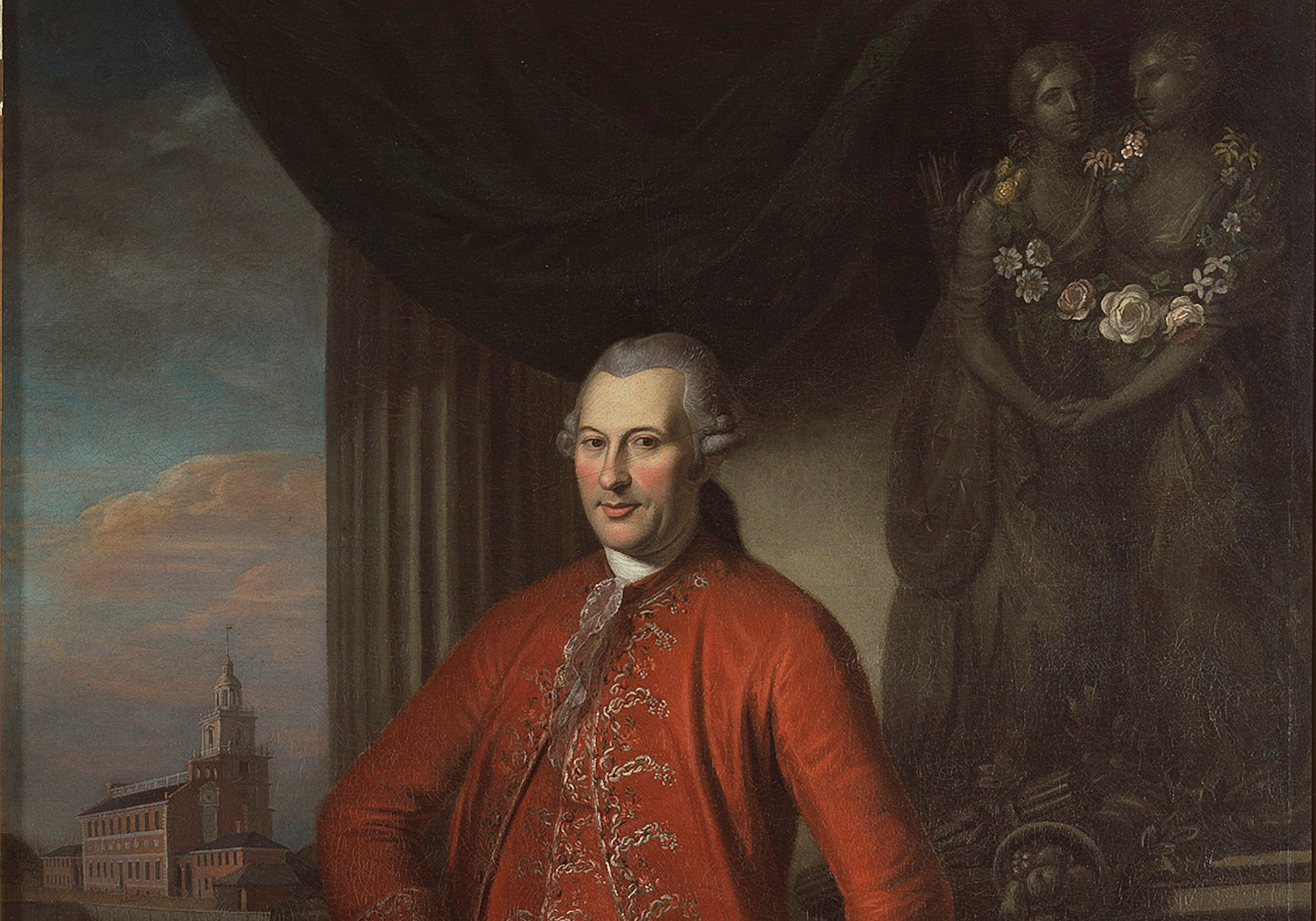
Celebrating FactGrid’s Q100000: Conrad Alexandre Gérard

Silently and without any fanfare we have passed the 100,000 mark on FactGrid! The item in question is a person: Conrad Alexandre Gérard. In a way he is the perfect candidate to mark this occasion. FactGrid has been diving into networks obscure and less obscure, and Gerard travels on both sides of this distinction: The first French ambassador to the United States and a person interested in Mesmerism, the world of miraculous cures based on “animal magnetism” in the 1780s. Our project started with the German Illuminati and spread into Freemasonry. In doing so, it broadened its scope to include France and England. Gerard is again a perfect representative of this outlook: born in Masevaux, France, in 1729 he pursued a diplomatic career that brought him to Mannheim and Vienna and eventually to the young United States of America. If our hopes are fulfilled, we will follow in his tracks and extend ourselves westwards and across the Atlantic over the next year.
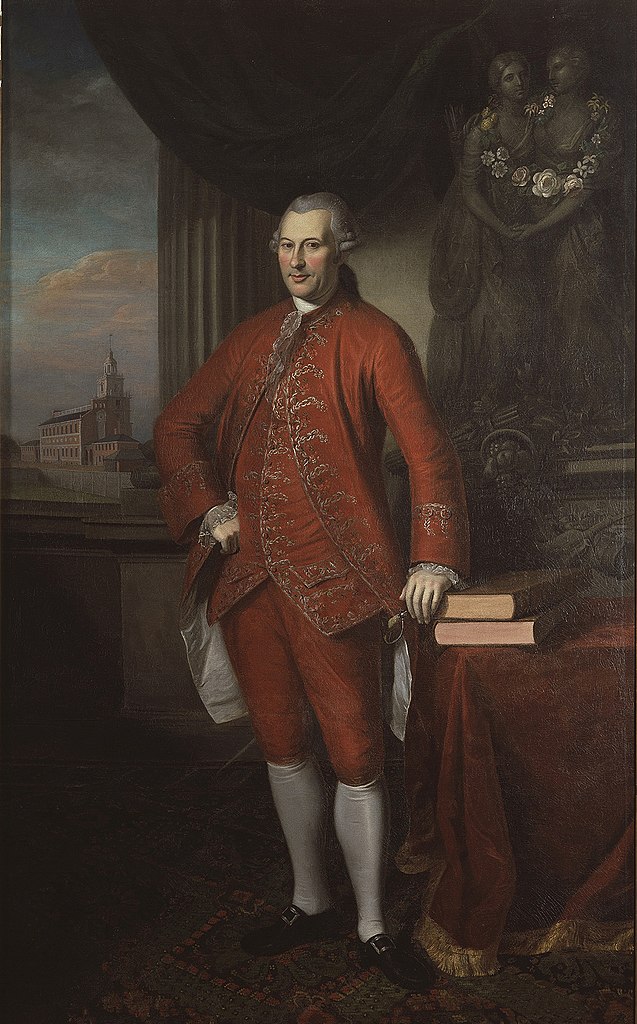
Conrad Alexandre Gérard, Philadelphia 1779
The 100.000th item was created by Bruno Belhoste who began to fuse the Francophone Harmonia Universalis database into FactGrid from where the Mesmerism of 1780s and 1790s Paris will now radiate outwards and into the network of its French and continental adherents. J.J.C. Bode brought these spheres into exemplary contact on his journey to Paris in the summer of 1787 – in the journey that marked the end of the Illuminati since he subsequently declined to resume his work as the last active secret superior when he returned home later that year. Mesmerising is the right word – a word derived from Franz Anton Mesmer, who will stand in the centre of the exceptional scene that is unfolding here.

FactGrid was established in order to give historical data a wider outreach and deeper impact. It is living up to its promise. We welcome joint ventures between platforms. We love to give data an additional outreach. We hope that we can give data sets wider connections and place them within unexpected and exciting contexts of research; and we hope that we can bring research teams together on this mission. Wikibase is designed to encourage this mission.

Looking back: we grew much faster than expected

Bruno Belhoste’s (and David Armando’s) project will deserve a longer blog post in 2020; it will take him another two or three months to feed all his data into the database and to be able to offer more substantial and significant insights; the present input is just preparing the basic structures one can then begin to interconnect. The 100,000th item is more of an opportunity to look back and to speak about the future as far as we can see it from our current vantage point.

Collective editing on FactGrid started on June 11, 2018. We began with data from the two Illuminati research projects that have dominated the scene since the late 1990s. The Illuminati will remain a construction site as we hope to bring online the entire “Swedish Box” (the core collection of Illuminati documents as amassed by Bode from 1782 until 1789). Berlin’s Lodge “To the Three Globes” and the Privy State Archive in Berlin have given encouraging signs that they would support the digitisation and detailed cataloguing. We will need three years of public funding for a project of these dimensions.

The Wikibase installation also invited local low-level projects that were open to testing and developing this resource. Would the “citizens” of Gotha be able to work on one and the same platform used by scholars in their wider international projects? Gotha’s City Church Archive was willing to bring its catalogue online on FactGrid. Heino Richard of the city’s Genealogy Association began an enormous project and has already transferred about two thirds of the “Pfarrerbuch”, volume one of the former duchy of Gotha’s pastors, into structured database information. The former duchy’s 140 pastorates are the project’s backbone; more than 2000 pastors filled the positions since the Reformation. The database has linked them to their parents, their spouses, their respective families, and Heino Richard is now on his way to add all the children — work which will eventually comprise over 15.000 data sets. Here is a perfect opportunity for scholarly professionals since we are dealing here with a tight network of families marrying among each other for over five centuries. We will add information about the professions to allow the sociological evaluation of these family ties.

The Illuminati allowed for the database to grow and merge with Freemasonry — after all this was what they were doing in the 1780s: infiltrating lodges in the German speaking territories. Hermann Schüttler had already identified members of some 130 lodges. Christian Wirkner brought his dissertation on Göttingen’s two late 18th century lodges into the database with some 800 biographies which inspired Martin Gollasch to widen the scope with his own research on the beginning of German’s student fraternities. We are now beginning to understand how the “Landsmannschaften” and a wider spectrum of quasi masonic organisations which recruited students in the central Protestant university cities, laid the ground on which the early 19th-century “Burschenschaften” emerged in the years of the Napoleonic wars. Martin Gollasch’s data sets are enriched by information about all the smaller, more intimate circles of friends which traveled through these wider organisations as he has been mining contemporary “books of friends”, the “Stammbücher” in which students collected entries from their dearest friends.

Bruno Belhoste’s and David Armando’s Harmonia Universalis data will widen the spectrum. One thing has already happened with this new project: Bruno Belhoste has effectively turned the entire site into a trilingual project: All our properties are now available in German, French and English. The interface is already speaking Russian and Chinese (and more than 100 other languages), so there remains some work to be done.

We would love to turn Magnus Manske’s Reasonator into the standard — multi-lingual — interface for simply viewing FactGrid data; that, however, will need a bit of more work from different sides.

One of the projects is hibernating at the moment: Tim Herb made it possible to quote the entire (Protestant) Bible on FactGrid down to the level of the individual verses. The central idea was here to connect all the people and places mentioned in the Bible and the Quran and thus to transform the Biblical historicity and genealogy into structured information. The project is daunting: Wikibase allows contradicting statements. How would a database fare with the competing chronologies of modern and early modern historians? Our predecessors saw the Bible with its succinct 6000 years of Universal history since the creation of the world as the ultimate historical source. When they made the comparison to the Greek and Roman sources, it seemed to them as if the pagans had nourished blatant mythologies. How would the project develop if it was widened into the Quran? The Bible and Quran project is an open challenge at this point. Being able to quote the Bible down to the level of verses has, in the meantime, the charm of offering concise intertextual connections: We might develop a new focus on “Early Modern Networks of Religious Dissent”. The protagonists of this scene had their favorites among the Biblical Books — Daniel, the Prophets, the Apocalypse. Collecting the references we should be able to see how the Bible was used by competing groups on their respective missions, so there is potential here.

The shadow of history: All the GND’s Masonic lodges on a map. The former German speaking regions are coming back to life. We have to get beyond this map – and our map should have historical layers.

Our work on Freemasonry is ultimately as much of a challenge: We could theoretically invite lodges from all over the world to map their historical membership lists and their institutional networks of affiliations and systems back in time. FactGrid should allow visualisations of the spread of Freemasonry on timelines and maps. We are presently at about 850 lodges mostly in the former German speaking territories thanks to a test input of GND data, and these data are broadly unconnected so far — an invitation to dream of the far bigger project that could explore Freemasonry as part of early modern globalisation.

…and ahead: a year of massive challenges

2019 was still a year of cautious consolidation. We have grown faster than expected but we remained a platform of projects that worked silently side by side and in a spirit of open-minded friendship, interlocking knowledge here and there. All data on FactGrid is so far hand picked in tremendously time-consuming work. The GND-input should change the work flow and it should invite projects to start right in the middle of publicly available knowledge. Ten million data sets of people, organisations and places will create a landscape ripe for immediate cultivation.

A lot of questions are still open in this project: Shall we include the whole GND in order to operate as a complete DNB-filial project? Our initial idea was to restrict FactGrid to the early modern period but even such self-imposed and somewhat arbitrary limitations were open to later revision. 1900 had been the line we would draw back in 2018. Today we are confronted with ideas to open FactGrid for research on the entire range of data harvested at the German National Library. How could we deal with personal information of living people without the National Library centre that is responding to requests to modify these data? The opposite threat is just as crucial: And how will we make sure that the input (no matter where it ends) does not turn FactGrid into an agglomeration of data that only a few SPARQL-specialists will be able to mine and which we can hardly keep fresh and alive on our site?

We will have to generate a wider community. We will have to advertise the project in the wider field of Wikimedia projects in order to attract fans of open knowledge from Wikidata and from the different Wikipedia history projects. We will need technical help during the input and we will need a community that adopts this mass of data and that transforms the massive mound of date into a vibrant intellectual playground.

As FactGrid is not exactly a grass roots project we will have to make sure that historical research, archives and libraries will see us as a resource and as a site of collective work. If you belong to the wider world of historians, librarians and archivists and if you are interested in big data you should feel challenged by a project that will turn public data into a treasure one can now, all of a sudden, revise, enrich and explore with unprecedented freedom.

The project will need a more solid technical basis on this course. We need an interface to meet the wider public: an interface which anyone can handle without SPARQL. The interface should be multilingual and it will look more like the Reasonator than our present Wikidata-style pages, which want to be edited rather than looked at.

So, some quite daunting challenges ahead – but we expect it to be inspiring to confront and eventually master them. The software is incredibly cool. It has been opening doors to us during its first one and a half years and we have every reason to think that it will continue to demonstrate this potential for the next years. Wikibase is on its way to become the software of a wide network of Wikibase instances and we should try to become a research platform in this network.
The Illuminati Files Online: Some remarks on the FactGrid’s first – roughly 16,000 – datasets

German Version

The FactGrid (still lacking a unique design) has, over the last six weeks, just received its first project data – data from Halle’s and Gotha’s Illuminati research of the last 20 years, which I will briefly outline in the following. Some of the datasets are still lacking the complexity we are aiming at, others have gained quite some depth:

We are presently listing some 2,000 people, about 1,350 of whom have been Illuminati members in the 1780s; the rest are mostly people mentioned in the correspondences which we are trying to map. We are hesitating here with the far more complex biographical input which he have in store, since this would be better done in joint ventures with the GND and with Katrin Möller, university of Halle, who has become the leading expert on 18th-century careers and professions. We are negotiating in both directions. Our roughly 2,000 titles of research on the Illuminati come in equally rudimentary sets. Again, we have realized that it would be more interesting to base this work on library catalogue norms from the outset.

But we are quite detailed with the more than 9,000 documents currently associated with the original Illuminati: documents that survived with the publications of Illuminati documents by the Bavarian state of 1786 and 1787 and with the archives of Adam Weishaupt, Johann Joachim Christoph Bode, of Gotha’s first lodge “The Compass”, and of Ernest II of Saxony-Gotha-Altenburg.

Some 3,000 of these documents received detailed and complex metadata on our database; they will shed light on Gotha’s Illuminati research of the last five years. Led by Martin Mulsow, Markus Meumann and I have been mapping and analysing Illuminati Essays collected in the “Schwedenkiste”, the famous “Swedish Box”. Our work had started with volume 13 and had soon moved beyond. Junior scholars had joined us with their research. Christian Wirkner dealt excessively with the minutes of the meetings collected in volume 15 and with exemplary strands of “Quibus Licet”/“Reproch” communication which the Order had designed to guide its members. Gotha’s research comes therefore with an emphasis on volumes 11 to 16 of the “Swedish Box”

The Gotha Illuminati Research Base, a conventional MediaWiki which we had set up in order to organise the team’s research became within a year of its existence the pool of ongoing work for the entire (small) community of Illuminati researchers. It attracted the first massive external data inputs: Hermann Schüttler offered us a list of members which he eventually connected with biographies to all our documents. He moved on with a technological relic: an Access database of the research he and Reinhard Markner had conducted for the two volumes of The Illuminati Correspondence (published in 2005 and 2013 respectively). These data are now the deeper layer under the special qid Item: Q11305.

Schüttler provides the following overview of this special database:

1. What is in it? Letters collected by a) Adam Weishaupt now located Hamburg’s State Archive, as deposit of the “United Five” (lodges) Hamburg, and b) the of the “Schwedenkiste”, – collected here by Johann Joachim Christoph Bode and augmented by Ernst II. of Saxony-Gotha-Altenburg, now located in the Prussian Privy State Archives, Berlin (formerly located in State Archive of the GDR, Merseburg). We have added any materials of the Illuminati context from other sources, where we could spot them.
2. Who has been working on this from when to when? The data was collected during the years of the IZEA project between early 2000 and mid-2005 by Hermann Schüttler and have been partially supplemented by Reinhard Markner.
3. Which archives have been visited? Hamburg’s State Archive, the Prussian Privy State Archives, Berlin, the Bavarian Main State Archives, Munich (Weishaupt letters in the “Kasten Schwarz” collection), the Palatine State Library, Speyer (collection Schwanckhardt).
4. Which publications are linked to this? The titles, which are listed under the qid Item: Q11305.

For the first time, the FactGrid can therefore present the tip of the iceberg of the Illuminati files online. Future projects will be able to add to this now that the grid is laid out – but we could also enter a far more dynamic process offering the digitized documents together with the metadata we have here collected. This will only be conceivable in a project for which the Grand Lodges and the archives involved remain to be won.

The creative part of the work can now begin

Compared to the previous MediaWiki, the FactGrid is structurally in one aspect at a disadvantage: The wiki offers transcripts and summaries of hundreds of documents and sessions of the Order (see here what we did with Document 70, Schwedenkiste volume 13 in our conventional Wiki and see here the respective database record: Item:Q6641). It would be exciting to make the transcripts available in the database itself. We will write out two work contracts, on the one hand to bring database information into the conventional wiki – on the other hand to develop a concept of how we could use the FactGrid as our sole repository for data, extended digests, transcripts and media files.

The database is otherwise far superior to the previous MediaWiki: It creates the grid which future research can use while it is opening the door to the data mining that can now begin. One will now be able to map the entire work of the Order between the late 1770s and 1788 (as far as it is still documented). It will be possible to examine membership careers (as soon as we get on with the personal data in greater detail): Who got into the Order on whose proposal? What kind of networking did members unfold within the Order at what stage of its brief existence?

The project will now need groups to bring their own research into the database. It should at the same moment begin to attract “data scientists” and “data visualizers”. And, of course: We are immensely curious about what information others will make visible where we can only offer our gut feelings and sketchy ideas of personal networks that developed in this web. The FactGrid blog will be a good place to present data analytics, which SPARQL enthusiasts can now do far better than the researchers behind the data resource.

More

In alphabetical order: Lorenza Castella, Erik Liebscher, Reinhard Markner, Markus Meumann, Martin Mulsow, Hermann Schüttler, Olaf Simons and Christian Wirkner

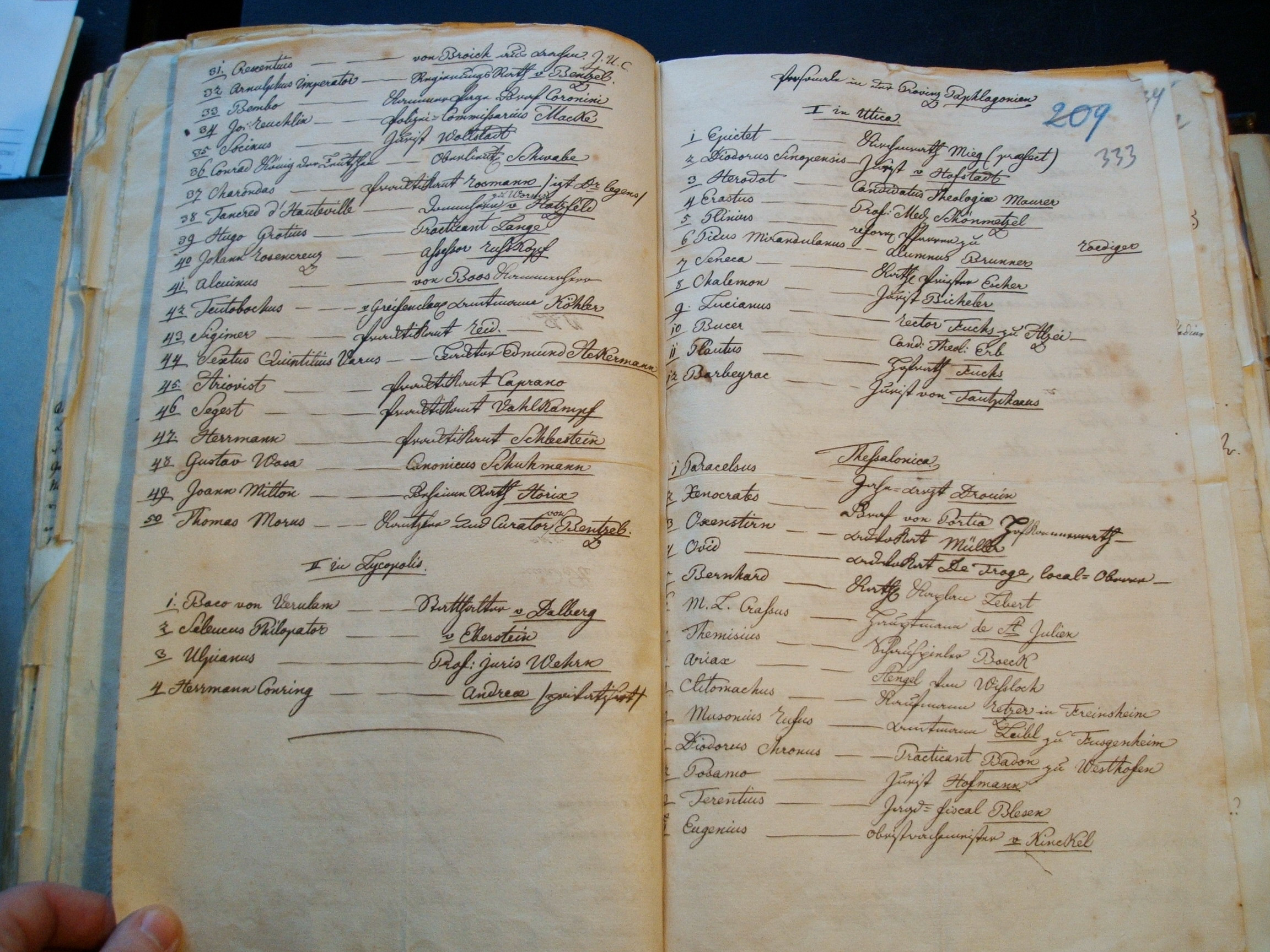
Featured image: Item: Q4545 last page and Item: Q4546 first page: The membership code names used by the Minerval churches of Frankfurt (Epidamnus, continuation from the previous page), Lycopolis (Erfurt), Heidelberg (Uttica) and Thesalonica (Mannheim).

Die Illuminatenakten Online: Einige Bemerkungen zu den ersten knapp 16.000 Datensätzen des FactGrid

in English

Das FactGrid (noch immer ohne ein eigenständiges Design) erhielt in den letzten Wochen seine ersten Projektdaten – Daten aus der Illuminatenforschung Halles und Gothas der letzten 20 Jahre, die hier kurz umrissen seien.

Rudimentär sind in diesem Stadium noch die Datensätze zu den gut 2.000 gelisteten Personen. Etwa 1.350 von ihnen waren Illuminaten, die übrigen zumeist Personen, die von ihnen in Briefen erwähnt wurden. Wir schrecken im Moment vor der Eingabe der uns vorliegenden runderen Datensätze zurück, da sie weit interessanter in einer Kooperation mit der GND und unterstützt durch Katrin Möllers Hallenser Projekt zu Erwerbsbiographien geschähe. Verhandlungen in beide Richtungen laufen. Rudimentär sind im selben Moment auch die gut 2,000 Titel Forschungsliteratur zum Illuminatenorden gelistet. Auch hier wurde uns klar, dass es interessant wäre, diese Arbeit von vornherein an bibliothekarische Katalogsysteme anzulehnen.

Im Zentrum bietet das FactGrid indes nun die gut 9.000 Dokumente, die aktuell in Forschungskreisen mit dem Illuminatenorden und ihren Aktenkonstellationen in Verbindung gebracht werden: Dokumente aus den Nachlässen Adam Weishaupts, Johann Joachim Christoph Bodes, der Gothaer Loge „Zum Compaß“, Ernsts II. von Sachsen-Gotha-Altenburg, sowie der 1786 und 1787 geschehenen Veröffentlichungen aus Bayern.

Etwa 3.000 dieser Dokumente sind sehr viel eingehender erfasst. Sie geben in ihrer obersten Schicht Einblick in Gothas Illuminatenforschung der letzten fünf Jahre: Unter der Projektleitung Martin Mulsows untersuchten Markus Meumann und ich von Nachwuchsforschern unterstützt „Illuminatenaufsätze“, mit ihrem Schwerpunkt im 13. Band der „Schwedenkiste“. Unsere Arbeit griff schnell in die benachbarten Bände aus. Christian Wirkner erschloss dabei in mehreren Schüben die Sitzungsprotokolle sowie einzelne Stränge der Betreuungskorrespondenz zwischen Mitgliedern und den „Unbekannten Oberen“ – den Austausch von „Quibus Licet“ und „Reprochen“. Der Gothaer Schwerpunkt liegt mithin in den Bänden 11 bis 16 der „Schwedenkiste“.

Das von uns aufgebaute „Illuminatenwiki“, die Gotha Illuminati Research Base, wirkte unerwartet in die Forschung hinein. Mit ihm kamen die Datensammlungen Hermann Schüttlers und Reinhard Markners ins Gehege, die bis in das Jahr 1998 zurückgehen. Hermann Schüttler publizierte 1991 das erste Kompendium zu den Mitgliedern des Ordens (und arbeitete diese bereits in die Gotha Illuminati Research Base ein: Die Mitglieder des Illuminatenordens). Gemeinsam mit Reinhard Markner erschloss er ab 2000 in großem Umfang die Ordenskorrespondenz. Eine Access Datenbank kam aus seiner Hand von hier aus in das Startangebot für das FactGrid – im FactGrid regulär mit der qid Item:Q11305 als Forschungsleistung ausgewiesen:

Hermann Schüttler zu diesem Datenbestand:

1. Was ist drin? Briefe vor allem aus a) dem Teilnachlaß von Adam Weishaupt im Staatsarchiv Hamburg, Depositum der „Vereinigten Fünf“ (Logen) Hamburg, sowie b) der „Schwedenkiste“, d.i. dem Nachlaß von Johann Joachim Christoph Bode, vermehrt um Papiere von Ernst II. von Sachsen-Gotha-Altenburg im Staatsarchiv Preußischer Kulturbesitz Berlin, zuvor Staatsarchiv der DDR, Merseburg. Dazu vereinzelt Material mit eindeutig illuminatischem Bezug verschiedenster Provenienz.
2. Wer hat wieviel von wann bis wann daran gearbeitet? Die Daten wurden während der Laufzeit des Projektes im IZEA zwischen Anfang 2000 und Mitte 2005 von Hermann Schüttler erfaßt und danach von Reinhard Markner teilweise ergänzt.
3. Welche Archive wurden besucht? Staatsarchiv der Freien und Hansestadt Hamburg, Geheimes Staatsarchiv Preußischer Kulturbesitz, Berlin, Bayerisches Hauptstaatsarchiv, München (Briefe Weishaupt im Bestand „Kasten Schwarz“), Pfälzische Landesbibliothek, Speyer (Nachlaß Schwanckhardt).
4. Welche Veröffentlichungen knüpfen sich daran? Die Titel, die sich jeweils unter der qid Item:Q11305 zur gesamten hier erbrachten Forschungsleistung gelistet finden.

Das FactGrid kann damit erstmals den Eisberg so halbwegs bemessen und im Projekt der Illuminatenakten Online in den Metadaten vorlegen. Zukünftige Projekte können von hier aus fortfahren. Mit ganz anderer Dynamik ließe sich das große hier angelegte Raster indes füllen, wenn wir mit der Datenbank die Digitalisate aller Dokumente zugänglich machen könnten. Das aber wird nur in einem Projekt denkbar werden, für das die Großlogen und Archive, in deren Eigentum respektive Besitz sich die meisten der Akten heute befinden, noch zu gewinnen bleiben.

Der kreative Part der Arbeit kann damit beginnen

Gegenüber dem bisherigen Wiki ist das FactGrid an einer Stelle strukturell im Nachteil: Das Wiki macht Transkripte und Zusammenfassungen von Hunderten Dokumenten sowie detaillierte Informationen zu Sitzungen des Ordens zugänglich (hier eine Musterseite zu einem Dokument – dem Dokument 70 im 13. Band der Schwedenkiste – im alten Wiki; hier die Datensammlung zum selben Dokument im FactGrid: Item:Q6641). Spannend wäre es, diese Texte und Informationen in der Datenbank selbst verfügbar zu machen. Wir werden zwei Werkverträge ausschreiben, einerseits um das alte Wiki zu entlasten, in dem wir Metadaten großflächig und laufend aktuell aus der Datenbank einspielen. Ein komplementärer Werkvertrag wird der Frage gelten, wie wir das konventionelle Wiki zur Vermeidung doppelter Arbeit im FactGrid (respektive in einer eigens zu gründenden FactGrid Ressource für Objektrepräsentationen) verlustfrei aufgehen lassen könnten (siehe hier die Vorformulierungen zu diesen beiden Werkverträgen).

An einer anderen Stelle ist die Datenbank dem bisherige MediaWiki bei weitem überlegen: Mit ihr ist die verfügbare Materiallage im großen Raster erfasst, in dem sich weiterforschen lässt – und die Tür geöffnet zum Data-Mining. Man wird nun daran gehen können, die gesamte Aktenproduktion kartographisch wie auf Zeitleisten zu erfassen. Man wird (insbesondere sobald die Personeninformationen zu den Berufen detaillierter eingegeben sind) durchleuchten können, wer mit wessen Fürsprachen welche Karrieren im Orden machte und dabei welche Netze des ordensinternen Austauschs generierte.

Gefragt sind damit zum einen Gruppen, die mit eigener Forschung im Feld weitermachen und zum anderen Data-Miner, Datenvisualisierer – und wir sind natürlich gespannt, welche Informationen sie dort sichtbar machen werden, wo wir bislang vor allem Detailinformationen mit dem gröberen Bauchgefühl der Beziehungen im Orden nachgehen. Der FactGrid Blog wird eine gute Adresse sein, um Daten-Analysen vorzulegen, die SPARQL-Begeisterte nun weit besser durchführen können als die Forscher hinter dieser Datenressource.

Mehr

In alphabetischer Reihenfolge: Lorenza Castella, Erik Liebscher, Reinhard Markner, Markus Meumann, Martin Mulsow, Hermann Schüttler, Olaf Simons und Christian Wirkner

Featured Image: Item:Q4545 letzte Seite und Item:Q4546 erste Seite: Die Mitgliederaufschlüsselungen der Minervalkirchen Frankfurt (Epidamnus, Fortsetzung von voriger Seite), Lycopolis (Erfurt), Heidelberg (Uttica) und Thesalonica (Mannheim).