We are very pleased to announce a pilot project funded by the U.S. federal government’s National Endowment of the Humanities (NEH): “PhiloBiblon: From Siloed Databases to Linked Open Data via Wikibase: Proof of Concept.” It will begin June 1, 2021. and end May 30, 2022 and will be hosted by FactGrid.
The project is focused on PhiloBiblon. a forty-year-old database for the study of the medieval history and literatures of the Romance cultures of the Iberian Peninsula: Portuguese and Galician-Portuguese, Castilian, and Catalan. It contains four subsidiary databases:
BETA: Bibliografía Española de Textos Antiguos: Medieval texts in Spanish.
BIPA: Bibliografía de la Poesía Áurea: Golden Age (16th-17th c.) Poetry in Spanish.
BITAGAP: Bibliografia de Textos Antigos Galegos e Portugueses: Medieval texts in Galician, Galician-Portuguese, and Portuguese,
BITECA: Bibliografia de Textos Antics Catalans, Valencians i Balears: Medieval texts in Catalan.
The project is designed to solve one of the most vexing problems facing long-standing digital projects: maintainance of the software platform. PhiloBiblon started out in 1975 as an ancillary database of the Dictionary of the Old Spanish Language project, carried out at University of Wisconsin, Madison, by Lloyd Kasten and his student, John Nitti. In Madison the database management system (DBMS) used was FAMULUS, created, ironically, in Berkeley in 1964, for the Pacific Southwest Forest and Range Experiment Station. Since then, technological transformation has been a constant: from the CD-ROM discs of ADMYTE (Archivo Digital de Manuscritos y Texts Españoles ) to a first web version in 1997 to the current 2014 version. Each transformation has usually required multiple grant applications to agencies and foundations, especially to NEH.
PhiloBiblon currently runs under Windows on Revelation Technology’s MultiValue database, OpenInsight. PhiloBiblon’s 1987 implementation was designed on Revelation G., the ancestor of OpenInsight, by John May, a graduate student in History of Science who eventually left the academy for a business career. John has maintained and enhanced the PhiloBiblon DBMS for more than 35 years, building it out to encompass ten relational tables (texts, witnesses, primary source manuscripts and imprints, copies of imprints, persons, institutions, toponyms, and secondary references). Among them these ten tables contain 1246 data elements (fields), 98 controlled vocabulary lists with more than 3000 properties, 110 search indexes, and 30 data entry screens.
PhiloBiblon and its relational DBMS existed before Tim Berners-Lee invented the Worldwide Web at CERN in Geneva in 1989. It was evident from the advent of the first really useful commercial browser, Netscape, that the WWW offered a vastly superior vehicle for making information available to students and scholars, much better than print and CD-ROM. In PhiloBiblon’s first web version (1997), data were exported from the OpenInsight DBMS and uploaded to a web server at Berkeley in HTML format. Users could search only for authors, titles, or keywords; and the result of the search was just a list of manuscripts or editions, each of which had to be opened, one-by-one, to find the item of interest.
In the current version OpenInsight data is still exported—usually every two or three months—and uploaded to a web server at Berkeley (and to a mirror site at the Universitat Pompeu Fabra in Barcelona) in ten separate files, one for each table, in the more advanced XML format. On the server the eXtensible Text Framework (XTF) program, created by the California Digital Library of the University of California, parses each file into individual records, indexes them, and serves them to users as a result of a search request from the PhiloBiblon web site. The search mechanisms are much more powerful, offering not only keyword searching but also a set of search boxes tailored to each entity.
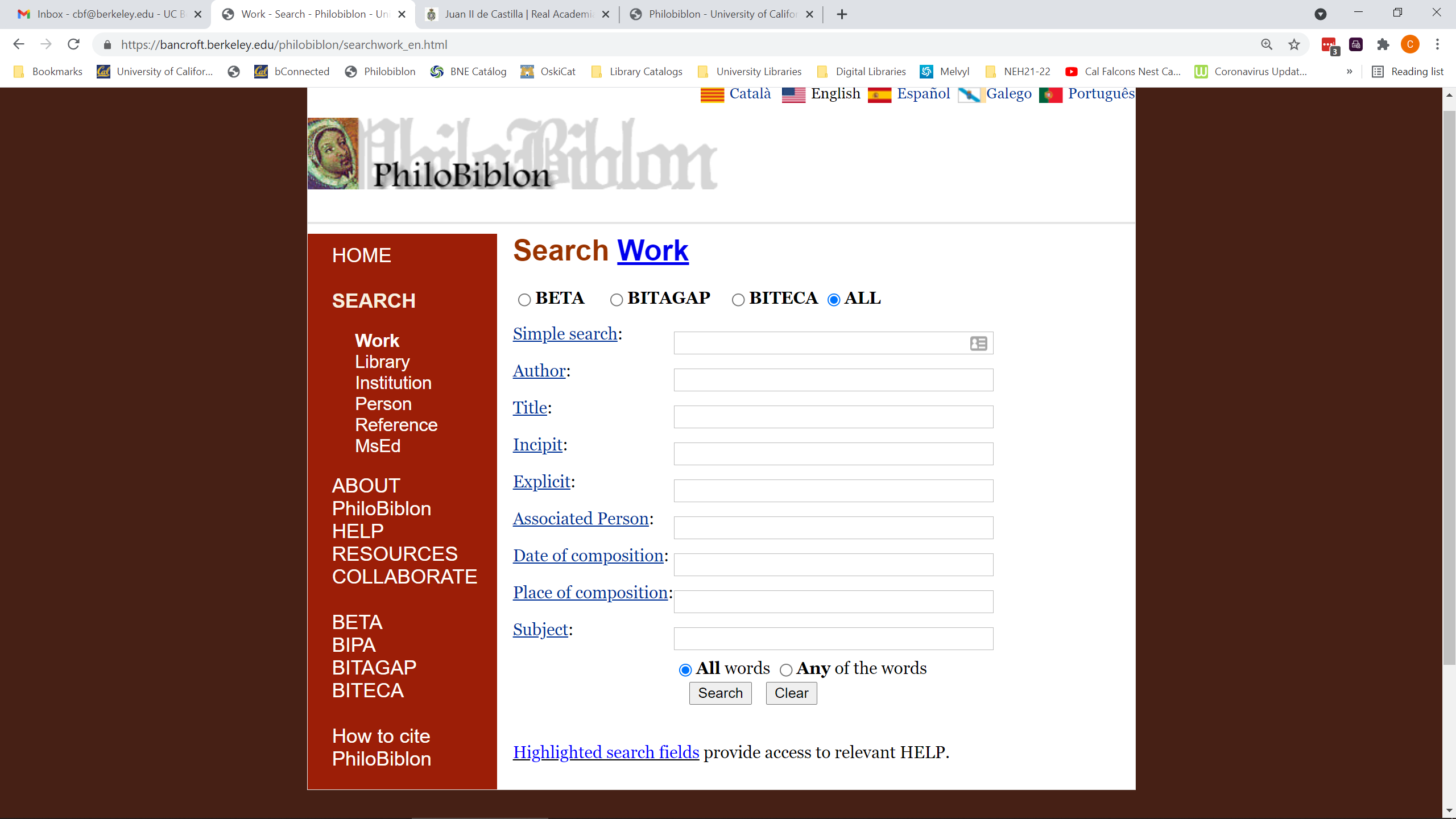
Thus for texts (works): keyword (simple search), author, title, incipit, explicit, associate person, date and place of composition, subject.
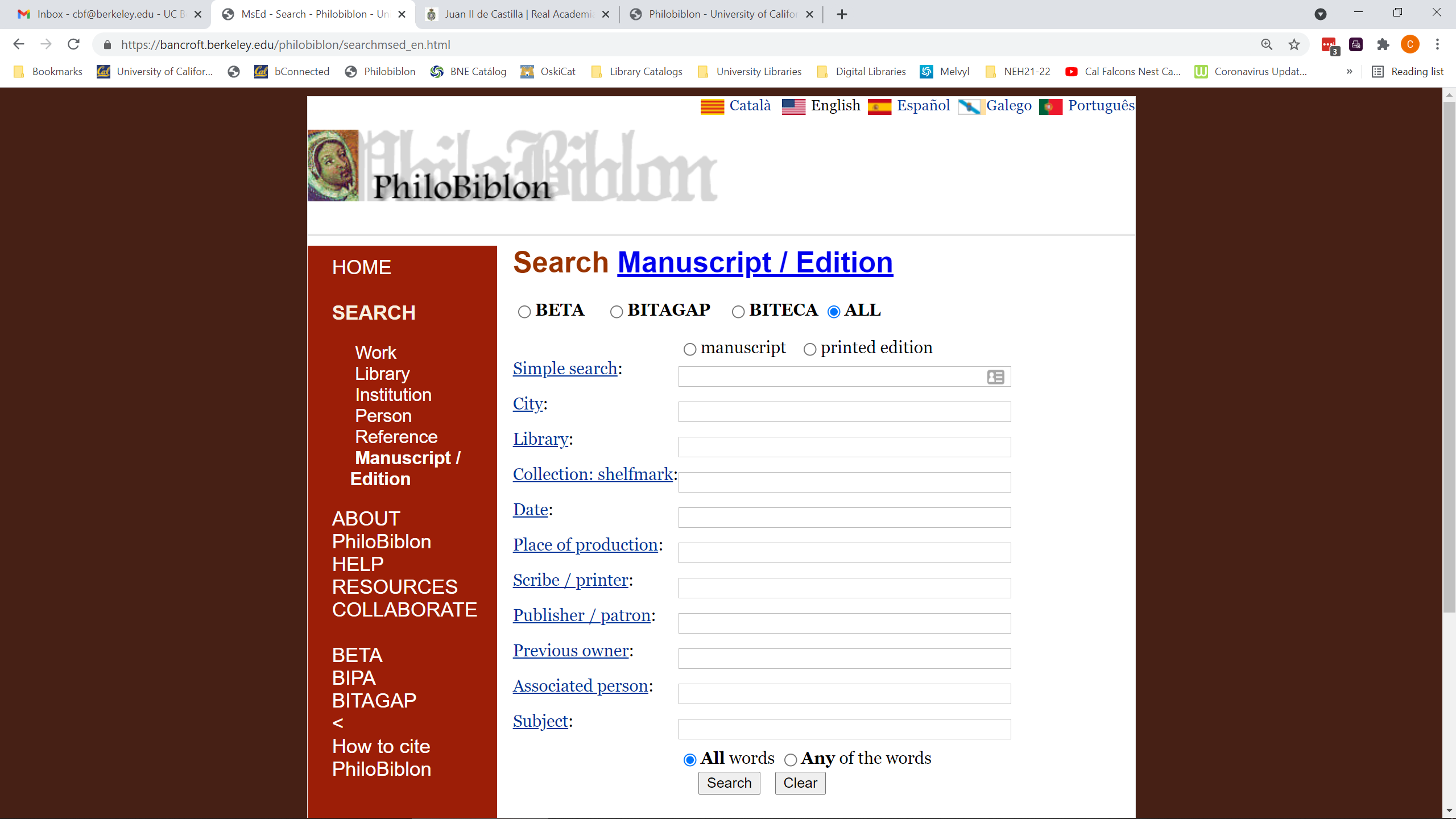
For manuscripts and editions: City and library holding the item, shelfmark, date and place of production, printer and publisher, scribe and patron, previous owner or other associated person:
The time lag between data input and its appearance on the web is annoying. Moreover, the process required to export data and upload it to the web to the web is is neither elegant nor efficient. Aside from this and from the problem of maintaining and enhancing both the Windows DBMS and the web software, the most urgent issue facing PhiloBiblon is its status as an information silo, with no organic relationship with other information sources. The web 3.0, the semantic web, is designed to make use of Linked Open Data and the Resource Description Framework (LD/RDF) in order to make possible automatic links to other information resources, like the Virtual International Authority File (VIAF).
Since 2014 the PhiloBiblon research teams have prepared a series of unsuccessful grant proposals, separately as well as in collaboration with other projects, to NEH and to Spanish, Catalan, and European agencies and foundations with the goal of funding the transformation of PhiloBiblon into an LD/RDF resource.
Last year, instead of proposing the creation ex professo of a new web-based DBMS for PhiloBiblon, on the advice of our neighbors at Stanford University, the University of California, Davis, and the international library consortium OCLC, we decided to explore a radically different solution: to incorporate PhiloBiblon into the wiki world. PhiloBiblon already cites Wikipedia constantly, more than 1400 times in nine different languages. Of more interest than Wikipedia as a model, however, is the more structured but still open environment of Wikidata. Wikidata, however, is too open. PhiloBiblon requires more control over the individuals who can contribute to it.
This led us to FactGrid, which is ideal for our purposes. Open only to members, it offers a perfect sandbox for the PhiloBiblon staff to explore the relationship between PhiloBiblon’s highly structured data model and the elegant and infinitely extensible model of triplestores based on Q# entities and P# properties. We are enormously grateful to Olaf Simons not only for his generous offer to make it available for this purpose but also for agreeing to serve on the Advisory Board of the current NEH project.
When this project ends May 31, 2022, we hope to have shown that the Wikidata model is viable for PhiloBiblon over the long term and that we can make use of its standard input processes, modified as necessary, to map PhiloBiblon’s 421,000 records into the corresponding FactGrid entities and properties, creating new ones as necessary. This work will be carried out primarily by data analyst Adam Anderson, whose academic specialization is Assyriology and cuneiform studies. He will also study Wikibase’s LD access points to and from libraries and archives and test the Wikibase data export module for JSON-LD, RDF, and XML on PhiloBiblon data.
TABLA
BETA
BITAGAP
BITECA
BIPA
ANALYTIC (witnesses)
14692
52084
12239
89926
REFERENCES
7270
21558
5976
472
PERSONS
7423
32309
3473
3418
GEOGRAPHY
1814
4759
840
211
INSTITUTIONS
794
3297
585
4
LIBRARIES
915
455
420
119
MANUSCRIPTS & IMPRINTS
5168
5886
1971
1572
COPIES OF PRINTED BOOKS
4157
1146
1473
137
SUBJECT HEADINGS
339
34
149
126
WORKS (texts)
6034
31962
6173
89913
TOTAL
48606
153490
33299
185898
421293
In addition, software engineer Josep María Formentí (Barcelona), after evaluating the Wikibase data entry module and report format, will create prototypes of more user-friendly query and data entry screens and report formats.
All of this work will be carried out in collaboration with the twenty members of the PhiloBiblon volunteer academic staff and, we hope, numerous volunteers from the Hispano-medievalist community.
Image: Rueland Frueauf the Elder (1440–1507) The Education of the Infant Christ (1506) Wikimedia Commons.
Germany’s national author Johann Wolfgang von Goethe called it a “masquerade in red and white”, but was himself a member (just as he became a member of the Illuminati a little bit later; it made sense to join such organisations and to know from within what they were all about). Freemasonry was in its most idealistic terms an updated edition of the brotherhood of men united under a simple and strikingly anti aristocratic system: the system of the old craft guilds. With their three degrees of apprentice, fellow and master there was no room for privilege of birth. German masonry evolved from the late 1730’s through the 1750’s principally as a system of four degrees, with Scots Master at the apex and the development did not stop there. The chivalric degrees of the 1760’s and 1770’s gave way to increasingly complex systems, overgrowing this initial construct. These high-degree systems claimed roots in the middle ages if not deeper pasts, synthesising Christianity with alchemy, magic, and theosophy. Masonic entrepreneurs travelled through Europe selling secrets which they would convey in extraordinary lodges. What they offered would have been considered heresies only a generation before, and now became a market of esotericism – a market that turned the masonic world into its first framework and distributor. The Strict Observance or Order of the Temple, the masonic high-grade-system founded by Carl Gotthelf von Hund und Altengrotkau in Germany in 1751 was the biggest player on this stage in central Europe – the system of red and white, the colours of the Knights Templars.
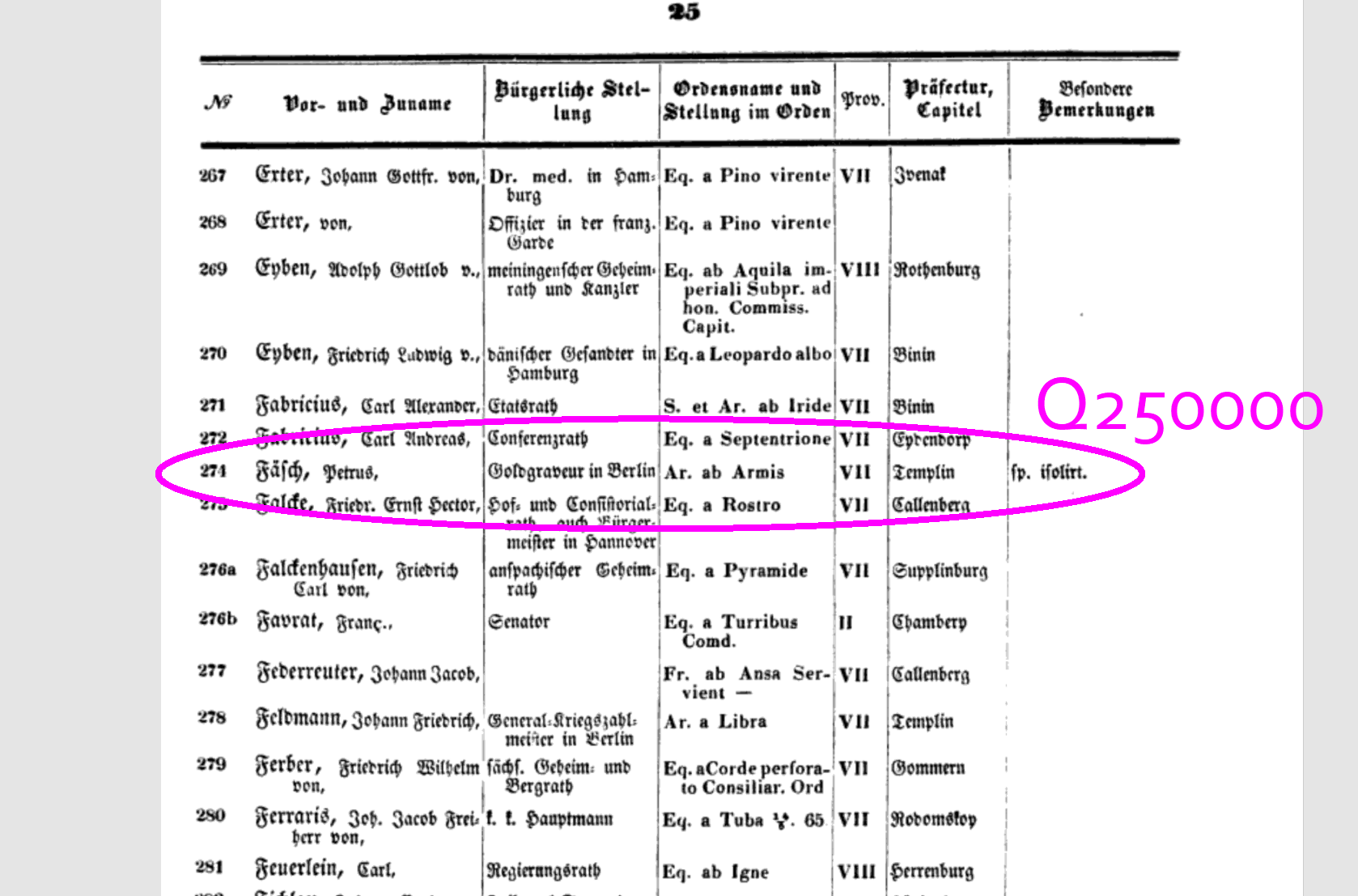
Q250000 is the FactGrid item number of Pierre Faesch, a Frenchman, by profession a gold engraver, who settled in Berlin where he and some of his friends eventually founded their own lodge “Indissolubilis”. He was number 274 in von Lindt’s list of the members of the Strict Observance, published 1846 – number 274 of the 1,266 members he could establish.
Josef Wäges broke the quarter of a millionth item with the input of this list on May 10, 2021 at 7:20 (EST). FactGrid became immediately the most interesting environment for this dataset. 180 of his 1,266 records were old acquaintances: members who already had their Q-numbers on FactGrid. But the new data set which anyone can now create on FactGrid is substantially bigger: it lists 1,595 members with interesting overlaps of projects that have been working on FactGrid over the last three years:
Josef Wäges will publish a more detailed article on the dataset in a lavishly illustrated blog post. The links to the Illuminati are perhaps the most interesting thing to explore in this data set. Von Hund’s claim that the Strict Observance had its roots in the order of the Knights Templar had been both immensely attractive and explosive. The heads of the medieval Order had burned on the stake on May 12, 1310 – but the organisation had gone underground and fused into Scotland’s crypto Catholicism, so the story goes, including the idea that the “Pretender” (to the British throne) was the secret leader of the organisation. The Strict Observance soon expanded from Germany to France, Sweden, Italy, the Baltics and Russia. State leaders became Knights of the Order and met in fancy costumes while members like Goethe or Christoph Bode could easily cast doubts on the historical construct. Von Hund died in 1776 without having given the final proof of the legacy. The organisation itself was by that time in financial troubles over plans to create an insurance system for its members on a foundation of factories, which were to be built under command of the Order on the eve of industrialisation, an organisation that was not really established in the world of modern capitalism.
The internal conflicts culminated in the summer of 1782 when the rank and file of the Observance met at their last convention in the resort of Wilhelmsbad near Frankfurt am Main. The alleged history stood in the centre of the debates and tore the Order apart while a new organisation was secretly emerging behind the scenes: the Order of Illuminati, both as an antithesis and also as a potential heir of the entire infrastructure. They too were by 1782 a masonic high degree system, and they infiltrated lodges far more cunningly from below than from above. With the help of young “Minervals” which they tunnelled from below into the lodges of their interest, and from above with the help of masonic functionaries in the Illuminati leadership. The fascinating thing about the Illuminati was that all the bombastic narratives were handled as little more than a Machiavellian façade by those who acted as “Unknown Superiors” in the hidden centre of this organisation.
Our critical mass: strange organisations of the second half of the 18th century
FactGrid is growing fast. We are doubling our numbers almost every year; that is the more superficial message of the Q250000 jubilee. The more complex message will be: We are (thus far) growing particularly well where we reached our particular critical mass. Entries like Pierre Faesh are the almost ideal subject matter for a Wikibase installation. No portrait has survived, we know little about the biography but we can produce some interesting details with far reaching network information. A genealogy software would not be versatile enough to handle such knowledge. A regular Wiki, with its focus on articles to be written, would on the other hand need to be filled with desolate fragments of repetitive information – we do not know enough to write interesting articles about these people. Using a Wikibase we can easily turn the few points of data we have into an asset. If you want to know more about the “Strict Observance” we can offer the sociological details, networks of the members, family ties, knowledge of the organisation and its surroundings: We can list the various organisational ties of these members and we can – theoretically – give a picture of the landscape of Masonic organisations as they grew and changed from the 17th into the 19th century.
Not quite the software of citizen science: Our Gotha specialisation
At an early point we decided to test the software on the wider audience in a local experiment. Gotha is a small town of some 45,000 inhabitants. We could easily give database courses at the Research Centre. The local project developed with mixed success: Gotha’s Archive of the Lutheran City Church embraced the offer of the free database. Heino Richard of Gotha’s genealogical society entered this project and created its biographical backbone with some 20,000 biographical records linked to the archive’s work and to the city’s history. The integrative appeal remained, however, comparatively weak.
The Wikibase conclusion so far, is interesting in the hands of researchers who are delighted about the flexibility they get with this software. The same tool remains opaque in wider use. We will need interfaces for genealogists and archivists to make broad editing easier, and these interfaces will come.
Novels, religious dissidents, medieval codices and Nazi concentration camps – leaving our comfort zone
We are, nonetheless leaving our comfort zone, the zone of late 18th-century biographies, and this is challenging wherever it leads into fields of information without more comfortable background knowledge:
Marie Gunreben of the University of Konstanz has started a project on German novels 1670 to 1750. We have widened this project. We should get the European flow of developments into the picture, the exports and imports, the flow of translations and influences across the European borders. The move is an immense theoretical challenge: We are using a software that creates essential notions of sameness wherever it sets a Q-number. The modern English “novel” should, of course, be the modern French or German “Roman”. But the conceptual equivalents do not really lead us back into the early 18th century. The English “novel” was back then what we will today call a “novella”. Robinson Crusoe, if anything, was a “romance” – a spectacular move in 1719 as the romance had just been pronounced dead, finished by the modern novel(la). How should we handle different conceptual developments in different languages? We are experimenting with set language Items and with Q-items that use the modern conceptual frame as an alleged continuum. It remains to be seen how this will work.
Lionel Laborie is about to open the long-expected section on Early Modern religious dissent which our present data have been calling for for the last three years. Freemasons, Rosicrucians and Illuminati, quasi-religious associations built upon a new consensus that their members would leave all their confessional controversies aside and focus on a truth beyond. The result was not exactly deism that shined through all the allusions to God as the master builder and supreme architect. It was rather a competition of increasingly eclectic historical constructs of diverse religious dimensions – of heresies in the old terms of the Catholic or Lutheran orthodoxy and these new orthodoxies emerged within this spectrum with different systems that would not necessarily acknowledge each other. If successful we should be able to eventually give a sketch of the changing map – now with a perspective on the biographies that travelled on this map of ever changing options.
Steps into uncharted territories are a challenge on a Wikibase. You want to augment and to interconnect known objects, you want to work on the basis of our collective present knowledge and suddenly you have to create ever new objects that need ever new objects in order to make sense.
The Middle Ages – the new territory where we will see the biggest growth on our course to Q500000
We will enter new fields and Q500000 is already knocking at our doors. Led by Charles Faulhaber the trilingual PhiloBiblon project has decided to fuse their data into FactGrid – 450.000 items of (late) medieval Iberian books and manuscripts. The project will be a test. We might arrive at the conclusion that the global text production deserves its own Wikibase. It might just as well dissolve the present demarcation lines between archives and libraries on the one hand and historical research on the other. Historical information is in its last consequence not much more than an interpretation of remaining textual and documented evidence. We will bring the evidence and the interpretation onto the same platform.
FactGrid will learn Spanish and Portuguese in the course of this project. The PhiloBiblon group arrives as a team of superbly informed people with different specialisations from data management and librarianship to (literary) history. The technical aim will be to create a user interface on the specific material base that will communicate with the database. FactGrid will act here in the background – nothing to regret, rather the model to go for: The model of a single compound of knowledge that serves various projects as the reservoir of broader collective knowledge.
In the middle of technical developments
Wikibase is not yet a widely used software – it has the potential to become this software. The problem is apparent in any imaginable “normal” use case. You search something – but how do you search anything on the SPARQL Query Service? – on a Query Service that expects you to know what you can search and how you would ask for it – without giving you the slightest hint on either question.
You can use the Wiki surface but here again you will be puzzled. What exactly is the message of these Item pages that collect various statements without order and cohesion? Even if you arrive at a complex item like Q133, Christoph Bode, that item will not tell you half of the story – it does not tell you that this man is the author of hundreds of letters stored in this database, and the recipient of as many – who is mentioned in hundreds of other sources the database has registered.
Markus Manske’s Reasonator gave a glimpse of what one could do with a Wikibase such as Wikidata: One could produce well-structured pages of information automatically in hundreds of languages. The Reasonator did not make it into the software package nor is it easy to use on an external Wikibase.
We will get such browsers – not in the singular but in the plural of general and specific purposes and two of these have entered a test phase last month: Bruno Belhoste’s “FactGrid Viewer” and Michael Ringgaard’s “SLING Browser”. Both seem to do pretty much the same job, but they are doing it differently, opening doors into quite different future developments.
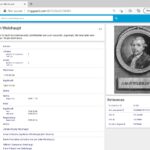
Bruno Belhoste’s FactGrid Viewer (you have been using it over the last minutes wherever you followed the Item-links in this article) is drawing its information straight from the database as you see it. Change data on FactGrid and you will see the new situation with the next browser update. You can switch languages. You get a history of your movements on the site and you get an idea of where you are with a specific item as the object is connected to “what links here?” information.
You can implement Bruno Belhoste’s viewer – pure Javascript – on any website anywhere in the world to see your choice of FactGrid data – the solution for projects who want to use the FactGrid database simply as their database without a further interest in the broader platform.
Michael Ringgaard’s SLING Browser works on the basis of the data dump which FactGrid supplies every evening around 21:15 CET. A new edition of the SLING browser’s presentation of information is created every day. The potential is visible in an intricate detail: The Q-Numbers of SLING browser searches are not necessarily FactGrid Q-Numbers (Christoph Bode our Q133 is on the SLING Browser Q213880). If there is information about the same object available on Wikidata the SLING Browser will give it under the Wikidata Q-Number, and this is only the beginning of the upcoming development: We will eventually see pages that accumulate information from various Wikibases – not in a show of serialised harvests but in a single coordinated representation that accumulates information and that marks the differences only where it arrives at disagreeing statements. This is a tremendous step into the world of “federated Wikibases” that will eventually present the best information of specialised platforms that all speak a common language of triple based statements.
Both browsers are part of the FactGrid-menu-structure but not yet the breakthrough to a simple widespread use of our data. The big issue is at the moment the missing search interface. Google will lead you straight into our items – where you will be lost before you understand how you can navigate on such a platform. The two browsers do not give you a better search interface than the input field on the database’s wiki. If you have just the last name of a person and a rough idea of where they lived that will not help you here or there. You will get to the family name without a hint of how to find those who lived with this Family name. Future Wikibase browsers will have to overcome these dead ends of the individual browsing histories; they will need an advanced search to access data in the first place and internal information that shows why the database has listed the particular object. We will see these interfaces becoming available in a variety of technical options and a broad range of integrations over the next few years.
Integrating FactGrid: NFDI-4Memory participant and GND partner project
We have been surfing a wave of success over the last three years – the wave which Wikibase was creating, the software that is about to be used by national libraries worldwide and in “National Research Data Infrastructures” all over the world.
The reason why National Libraries are experimenting with Wikibase platforms is simple: They have all created authority control data to run the various catalogues that use these data. Humans can understand that Death in Venice was written by Thomas Mann, the 1929 Nobel Prize in Literature laureate. Fresh publications under the same name must have other authors of the same name and this is where databases need a superior form of knowledge. They will handle the 28 authors under that name in a combination of unique identifiers (supplied for instance by the German National Library’s GND’s) and specific biographic background information detailed enough to define who is who in this mess. The system has been working well in its various national boundaries but it was difficult to tell who a specific Thomas Mann was on the BnF’s complementary cataloguing system. It is this riddle that Wikidata has begun to solve. Not only does Wikidata interconnect the up to 300 Wikipedia articles that exist on the various language projects on “the same” entities. The respective Wikidata items will also clarify who these people, organisations and places will be on hundreds of external databases – from the GND to the BnF catalogue.
Historians should states these references on all data they are producing (wherever available) since this is the only way for anyone using their data to automatically check who is who in the different sets they are merging.
The easiest thing FactGrid could do is offer simply all the GND items in the basic pool of objects available on the site to link to. Yet the easiest thing will not be the best thing here. As the National Libraries are about to create and to interconnect their own Wikibases we should enter this compound more as a partner than an interested user. “Our” data should profit from corrections made elsewhere in the wider environment. Corrections made on FactGrid should in return enter the global exchange with information about the research that led to these changes.
We are still living in a world in which DH projects are basically transferring their view of the book world into the new medium of the internet. Books have to be quoted as do web projects – so the common logic, that is creating ever new islands of information on isolated web-platforms.
The future is not the web project quoted in a book or by another web project. The future is in data ready to be downloaded and used in ever new environments. We will need authority to control data, to ensure that those who use our data know what they have downloaded, and we will need collective platforms to offer data in an environment in which the augmentation and further development of information can take place.
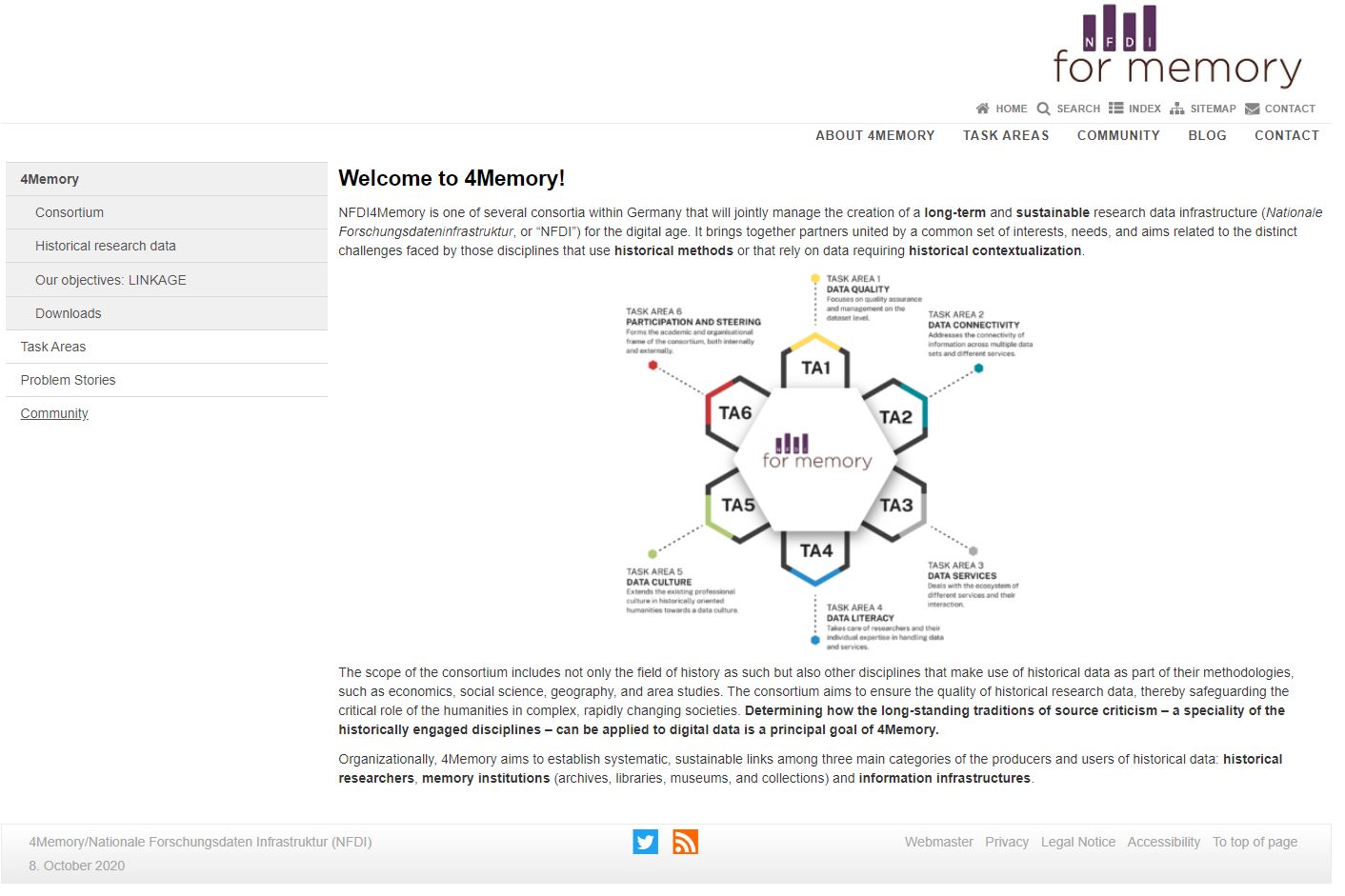
https://4memory.de/
It was therefore paramount for us to enter Germany’s present NFDI process. The process is on a trajectory of creating research data repositories in all the fields of the sciences and academic studies – repositories, that will eventually present their data under a broader search engine. We have entered this development as a “participant” of the NFDI’s upcoming 4Memory compound (the compound of the studies that are dealing with historical data).
Our present consideration is how to balance such an integration as a decidedly international site. We will need an international board of FactGrid Stakeholders since this is what we have become over the last three years: an international platform using a multilingual software in order to interconnect research across the borders.