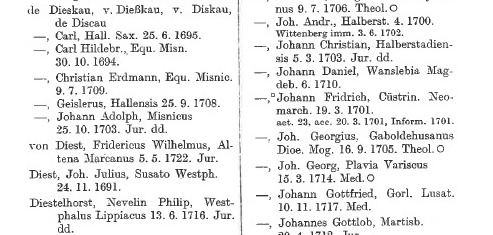
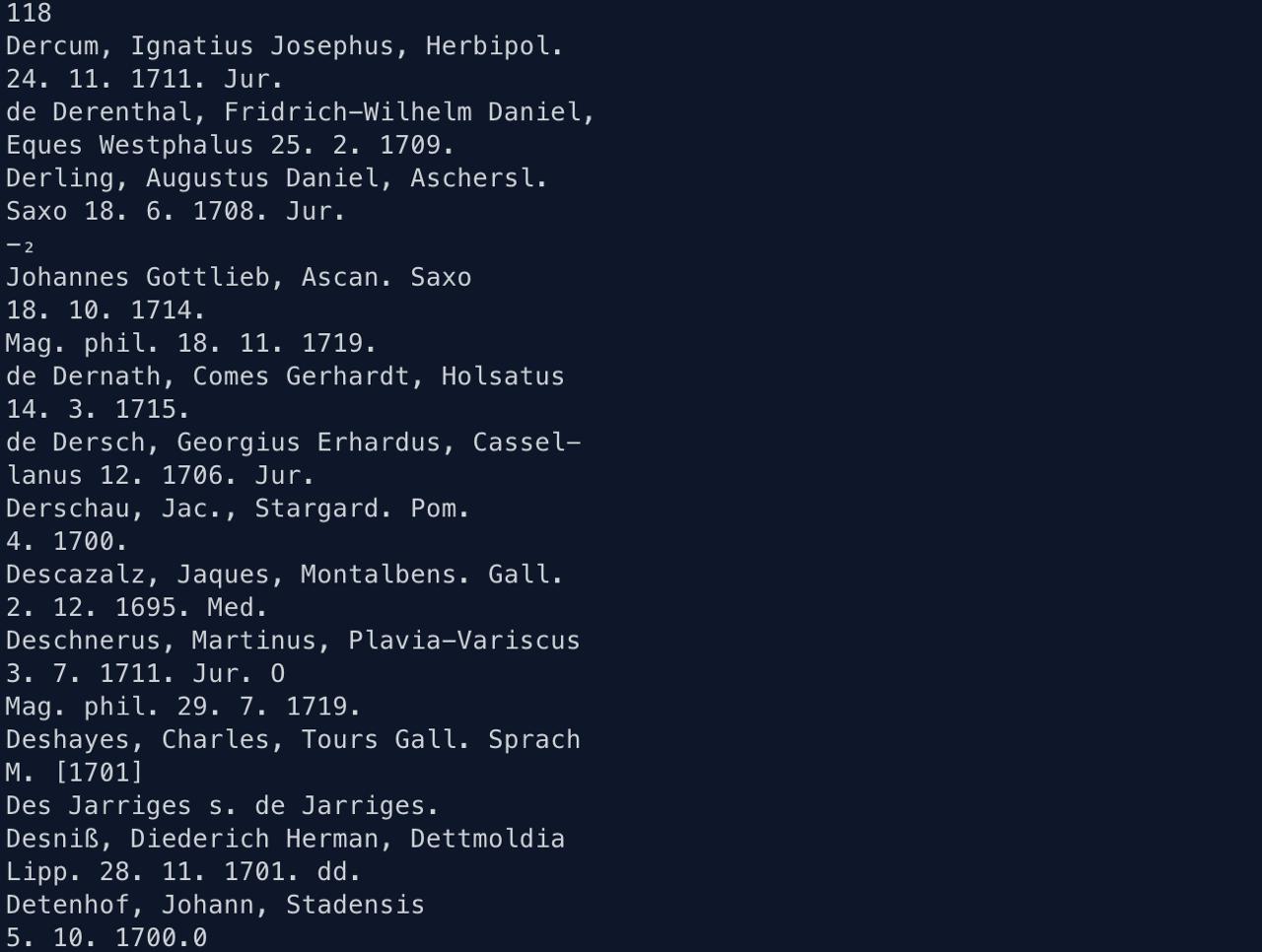
Professors represent a key group with substantial influence as scientific, cultural, and political actors well beyond the boundaries of their institutions. While numerous universities and archives have already undertaken efforts to create comprehensive professor catalogs, some of which are available online, such as those in Hamburg, Kiel, Rostock, Dresden, and Halle, there is still no database that provides an interconnected overview of the professoriate across Germany, let alone Europe as a whole, spanning different eras and institutions. This article argues, drawing conclusions on first existing example datasets, why it would be beneficial to merge these individual collections into a common platform. It also highlights the advantages of building a large, collaborative dataset instead of relying on fragmented, institution-based data silos, and outlines the research potential such an endeavor would unlock.
The first important observation is that existing catalogs vary considerably in terms of depth, scope, and usability. To make these data further usable and linkable requires a database that allows information from different sources to be flexibly combined and connected. FactGrid stands out as a particularly suitable platform for this purpose: its Wikibase software offers unprecedented flexibility for academic research. Unlike more restrictive systems with rigid relevance criteria, FactGrid supports the inclusion of raw data, working hypotheses, and preliminary chronologies, an essential feature for a project that extends beyond the notability of individual figures. Its multilingual design also encourages international collaboration, which is indispensable for achieving a pan-European perspective. Moreover, FactGrid’s wide range of functionalities enables complex analyses, such as network research or the visualization of maps and timelines. In addition, it facilitates transparent teamwork, offers automated import of existing datasets, and ensures long-term sustainability and accessibility.
For further information: FactGrid FAQ – Why should I use FactGrid for my research project?
Before such a project could be implemented on a large scale, however, two key challenges would need to be addressed: (1) establishing a minimum indexing standard for professor data, and (2) systematizing and indexing additional contextual information that extends beyond personal data records but remains crucial for accurate indexing. With regard to the first challenge, a review of existing catalogs suggests the following core categories for personal data collection:
Basic information: Gender, date and place of birth, date and place of death, religion, language skills.
Educational background: Records of universities attended, with information on years of study, subjects, academic degrees, as well as teachers and academic supervisors.
Career paths: Career stages (research assistants, Privatdozenten, full professors, etc.), universities with corresponding dates, fields of work, and faculties.
Memberships: Participation in non-university organizations and networks (academies, political parties, etc.).
Record Linking: Connections to external databases (Wikidata, GND, professor catalogs, doctoral databases).
In addition, it would be necessary to compile repositories of existing databases and research literature, as well as to comprehensively document universities and their faculties in their historical development.
Some integration work has already been carried out: the professor catalogs for Dresden, Kiel, and Helmstedt have been fully indexed and linked within FactGrid, with Helmstedt and Dresden reaching the most detailed level of representation so far. Likewise, the catalog of the University of Halle has been integrated, and through Wikidata imports, parts of the Hamburg catalog have been added, producing an initial dataset of roughly 9,000 individuals.
For more information on the so far gathered data: Europe’s university registers – Project Page
This dataset now serves as a foundation for further indexing projects and has already been linked to other FactGrid projects. Examples include Bruno Belhoste’s dataset on members of the French Academy of Sciences, Hans Bauer and Tillmann Kinzel’s work on the Erik Amburger database, Isabella Schwaderer’s research on the Schopenhauer Society, and Richard Heidler’s GEPRIS Historical: Expelled Scientists in FactGrid, among others.
These data already illustrate the significant added value of a consolidated general professorial catalog for academic research. Such a resource would overcome the limitations of isolated case studies and enable broader comparative perspectives. While localized studies provide valuable insights, their interpretive power is limited unless situated within a larger context. Comparative analysis reveals, for example, how professorial careers, age structures, or political affiliations vary geographically or over time; between northern and southern Germany, or between predominantly Catholic and Protestant regions. Embedding local findings into a broader framework enables more precise contextualization and helps determine whether certain observations reflect isolated cases, regional characteristics, or supra-regional trends. For instance, an apparent overrepresentation of specific groups within a faculty may indicate a deliberate appointment policy – but without comparison, it remains unclear whether this is a local anomaly or part of a wider disciplinary development.
A broader database would also make it possible to study institutional differences systematically, for example, between traditional universities, technical universities, and church institutions. Temporal dynamics, such as the aftermath of 1918, 1933, or 1945, could likewise be examined in their full scope. Disciplinary comparisons could further illuminate differences between the humanities and natural sciences, or between politically sensitive and less exposed fields.
Most importantly, a supra-regional catalog would reveal large-scale trends and patterns not detectable in local studies. Academic mobility, for instance, can only be properly understood from a pan-German or pan-European perspective: Who moved where, for what reasons, and which universities functioned as springboards or final destinations? Only with sufficient data volume can network research reconstruct connections through shared education, memberships, or career paths. Similarly, questions about the recruitment of academic elites, through professorial families or specific social backgrounds, require a broad empirical foundation.
Such a resource would also open up new avenues of inquiry extending beyond individual institutions or careers: global migration of academics, the impact of wars and political upheavals on the academic landscape, or long-term changes in the structure of the professoriate.
Finally, the significance of such a catalog would extend far beyond historical research. Fields such as educational studies, sociology, political science, or even artificial intelligence, for example, in the analysis of career patterns, could all benefit. A pan-European professor database would thus not only overcome the fragmentation of existing initiatives, but also create an interdisciplinary foundation for innovative research.
In conclusion, the establishment of a European professor database in FactGrid would consolidate previously fragmented initiatives and open entirely new research perspectives. Linking data across eras, institutions, and countries would sharpen the contextualization of local studies and reveal broader patterns, for example, in mobility, networks, and elite formation. FactGrid’s flexibility, interoperability, and sustainability make it especially well-suited for this task. Beyond history, the project promises substantial interdisciplinary value in sociology, education, political science, and digital methods. A comprehensive European professor database would therefore not only transcend the limitations of localized studies but also lay the groundwork for innovative research with lasting impact.
Image: Ludwig Lichtheim was Professor of Internal Medicine at the Albertus University of Königsberg until 1912. This photo was taken at his retirement in the lecture hall of the Medical Clinic in the circle of colleagues. Archive of the Franz Neumann Foundation, managed by Eberhard Neumann-Redlin von Meding, printed in the East Prussian Doctor Family Summer 1963, p. 33 f. Wikimedia Commons